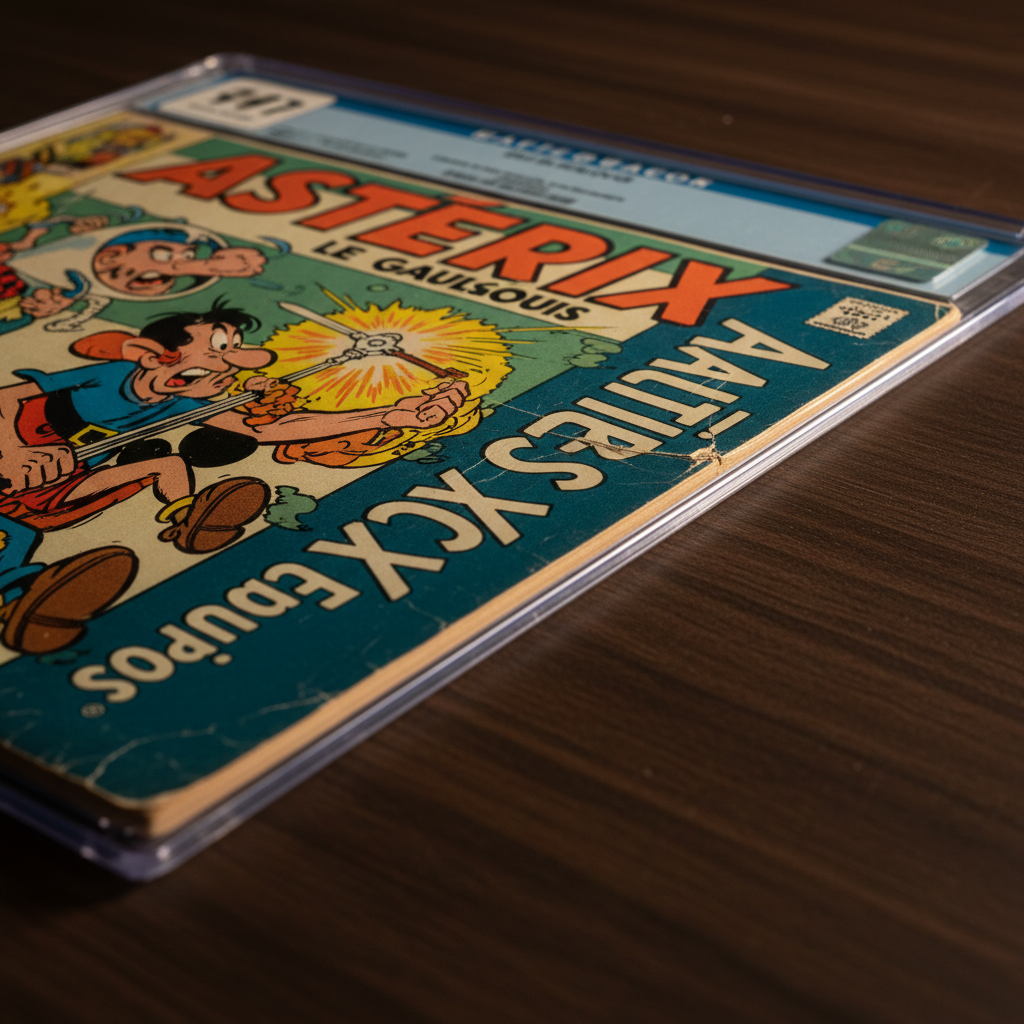
An original Albert Uderzo cover — one of the most recognizable hands in European comics history — is headlining Heritage Auctions' April comic art sale, and the supporting cast is just as serious. The auction brings together original manga by Jiro Kuwata and Osamu Tezuka, alongside Western heavyweights including Moebius, Gene Colan, Robert Crumb, and Frank Frazetta. On paper, it reads like a greatest-hits compilation. In practice, it's one of the more geographically diverse comic art offerings Heritage has assembled in recent memory.
Uderzo, who co-created Astérix with René Goscinny in 1959 and continued the series solo after Goscinny's death in 1977, produced some of the most commercially successful and culturally embedded comics in European history. Original covers from that run are genuinely scarce on the open market — the bulk of the Uderzo estate material has historically moved through European houses like Artcurial in Paris, which has set multiple records for bande dessinée originals. When a significant Uderzo piece surfaces at a major American auction house, it's an event.
East Meets West in the Lot List
The inclusion of Kuwata and Tezuka originals is the underreported story here. Japanese manga originals — particularly from the foundational postwar era — remain dramatically undervalued relative to their Western counterparts, and Heritage has been one of the few major American houses willing to push that market forward.
Tezuka, who essentially architected modern manga storytelling, commands reverence but not yet the auction prices his influence warrants. A Tezuka original at Heritage puts that work in front of a Western collector base that may be encountering it seriously for the first time. Kuwata, best known internationally for his Batman manga adaptation from the 1960s — a cult object that gained renewed attention through DC's archival reprints — brings crossover appeal that bridges superhero collectors and manga purists simultaneously.
That's a meaningful distinction. Comic art buyers tend to be tribal. Putting Kuwata in the same sale as Frazetta isn't just curation — it's an argument about what the canon should look like.
The Western Anchors
Frank Frazetta originals need little introduction to anyone who has watched the comic art market over the past decade. His work has consistently outperformed expectations at auction — a 2022 Heritage sale saw a Frazetta oil clear $1.79 million, and even his paperwork and studies have commanded five figures with regularity. Any Frazetta lot in a major sale functions as a market anchor, drawing bidders who might then stay for the rest of the catalog.
Moebius — Jean Giraud — occupies a similarly elevated position in the European market, though his prices in the U.S. have historically lagged behind what comparable work fetches at Artcurial or Millon. That gap has been closing. Collector awareness of Moebius has accelerated sharply since his 2012 death, and the pipeline of institutional-quality material is finite.
Gene Colan's presence rounds out the Marvel faithful. Colan's atmospheric, cinematic pencil work — most associated with his runs on Daredevil, Doctor Strange, and Tomb of Dracula — has seen steady appreciation as Silver and Bronze Age original art continues its long bull run. Robert Crumb, meanwhile, is essentially his own category: underground comix originals remain among the most philosophically interesting corner of the market, where fine art collectors and comics lifers compete on the same ground.
Reading the Room
Comic art as an asset class has matured considerably since Heritage began its dedicated sales in the early 2000s. The house has reported over $1 billion in cumulative comic art and comics sales, and the category consistently outperforms expectations in mixed-market conditions — partly because the collector base skews toward passion buyers rather than pure speculators.
A sale structured like this one — with a marquee European centerpiece, rare Japanese originals, and blue-chip American names — reflects how sophisticated the buyer pool has become. Five years ago, pairing Tezuka with Frazetta in the same catalog would have felt like a mismatch. Now it reads as astute programming.
The Uderzo cover will almost certainly set the price ceiling. But the lots worth watching may be the Kuwata and Tezuka originals — material where the market hasn't fully caught up to the history yet, and where the gap between cultural significance and realized price remains wide enough to matter.