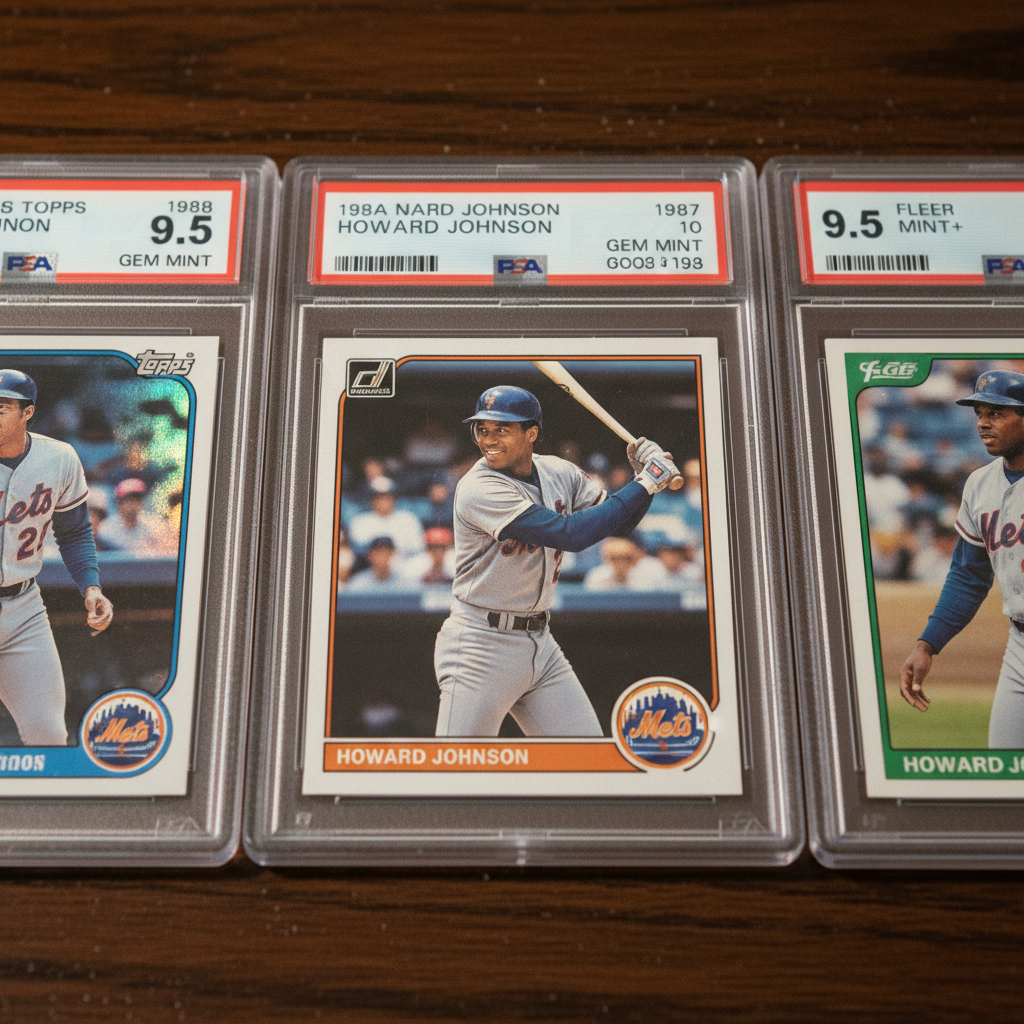
Howard Johnson did something between 1987 and 1991 that no switch hitter in National League history had done before: he hit 30 home runs and stole 30 bases in the same season — three times. Three. The 30/30 club is exclusive under any circumstances, but doing it as a switch hitter, in the senior circuit, repeatedly, is a statistical fingerprint that belongs to Johnson alone. And yet his cardboard footprint remains one of the most undervalued propositions in the late-'80s Mets collecting universe.
That disconnect — between on-field achievement and secondary market price — is exactly what makes Johnson an interesting conversation right now.
What the Numbers Actually Say
Johnson's peak years align almost perfectly with the junk wax era, which is both the problem and the opportunity. His 1985 Topps rookie card — shared with Barbaro Garbey on card #491 — is his most collectible early issue, but population data tells a story of collector neglect. PSA has graded fewer than 800 copies total across all grades, with PSA 10 examples trading in the $40–$80 range depending on the week. For a two-time World Series champion who reset the NL switch-hitting record books, that's almost absurdly cheap.
His 1987 Topps and 1988 Score issues are the cards most associated with his 30/30 prime, and both sit in deep-discount territory — sub-$20 for raw copies in excellent condition. The 1988 Donruss Diamond Kings version, one of the more aesthetically distinctive cards of the era, occasionally surfaces at shows for under $5 ungraded. That's not a knock on Johnson. That's the junk wax tide pulling everything down regardless of merit.
The more interesting play may be his 1984 Topps Traded issue from his Detroit Tigers days — a card that predates the Mets dynasty years and carries the added narrative of Johnson as a young infielder before Davey Johnson turned him into a cornerstone of the 1986 championship roster. Low population, pre-Mets provenance, and a clean design make it the sleeper of his cardboard catalog.
The Mets Dynasty Context
Collecting Johnson in isolation misses the larger market dynamic at play. The 1986 New York Mets are having a genuine nostalgia moment — the 2026 anniversary of that championship will almost certainly accelerate interest in the entire roster's cardboard. Dwight Gooden and Darryl Strawberry dominate the conversation and command the prices, with high-grade Gooden rookies clearing $500–$1,200 at Heritage and Goldin depending on centering. Gary Carter and Keith Hernandez hold their own in the Hall of Fame premium tier.
Johnson sits in an interesting middle band — not quite the superstar tier, not a footnote. He's the kind of player whose cards serious team set collectors already own, but whose individual market hasn't been pushed by the broader hobby's renewed appetite for late-'80s Mets material. That gap tends to close, not widen, as anniversary cycles approach.
The 30/30 angle also matters independently of the Mets brand. Switch-hitting power-speed combinations are genuinely rare in baseball history, and the hobby has shown it will pay for statistical singularity when the narrative is properly framed. Bobby Bonilla cards spiked on meme energy alone. Johnson's case rests on actual, verifiable, record-setting production.
The Collector Angle Going Forward
For collectors building a position in Johnson's cardboard, the calculus is straightforward. Raw copies of his key issues are available at virtually no premium — flea market and show prices haven't caught up to any renewed interest. Graded examples in PSA 8 and PSA 9 are accessible in the $15–$50 range for most issues, with PSA 10s on the flagship Topps sets still under three figures.
The risk, as always with junk wax era cards, is population ceiling. Millions of these cards were printed. High-grade copies aren't scarce the way a 1952 Topps or even a 1975 Topps Mini is scarce — they're just unsorted. Anyone who sat on a collection from that era and submits in bulk can move the PSA 10 population meaningfully. That's a real ceiling on price appreciation for the mass-market issues.
The smarter play is the pre-Mets material and any signed memorabilia that connects directly to the 30/30 seasons. Johnson has remained accessible to the hobby community, and authenticated signatures on cards from his 1987–1991 peak carry the kind of provenance story that moves product at shows and on platforms like PWCC and Goldin.
Johnson's legacy is a legitimate case study in how the hobby underprices statistical pioneers when their peak years overlap with high-print-run eras. The cards are cheap. The history isn't.