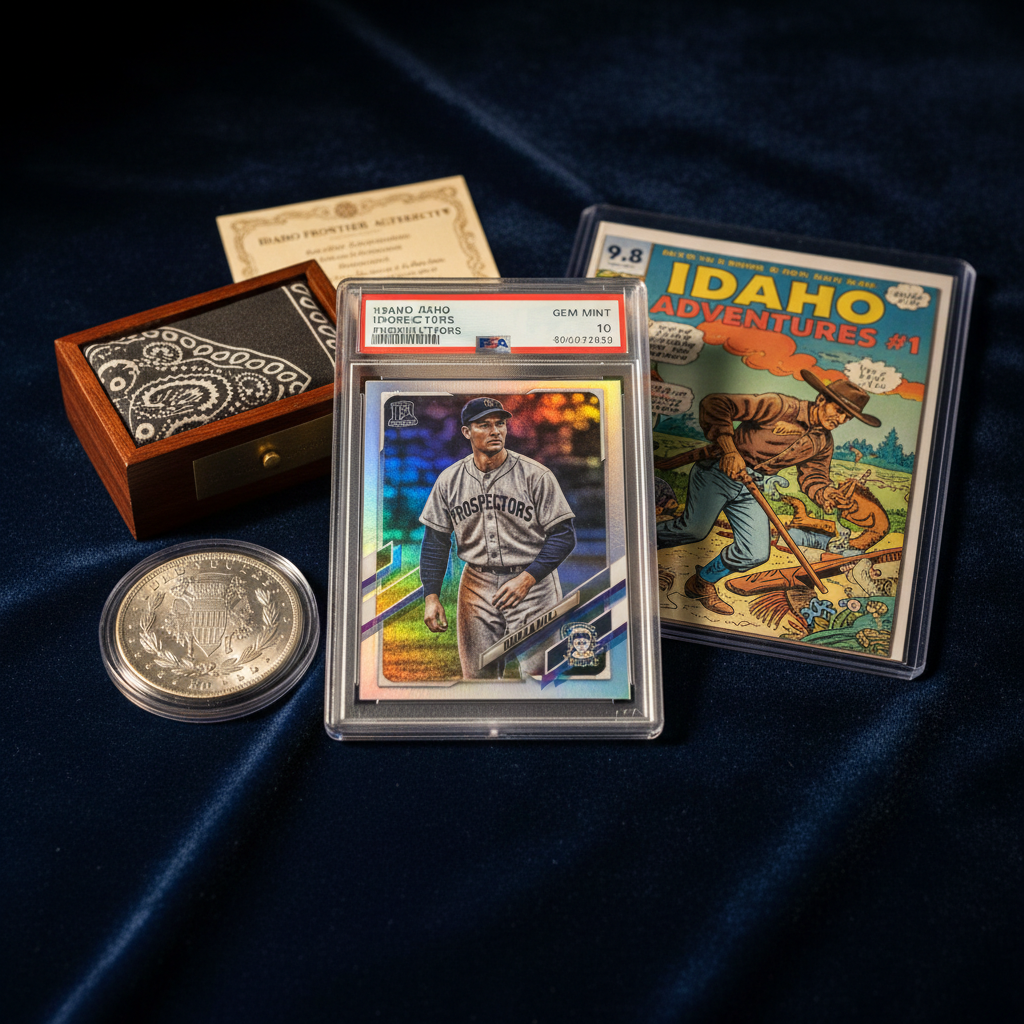
Most collectors don't think of Idaho when they're hunting for American historical material. That's exactly why they should.
As the United States marches toward its semiquincentennial in 2026, the broader antiques and collectibles market is waking up to a category that has been quietly undervalued for decades: Americana tied to the interior West. Idaho, in particular, sits at a remarkable crossroads of Indigenous heritage, fur trade history, mining booms, and agricultural industrialization — each chapter generating its own paper trail, material culture, and collectible artifacts that remain dramatically underpriced compared to their East Coast equivalents.
The Layers Collectors Are Missing
Idaho's collectible history doesn't begin with statehood in 1890. It begins centuries earlier with the Shoshone, Bannock, Nez Perce, and Coeur d'Alene peoples, whose material culture — beadwork, basketry, ceremonial objects — commands serious institutional and private collector attention. Authenticated pre-contact and early-contact Indigenous pieces from the Great Basin and Plateau regions have seen sustained auction interest, with quality Nez Perce beaded bags regularly clearing $8,000 to $25,000 at houses like Coeur d'Alene Art Auction and Heritage Auctions, depending on provenance and condition.
The Lewis and Clark Expedition passed through Idaho in 1805, and any document, map, or ephemera with a direct connection to that journey is effectively blue-chip Americana. A first-edition Biddle-Allen 1814 narrative of the expedition — the first published account — trades in the $4,000 to $12,000 range depending on condition, with fine copies in original boards pushing considerably higher at Stack's Bowers and Heritage.
Then there's the mining era. The Coeur d'Alene silver strikes of the 1880s generated an enormous paper record: stock certificates, assay documents, mining maps, and promotional ephemera from companies that boomed and busted inside a decade. Silver Valley mining stock certificates — particularly those from defunct operations with ornate engraving — have found a devoted collector base. Crisp, unissued examples from major operations like the Bunker Hill and Sullivan Mining Company regularly appear in the $150 to $600 range, with exceptional examples going higher. For a category this historically dense, those prices represent real opportunity.
The Statehood and Agricultural Paper Trail
Idaho's territorial and early statehood period is rich with philatelic and numismatic material that remains accessible. Territorial-era postal covers with Idaho Territory handstamps from the 1860s and 1870s are genuinely scarce — the population was thin, the post offices were few, and survival rates for frontier mail are low. A clean cover with a legible strike from an obscure Idaho Territory post office can fetch $200 to $800 from serious Western Americana philatelists, and the category has shown steady appreciation as the 250th anniversary drives renewed interest in early American postal history.
On the numismatic side, Carson City Mint coinage — struck from Nevada silver that often originated in Idaho mines — has long been a proxy play for collectors who want a tangible connection to the Mountain West mining economy. CC-mint Morgan dollars in MS-64 and MS-65 grades (PCGS or NGC certified) have held value well through recent market softness, with the 1893-CC Morgan in MS-64 sitting around $9,500 to $11,000 in current dealer inventory.
The agricultural chapter is less glamorous but no less collectible. Idaho's potato industry, which became economically dominant by the early 20th century, produced a wave of crate labels, seed catalogs, and promotional trade cards that now constitute a legitimate niche. Vibrant chromolithograph potato crate labels from the 1920s and 1930s — the peak era for label art — trade in the $20 to $150 range individually, but curated collections of Idaho agricultural labels have sold as lots for well over $1,000 at regional auction.
The 250th Anniversary Effect
The American semiquincentennial isn't just a historical milestone — it's a market catalyst. The lead-up to the U.S. Bicentennial in 1976 produced a documented surge in Americana collecting that lifted prices across categories from Colonial-era furniture to Revolutionary War documents. The pattern is already visible: Heritage Auctions has reported increased bidder registration in its Americana and Historical categories over the past 18 months, and dealers specializing in Western Americana are noting stronger floor traffic at major shows.
Idaho material specifically benefits from a scarcity dynamic that East Coast Americana doesn't share. There simply wasn't much being printed, minted, or manufactured in the Idaho Territory during the 1860s and 1870s. What survived is genuinely rare, and the collector base chasing it has historically been small relative to the material's historical significance.
That imbalance is correcting. Slowly — but it's correcting. Collectors who wait for Idaho to show up on the front page of a major auction catalog will have already missed the entry point.