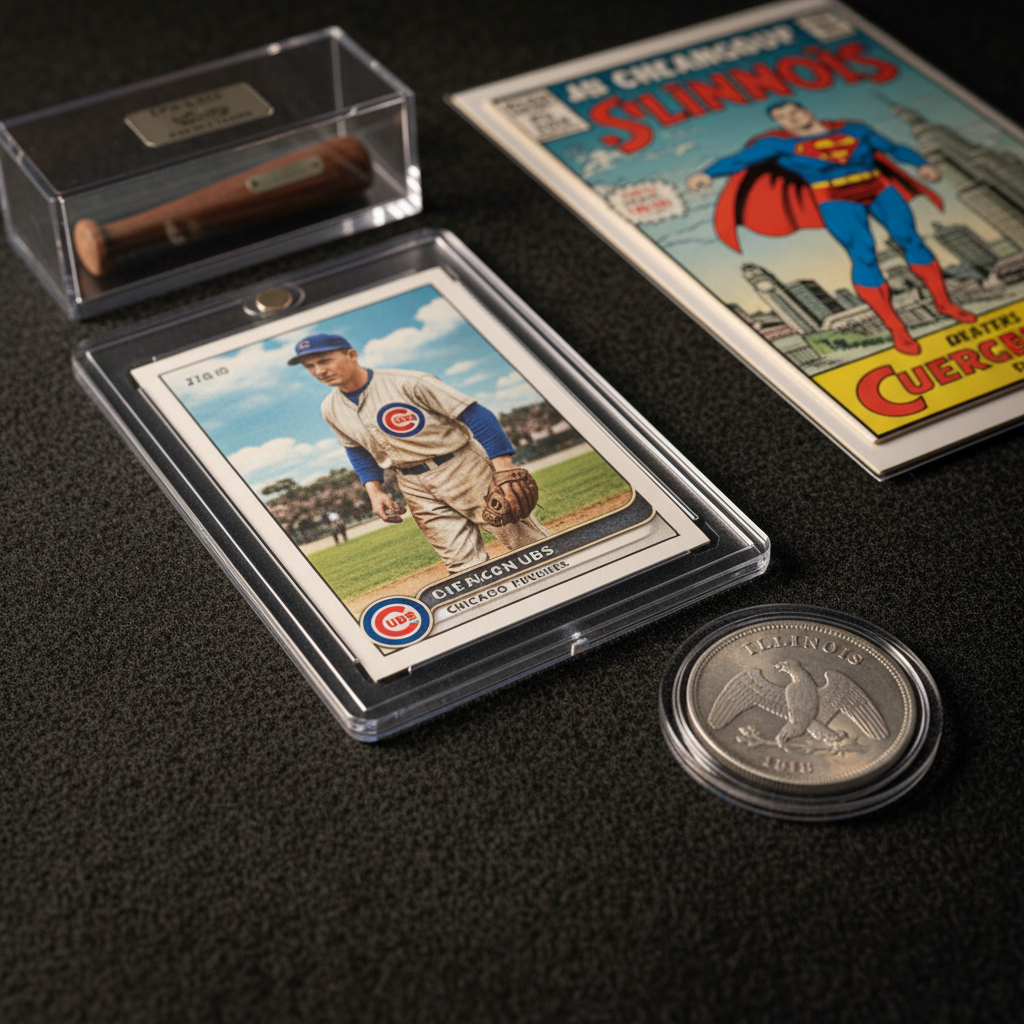
Two hundred and fifty years of American history have a way of concentrating themselves into objects. Pottery shards. Trade silver. Grain elevator tokens. Prairie-era furniture built from timber that no longer exists. As the United States counts down to its semiquincentennial in 2026, Illinois stands out as one of the most collectible states in the Union — not because it has the flashiest history, but because its history runs so deep, and in so many directions at once.
From the Cahokia Mounds — a pre-Columbian city larger than London was in 1250 AD — to the steel mills of Gary and the meatpacking floors of Chicago's Union Stock Yards, Illinois left a material record that serious antique collectors have been mining for generations. The approaching anniversary is sharpening that focus considerably.
What Illinois Collecting Actually Looks Like
The Illinois market is not monolithic. It breaks into distinct collecting verticals, each with its own price dynamics and buyer base.
At the top end, early Illinois stoneware — particularly pieces attributable to Galena potters working between 1830 and 1870 — has been climbing steadily at Midwest regional auctions. Signed or attributed examples in excellent condition regularly clear $1,500 to $4,000 at houses like Leslie Hindman (now Hindman Auctions, Chicago). Exceptional pieces with original surface and strong form push past $8,000.
Illinois-made furniture from the Arts and Crafts period tells a different story. The state was home to significant Prairie School craftsmen working in the orbit of Frank Lloyd Wright, and period pieces with documented provenance to Illinois workshops have appreciated sharply in the past decade. A well-attributed Prairie School settle or library table from an Illinois maker — not Wright himself, but documented contemporaries — can move for $6,000 to $15,000 depending on condition and paper trail.
Then there's the ephemera market, which may be the most accessible entry point for new collectors. Illinois World's Columbian Exposition material from 1893 remains among the most actively traded American fair memorabilia in the hobby. Admission tickets, souvenir spoons, and photographic views in excellent condition trade hands regularly in the $50 to $400 range, while rarer items — official medals, architectural fragments, or large-format chromolithograph posters — have sold for well over $2,000 at Heritage Auctions.
Indigenous Heritage and the Responsible Collecting Question
Illinois sits atop one of North America's most significant Indigenous archaeological landscapes. The Cahokia site alone produced artifacts that have circulated through private collections for over a century, often with murky provenance. The 1990 passage of NAGPRA (Native American Graves Protection and Repatriation Act) fundamentally changed the legal and ethical landscape, and serious collectors working in this space today navigate those waters carefully.
Pre-Columbian Mississippian artifacts with clean, pre-NAGPRA provenance documentation still appear at major auction houses, but the category demands due diligence that casual buyers frequently underestimate. Reputable dealers in this space will provide full provenance chains. If they can't — or won't — that's the answer.
The broader effect has been to push collector interest toward documented Indigenous-influenced craft objects: trade silver, beadwork, and early 19th-century material with clear collection histories. These pieces carry both historical weight and legal clarity, which is exactly the combination the market rewards.
The Anniversary Effect and What Comes Next
America's 250th anniversary isn't just a calendar milestone — it's a market catalyst. The run-up to the U.S. Bicentennial in 1976 produced a documented surge in Americana collecting that lasted well into the early 1980s, lifting prices across categories from folk art to political memorabilia to early currency. The semiquincentennial is generating similar momentum, and Illinois-specific material is positioned to benefit disproportionately given the state's outsized role in American industrial and cultural history.
Illinois was the 21st state admitted to the Union, achieving statehood in 1818. That places it squarely in the early Republic period that commands the highest premiums in Americana — the era of hand-crafted furniture, frontier newspapers, and land office documents that connect directly to the nation's westward expansion. Early Illinois territorial documents with original signatures, land grants, and county plat maps have been quietly appreciating for years. A signed document from the territorial period in fine condition can fetch $300 to $1,200 depending on the signatory and content.
Chicago's role as the nation's commercial crossroads — railroads, grain, steel, publishing — also means Illinois produced an extraordinary volume of industrial and commercial ephemera. Trade catalogs from Montgomery Ward and Sears, Roebuck & Co., both Chicago institutions, are among the most collected American retail artifacts. A complete, clean Sears catalog from the 1890s routinely brings $200 to $600; scarcer specialty catalogs from the same era push higher.
As 2026 approaches, the collectors who have been quietly accumulating Illinois material — the stoneware, the fair ephemera, the Prairie School furniture, the territorial documents — are sitting on inventories that the anniversary spotlight is only going to make more valuable. The Prairie State has always rewarded patience. That hasn't changed.