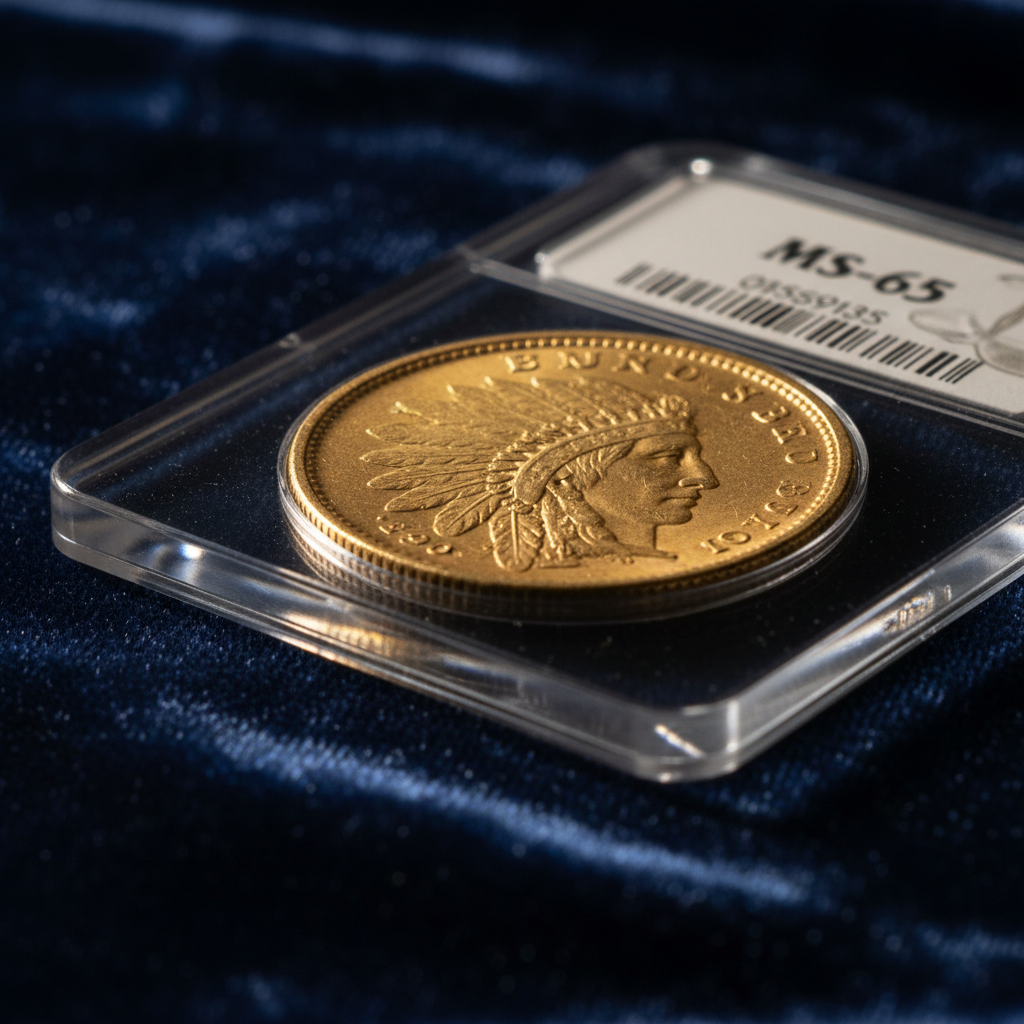
When Theodore Roosevelt commissioned a wholesale redesign of American coinage in the early 1900s, he wasn't asking for incremental improvement — he wanted a cultural statement. What emerged between 1908 and 1929 was a series of gold coins that remain among the most visually striking in U.S. mint history, and none is more quietly compelling than the Indian Head Quarter Eagle.
Struck at a face value of $2.50, the coin occupies an odd middle ground in the gold series — too small to command the headline prices of the Saint-Gaudens Double Eagle, too significant to ignore. That underdog status, paradoxically, makes it one of the more interesting collecting targets in early 20th-century American numismatics right now.
A Design That Broke Every Convention
The Indian Head Quarter Eagle was designed by Bela Lyon Pratt, a student of Augustus Saint-Gaudens, working from a concept championed by Roosevelt himself. The design borrows its incuse relief — meaning the imagery is recessed into the coin's surface rather than raised above it — directly from ancient Egyptian and Native American artistic traditions. It was a radical departure from everything the U.S. Mint had done before.
The obverse features a Native American in a war bonnet, the reverse a standing eagle. Both rendered in that sunken, almost sculptural style that gives the coin an almost meditative quality in hand. Critics at the time hated it. They complained the recessed design trapped dirt and germs — a concern that, in the context of 1908 public health anxieties, was taken seriously enough to generate congressional debate. The design survived anyway.
Pratt used the same incuse approach for the Indian Head Half Eagle ($5 gold), released simultaneously, making the two coins a matched set in both design philosophy and controversy. Together they represent the last gasp of Roosevelt-era numismatic ambition before more conservative tastes reasserted themselves.
The Key Dates and Where the Market Stands
The series ran from 1908 through 1929, with production split between the Philadelphia and Denver mints. Most dates are genuinely scarce by modern standards — annual mintages rarely cracked 500,000, and many years came in well under 200,000. That's a thin population base when you're talking about a coin that's now over a century old.
The 1911-D is the undisputed key date. With a mintage of just 55,680, it commands serious premiums even in circulated grades. A PCGS MS-63 example sold through Heritage Auctions in recent years for north of $20,000, and MS-65 specimens — genuinely rare — have pushed past $60,000 at major auction. The 1914 Philadelphia issue and the 1926 are considered semi-keys, offering collectors a more accessible entry point into the series without surrendering the thrill of chasing genuine scarcity.
For circulated examples, the market is more forgiving. A VF-35 or EF-45 coin from a common date like 1913 or 1925-D can be acquired for $350–$500 in today's market, essentially at a modest premium over melt. That gold content — roughly 0.1209 troy ounces — provides a meaningful floor that pure numismatic coins lack. With gold trading above $2,300 per troy ounce, the intrinsic value alone approaches $280 per coin. It's a rare case where the collectible and the commodity reinforce each other.
Mint state examples are a different conversation entirely. The incuse design, while visually distinctive, is notoriously susceptible to contact marks — the recessed fields act almost like a catch basin for bag marks during original mint handling. Finding a truly clean MS-65 or better is legitimately difficult, and PCGS and NGC populations at those grades remain thin across most dates. That supply constraint, combined with steady collector demand, has kept prices at the top of the grade spectrum firm even as the broader rare coin market has seen softness in some areas.
Collecting the Series Today
A complete date-and-mint set of Indian Head Quarter Eagles runs 15 issues across Philadelphia and Denver. Building a full set in circulated grades is achievable for a collector with patience and a budget in the $10,000–$20,000 range, depending heavily on what grade you're targeting for the 1911-D. Mint state sets are a different proposition — plan for six figures if you want everything in MS-63 or better, and accept that the 1911-D in gem condition may simply not be available when you need it.
Third-party grading is essentially mandatory for this series. The incuse design makes authentication and grading genuinely complex — cleaned coins are common, and the visual difference between a lightly circulated AU-58 and a true mint state coin can be subtle. PCGS and NGC holders provide the market confidence that makes resale realistic. Raw examples from reputable dealers are fine for budget-conscious collectors, but anything you plan to hold as an investment should be slabbed.
What makes the Indian Head Quarter Eagle worth a collector's serious attention isn't just the history or the design — it's the combination of genuine scarcity, gold content support, and a series just complex enough to reward expertise without requiring a lifetime to master. Roosevelt wanted coins that looked like art. A century later, the market is still agreeing with him.