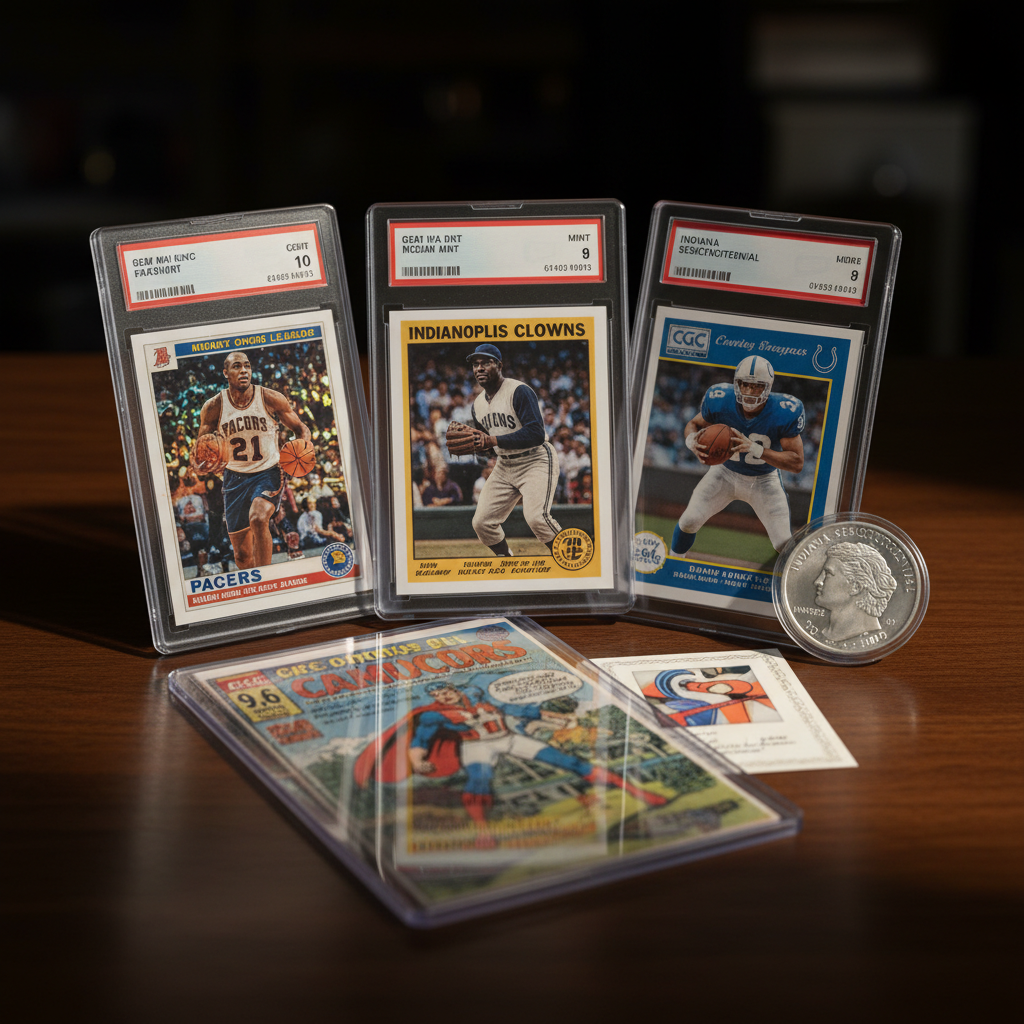
Two hundred and fifty years of American history leaves a paper trail — and Indiana's is longer and more collectible than most people realize. As the U.S. Semiquincentennial approaches in 2026, state-specific Americana from the Hoosier State is quietly drawing serious attention from collectors who understand that regional material, properly graded and documented, tends to outperform generic patriotic ephemera when the anniversary fever peaks and then fades.
Indiana entered the Union on December 11, 1816, as the 19th state. That founding moment — sandwiched between the War of 1812 and the early industrial era — produced a distinctive wave of printed material, currency, and material culture that remains undervalued relative to comparable items from coastal states. The arbitrage opportunity is real.
The Frontier Paper Trail
Indiana territorial and early statehood documents are among the most accessible entry points for serious Americana collectors. Land grants signed during the territorial period (1800–1816) occasionally surface at regional auction houses like Cowan's Auctions in Cincinnati and Heritage Auctions in Dallas, where condition-sensitive buyers can find material ranging from $200 to upward of $4,500 depending on signatories, provenance, and preservation grade.
Obsolete currency from Indiana state-chartered banks — institutions like the State Bank of Indiana (1834–1857) and its successor the Bank of the State of Indiana — represents one of the more compelling niches. PCGS Currency and PMG both grade this material, and high-grade examples (PMG 64 and above) from the antebellum period have appreciated steadily over the past decade. A PMG 63 $5 note from the Lawrenceburg branch of the State Bank of Indiana sold for $1,320 at a Stack's Bowers currency session in 2023 — not a headline number, but a meaningful comp for a category that rarely gets ink.
Civil War-era Indiana material is a different story entirely. Indiana contributed more than 196,000 soldiers to the Union cause — the highest per-capita rate of any Northern state — and the documentary output was enormous. Regimental histories, discharge papers, and GAR (Grand Army of the Republic) ribbons and badges from Indiana posts surface regularly and grade well under standard third-party authentication. PSA and JSA authenticate Indiana-origin Civil War signatures, and a signed carte-de-visite from a documented Indiana officer can move from $150 to over $2,000 depending on the regiment's engagement record.
Industrial Legacy, Collectible Output
Indiana's identity as the Crossroads of America isn't just a license plate slogan — it reflects a genuine industrial and transportation history that generated collectible material across multiple categories. The state was central to the early American automobile industry before Detroit consolidated its dominance. Stutz Motor Company (Indianapolis), Marmon, and dozens of smaller manufacturers left behind factory ephemera, dealership signage, and advertising lithographs that command serious premiums in the automobilia market.
A original Stutz Bearcat dealership poster in fine condition — the kind that surfaces maybe twice a decade at major auction — would conservatively estimate in the $3,000–$8,000 range today. Indianapolis 500 memorabilia is its own ecosystem entirely. Race programs from the pre-war era (1911–1941) in high grade routinely clear $500 to $1,800 at Heritage and Goldin, with the inaugural 1911 program representing the category's benchmark piece. A CGC-graded 1911 Indy 500 program in 7.0 condition sold for $6,800 at a Heritage Auctions Americana session — a number that would have been unthinkable fifteen years ago.
The Indy 500 racing card market deserves its own mention. Tobacco-era and early Exhibit Supply cards featuring Indianapolis drivers — Ray Harroun, Wilbur Shaw, Louis Meyer — are undergraded and undervalued relative to their baseball counterparts. PSA population reports show fewer than 40 graded examples for most pre-war Indianapolis racing subjects. Scarcity at that level, combined with anniversary-driven demand, is a setup collectors should take seriously.
The 250th Anniversary Window
Semiquincentennial collecting cycles follow a predictable pattern: interest builds in the 18–24 months before the anniversary date, peaks around the event itself, and then corrects as generalist buyers exit. The 1976 Bicentennial is the clearest precedent. Coins minted for that anniversary — the dual-dated Washington quarter, Kennedy half dollar, and Eisenhower dollar — saw retail premiums collapse within three years of the celebration. Serious collectors who bought pre-1976 state-specific Americana, however, held gains.
The lesson applies directly to Indiana material now. Generic Semiquincentennial merchandise will flood the market in 2025 and 2026. State-specific, historically grounded, third-party authenticated pieces are a different asset class entirely. Indiana's frontier documents, obsolete currency, Civil War ephemera, and automobilia occupy that category — and most of it remains priced as if the anniversary is still a decade away.
The Crossroads of America earned its nickname by sitting at the intersection of everything. Right now, it sits at the intersection of undervalued and about to be discovered.