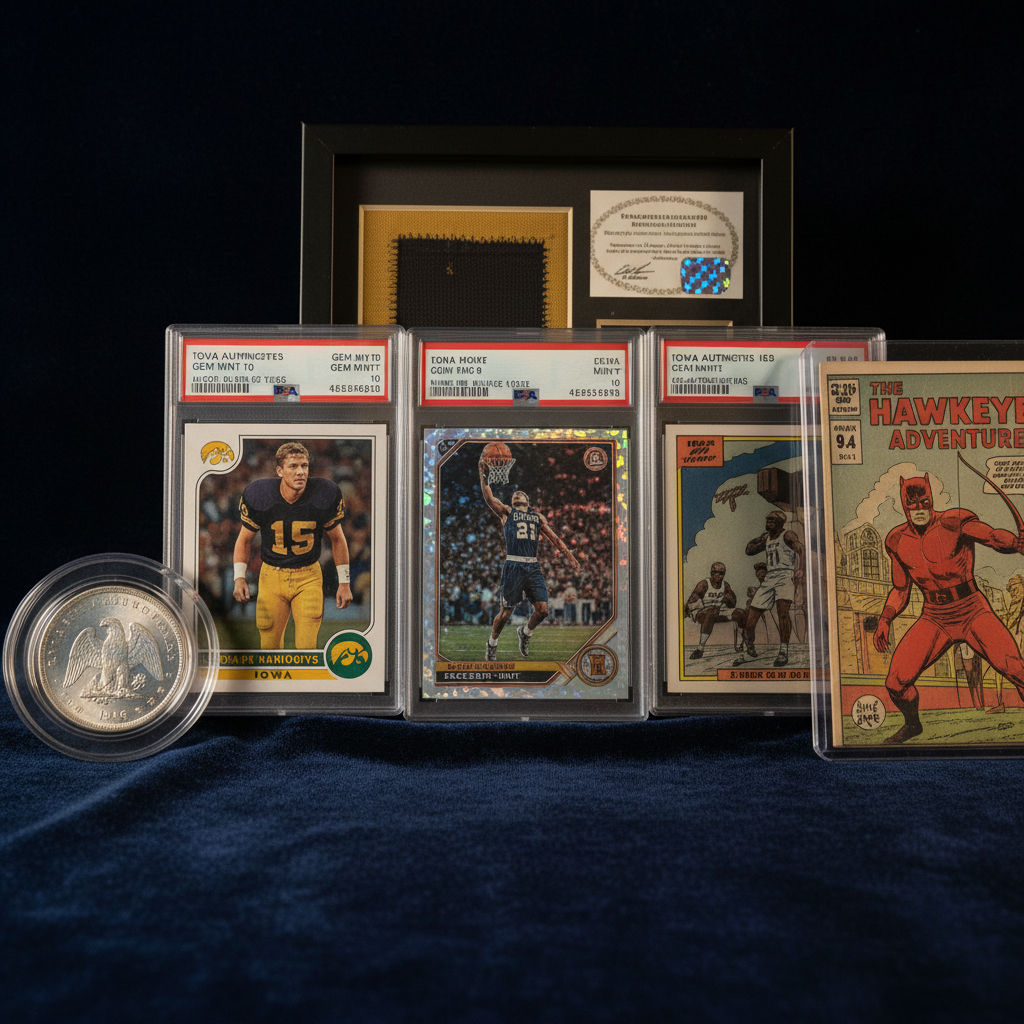
With the United States barreling toward its 250th anniversary in 2026, the collectibles market is quietly experiencing something it rarely does: a genuine surge of interest in Americana rooted not in coastal auction houses, but in the agricultural heartland. Iowa — the Hawkeye State — sits at the center of that conversation, and serious collectors are paying attention.
The state's material culture is richer and more market-relevant than most dealers give it credit for. From hand-thrown stoneware produced by 19th-century German immigrant potters in Dubuque to lithographed seed corn advertising tins that now routinely clear $400–$900 at Midwest regional auctions, Iowa's collectible heritage spans craft, commerce, and Indigenous history in ways that are only beginning to be properly documented and priced.
The Agricultural Advertising Boom
No category captures Iowa's collectible identity more precisely than farm and agricultural advertising ephemera. Pioneer Hi-Bred seed corn materials — the company was founded in Johnston, Iowa in 1926 by Henry A. Wallace, who later became FDR's Vice President — have seen consistent appreciation over the past decade. Early company calendars, pocket mirrors, and celluloid pinback buttons from the 1930s and 1940s now command $150 to $600 depending on condition, with pristine examples occasionally doubling that at Heritage Auctions when they surface in estate lots.
Iowa State Fair posters are another category worth tracking. Pre-WWII lithograph examples in Very Good or better condition have sold in the $800–$2,400 range, and the centennial-era pieces from the early 1900s are increasingly scarce in the open market. The Des Moines-based fair, established in 1854, produced promotional materials that doubled as folk art — bold typography, agricultural imagery, and a graphic sensibility that holds up aesthetically even by contemporary standards.
Stoneware is where the real depth lives. Iowa's river towns — particularly along the Mississippi corridor — supported a thriving ceramics industry through the late 1800s. Signed pieces from documented Iowa potteries, especially those with cobalt slip decoration, are undervalued relative to comparable Ohio or Pennsylvania examples. A decorated crock attributed to an Iowa maker might sell for $300–$700 where a nearly identical piece from Zanesville moves for twice that. That gap is either a persistent inefficiency or a buying opportunity, depending on your thesis.
Indigenous Heritage and the Provenance Question
Iowa's pre-statehood history is inseparable from the nations who inhabited it — the Meskwaki, the Sauk, the Ioway, and others — and that history increasingly shapes how the market approaches certain categories of material culture. Collectors and dealers operating in Plains and Woodland Native American material have faced intensifying scrutiny around provenance, particularly as the Native American Graves Protection and Repatriation Act (NAGPRA) enforcement has tightened since its 2023 regulatory updates.
This is not a peripheral issue for Iowa-focused collecting. The state has significant archaeological context, and any beadwork, pottery, or ceremonial objects with Iowa provenance require careful documentation. Reputable auction houses — Heritage, Cowan's, and Skinner among them — have strengthened their pre-consignment vetting processes accordingly. Buyers entering this space without doing that homework are taking on legal and reputational risk that simply wasn't priced into the market five years ago.
The Meskwaki Nation, whose settlement near Tama, Iowa represents one of the only tribally-owned land parcels in the Midwest purchased independently rather than granted by treaty, has been particularly active in cultural repatriation efforts. That context matters when evaluating any Iowa-origin Native material.
The Semiquincentennial Effect
The broader America 250 commemoration is already generating collectible product — the U.S. Mint's 2026 semiquincentennial coin program is expected to be one of the most ambitious in the modern era, with special issues likely to draw both numismatic buyers and casual commemorative collectors. State-specific Americana, already trending upward since roughly 2020, should see additional tailwinds as the anniversary approaches.
Iowa's positioning within that trend is specific. It's not a founding-era state — it achieved statehood in 1846 — so it won't benefit from the tricorn-hat and musket-ball nostalgia that drives New England Americana premiums. What it offers instead is a deeply American story about land, labor, immigration, and Indigenous displacement told through objects: quilts, farm tools, trade goods, advertising tins, and ceramics made by people who were building something from scratch in the middle of the continent.
That story is less glamorous than a Paul Revere silver piece or a Declaration-era broadside. But as the 250th anniversary focuses national attention on the full breadth of American history rather than just its founding mythology, the material culture of states like Iowa may finally get the market valuation it deserves. The collectors who got there early — buying Iowa stoneware and seed corn ephemera at estate sales when nobody else was looking — are sitting on positions that look smarter by the year.