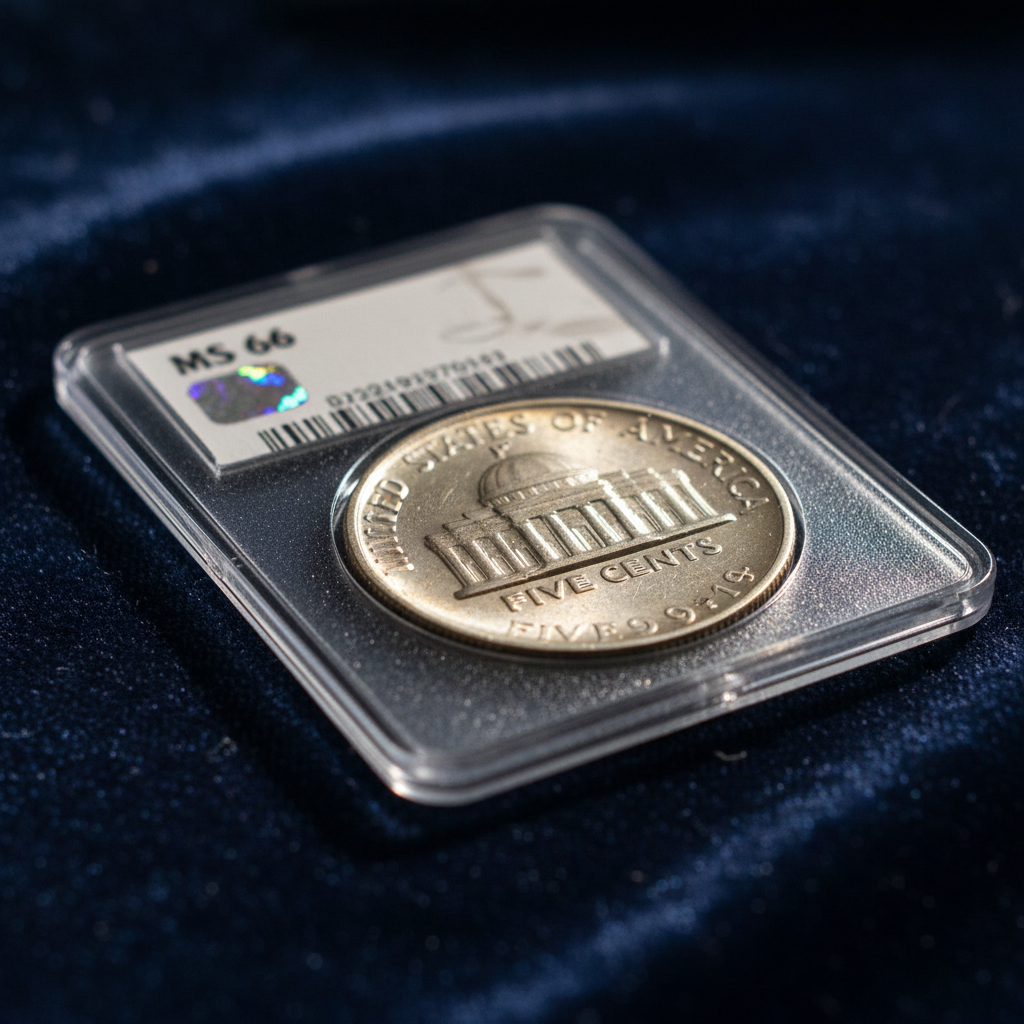
Wartime necessity created one of the most collectible — and most misunderstood — series in 20th-century American coinage. The Jefferson War Nickel, struck from 1942 through 1945, is the only U.S. circulating coin ever issued with a 35% silver composition, a direct consequence of the federal government's decision to redirect nickel to military hardware production during World War II. That singular fact has driven collector and investor interest for decades, and the market today reflects both the series' accessibility and its surprising ceiling for top-grade examples.
The story begins in 1942, when the War Production Board identified nickel as a critical strategic material — essential for armor plating, engine components, and munitions. The Mint's standard 75% copper / 25% nickel alloy was scrapped in favor of a wartime composition: 56% copper, 35% silver, and 9% manganese. The change took effect partway through 1942, meaning that year produced both standard and wartime compositions — a detail that matters enormously at the dealer table.
Reading the Coin: Mintmarks and Composition Tells
The Mint made the transition identifiable by moving the mintmark to the reverse, above Monticello's dome, and enlarging it significantly. Philadelphia issues — which normally bore no mintmark — received a large P for the first time in the Mint's history. Denver coins carry a large D, and San Francisco pieces show a large S. Any Jefferson nickel from this era without a large reverse mintmark is the pre-war copper-nickel alloy and contains no silver.
That distinction trips up casual buyers constantly. The silver content — roughly 0.05626 troy ounces per coin — gives war nickels a melt value that fluctuates with spot prices. At silver near $30/oz, a circulated war nickel carries melt value around $1.70, a meaningful floor that pre-war and post-war Jefferson nickels simply don't have. For type collectors, that silver floor makes even worn examples worth holding.
The manganese content creates one other tell: war nickels develop a distinctive golden or grayish tone over time, quite different from the cooler gray of standard nickels. Experienced dealers can identify them by color alone in a junk box. That's your edge if you're hunting at coin shows or estate sales.
Grading the Series: Where the Real Money Lives
In circulated grades, war nickels are genuinely common. A complete circulated set of the eleven coins — covering 1942-P, 1942-S, 1943-P, 1943-D, 1943-S, 1944-P, 1944-D, 1944-S, 1945-P, 1945-D, and 1945-S — can be assembled for well under $50 in Fine to Very Fine condition. That accessibility makes the series ideal for new collectors and a reliable entry point for anyone building a type set.
Uncirculated examples are where the calculus changes. The 1942-P in MS-66 Full Steps — the premium designation awarded by PCGS and NGC when Monticello's five or six steps are fully struck and uninterrupted — has realized over $1,500 at auction. The 1943-P in MS-67 Full Steps has traded above $4,000. Full Steps designation is the single most important grade modifier in Jefferson nickel collecting; without it, even a technically high-grade coin commands a fraction of the premium.
Population data tells the story. NGC has certified relatively few war nickels in MS-66 Full Steps across the series, with some dates — particularly 1944-D and 1945-D — showing populations in the single digits at that tier. That scarcity at the top end is real, not manufactured, and it's why registry collectors and type set completionists chase these coins with the same intensity they'd bring to a key-date Morgan dollar.
Proof issues don't exist for this series — the Mint suspended proof coinage from 1943 through 1949 — which means the top of the market is entirely occupied by business-strike gems. Cameo contrasts and deep mirrors, the hallmarks of proof coinage that drive premiums in other series, simply aren't factors here.
Market Context and Investment Angle
War nickels occupy an interesting position in the current market. Silver-content coins broadly have benefited from sustained precious metals interest since 2020, and the war nickel's dual identity — numismatic collectible and silver play — gives it a support structure most base-metal coins lack. When silver ran past $30/oz in 2024, dealer buy prices on circulated war nickels climbed accordingly, compressing the spread between melt and retail.
At the high end, PCGS and NGC-certified Full Steps examples have shown steady appreciation over the past decade, particularly for the Denver mint issues, which historically struck with softer detail due to die wear and higher production pressure. A 1944-D MS-65 Full Steps that sold for $800 a decade ago now regularly exceeds $2,500 in Heritage and Stack's Bowers results.
For collectors entering the series now, the value proposition is clear: low barriers at the entry level, a hard silver floor on every coin, and genuine scarcity at the top that the population reports confirm rather than obscure. The war nickel is one of the few series where a beginner and a serious registry collector can both find something worth pursuing — and that breadth of appeal is exactly what sustains a healthy long-term market.
Seventy-plus years after the last one rolled off the San Francisco presses, the war nickel remains a quiet testament to what happens when a government makes a pragmatic decision and the Mint executes it with precision. The silver is still there. So is the opportunity.