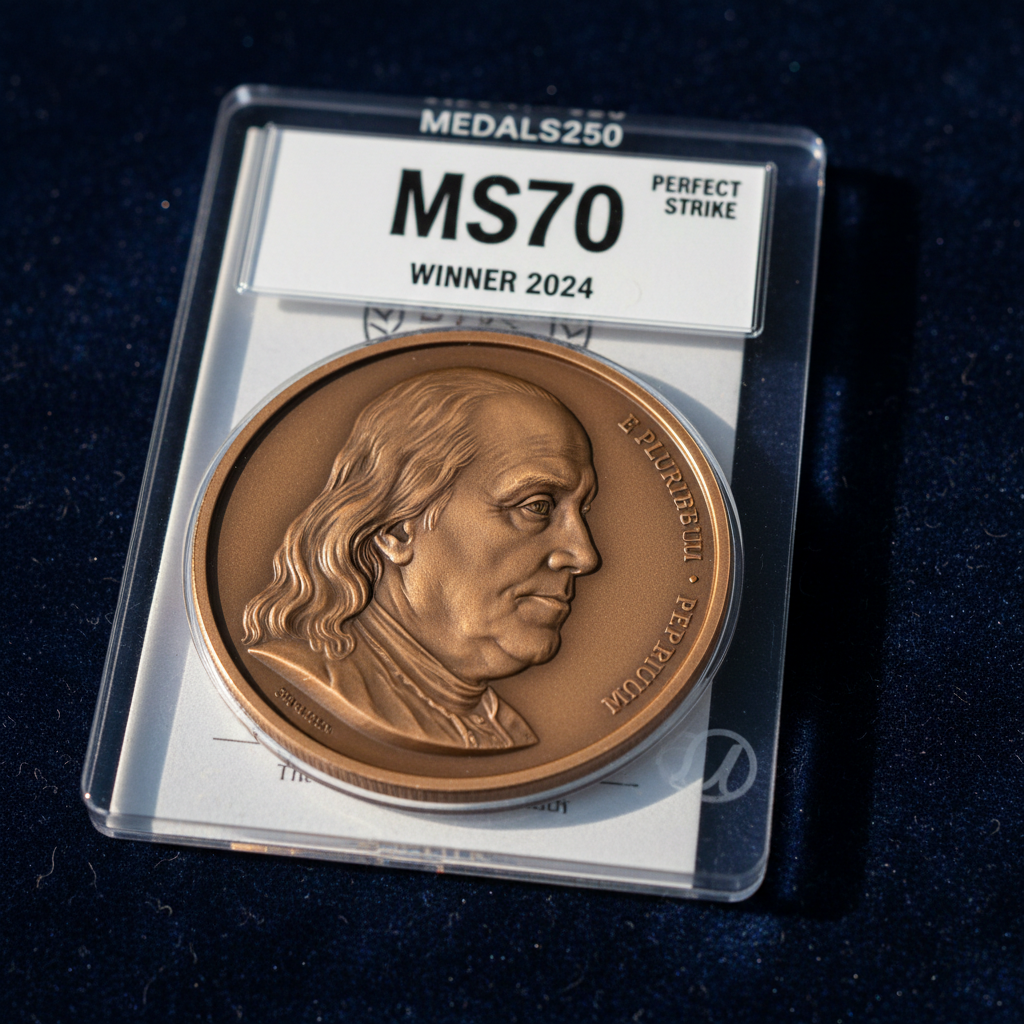
Jeffrey Briggs took home the top prize in the MEDALS250 competition, with his Young Benjamin Franklin medal edging out the field in a vote that, by all accounts, came down to the wire. The $500 first-place award is modest in dollar terms — but in the tight-knit world of American commemorative medal art, winning a reader-voted competition across CoinWeek's platform carries real weight.
The competition, tied to the 250th anniversary of American independence, challenged medalists to interpret foundational American subjects through original die work. Franklin — statesman, inventor, diplomat, and one of the most iconographically rich figures in U.S. history — is a natural subject. But Briggs' decision to render him young was the editorial choice that separated this piece from what could have been another profile in the familiar aging-sage tradition.
Why the Franklin Subject Still Commands Attention
Franklin's face has appeared on American currency and medals for well over a century. The 1706-1790 statesman anchors the obverse of the Franklin Half Dollar series, struck from 1948 through 1963, one of the most widely collected 20th-century U.S. coin series. Top-tier examples — think NGC MS-66 Full Bell Lines specimens — regularly command four figures at Heritage and Stack's Bowers. The subject is not new. What Briggs did was find an angle that most medalists and mint engravers haven't touched: Franklin before the powdered wig, before the kite, before the Constitutional Convention.
That interpretive freshness matters in competition contexts. Judges and voters in numismatic art competitions respond to technical execution, yes — but they also respond to concept. A medal that makes you see a familiar figure differently is doing something that a technically flawless but aesthetically inert piece cannot.
The margin of victory being razor-thin suggests the field was genuinely competitive, which is good news for MEDALS250 as an institution. A blowout would have told a different story.
The Broader MEDALS250 Context
MEDALS250 sits at an interesting intersection of numismatic tradition and contemporary craft. Commemorative medals occupy a category that serious collectors often undervalue relative to coins — there's no legal-tender premium, no mint-state registry chase driving prices the way the PCGS or NGC registries do for coins. But that also means the market is driven almost entirely by artistic merit and historical resonance, which arguably makes it purer.
American art medals have had a complicated market history. The early 20th century saw significant institutional support — the Society of Medalists ran a subscription series from 1930 to 1995, commissioning sculptors like Paul Manship and Malvina Hoffman, and those pieces now surface at auction with genuine collector demand. The contemporary medal market is thinner, but competitions like MEDALS250 serve a real function: they create visibility for working medalists and give collectors a discovery mechanism that the secondary market alone can't provide.
For Briggs, the win does more than put $500 in his pocket. It puts his name in front of an audience that includes serious numismatic collectors, dealers, and institutional buyers who follow CoinWeek's coverage. In a category where provenance and artist reputation drive long-term value, that exposure compounds.
What Collectors Should Watch
If you're not tracking contemporary American medal art, MEDALS250 is a reasonable entry point. The pieces produced for anniversary competitions tied to major historical milestones — and the 250th anniversary of American independence in 2026 is about as significant a milestone as it gets — tend to hold cultural resonance that purely commercial issues don't.
The Franklin Half Dollar parallel is instructive. Those coins were considered workhorse circulation pieces when they were minted. Decades later, a pristine 1955 Franklin Half in MS-66 FBL sells for north of $3,000 at major auction. The collecting market has a long memory for pieces tied to foundational American iconography, and it rewards the ones that got the artistic execution right.
Briggs got it right. The vote confirmed it, even if only by a hair.