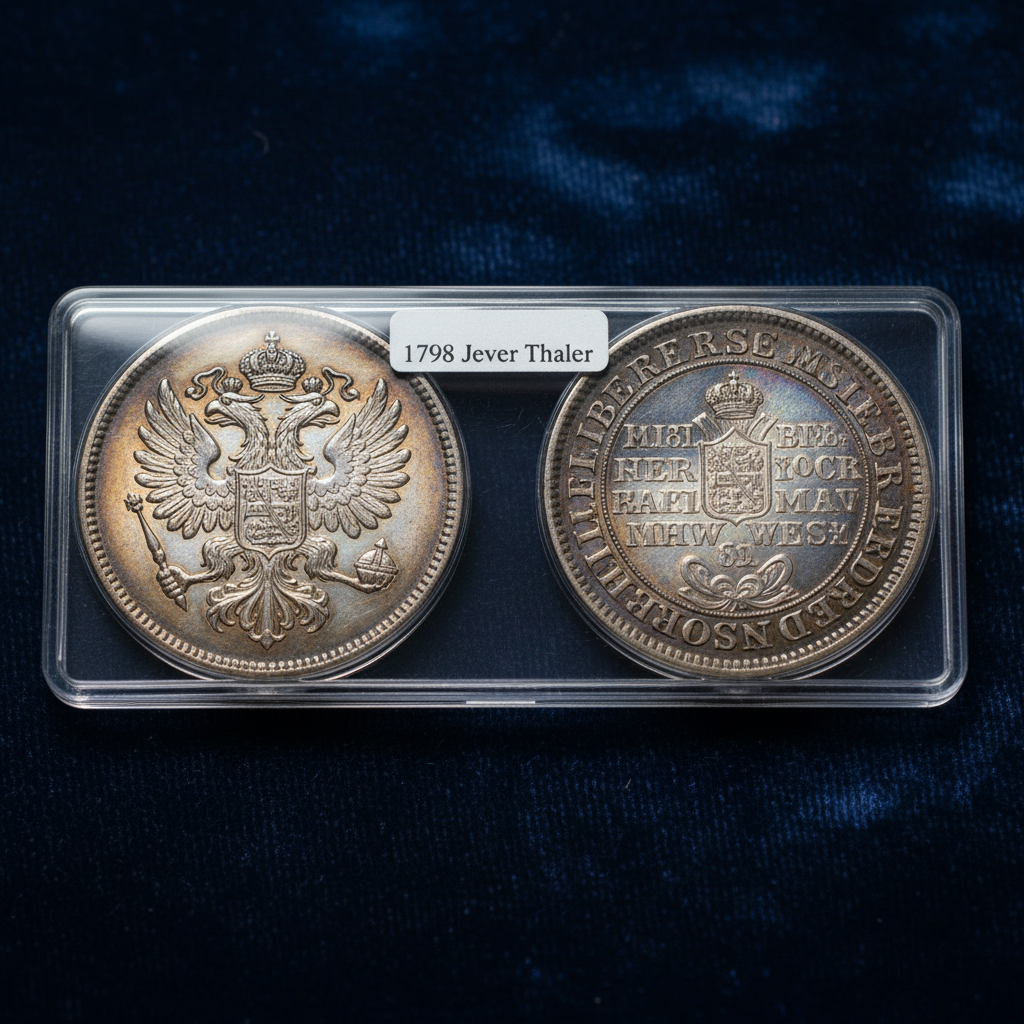
In 1798, a tiny North Sea lordship with fewer residents than a modern mid-sized town struck one of the most politically loaded coins in the entire German States series. The Jever thaler looked, at first glance, like any other late-18th-century German silver piece — heavy, beautifully engraved, carrying a noble title and a regional denomination. Look closer, and the obverse tells a different story entirely: a crowned double-headed eagle, the unmistakable symbol of Imperial Russia, staring back from a coin that named a German princess and circulated in a German-speaking coastal enclave.
That contradiction is precisely what makes this coin one of the more intellectually satisfying pursuits in world numismatics.
The Political Geography Behind the Strike
To understand the Jever thaler, you have to understand Jever itself — a lordship in what is now Lower Saxony, Germany, perched on the North Sea coast near the mouth of the Jade Bay. By the late 18th century, the lordship had passed through a labyrinthine chain of inheritance that ultimately deposited it in the hands of Friederike Auguste Sophie, Princess of Anhalt-Zerbst. That name should ring a bell. She was the sister of Catherine the Great, Empress of Russia.
When Friederike died in 1785, Jever passed directly to Catherine, making this scrap of German coastline — roughly 280 square kilometers — a personal possession of the Russian crown. The 1798 thaler was struck under Paul I, Catherine's son and successor, which explains the Russian imperial eagle on the obverse. Paul held Jever as a personal domain, not as a Russian state territory, but the symbolism was unambiguous. The coin was German in denomination and language, Russian in sovereign imagery.
That collision of jurisdictions produced a numismatic artifact with no real parallel in the German States series. Most German thaler coinage of the period reflects straightforward dynastic identity — a local ruler, a local symbol, a local mint. The Jever thaler fractures that template completely.
Rarity, Condition, and What the Market Actually Looks Like
Production figures for the 1798 Jever thaler are not well-documented in surviving mint records, but the coin's scarcity in the marketplace is self-evident. Major auction appearances are infrequent — we're talking single-digit appearances per decade at the top houses. When examples do surface through firms like Stack's Bowers, Heritage Auctions, or European specialists such as Künker and Gorny & Mosch, they command serious attention from both world coin generalists and Russian imperial collectors simultaneously, which creates competitive bidding from two distinct buyer pools.
That dual-audience dynamic is not trivial. A coin that attracts only German States collectors competes in one market. A coin that also pulls Russian imperial specialists — who are hunting anything touched by the Romanov dynasty — operates in a different pricing environment entirely. Recent auction results for comparable German States thalers of genuine rarity in NGC MS-62 or MS-63 range from $8,000 to $25,000, but the Jever thaler's Russian imperial crossover appeal pushes realized prices toward the upper end of that band and, for exceptional specimens, beyond it.
Circulated examples in VF-30 to EF-45 territory are more accessible but still represent a meaningful acquisition — typically $2,500 to $6,000 depending on strike quality and surface preservation. The coin's design is intricate, and weak strikes are common enough that a sharply detailed circulated piece often outperforms a softly struck Mint State example at auction.
- Denomination: 1 Thaler, 1798
- Issuing authority: Lordship of Jever, under Russian Tsar Paul I
- Obverse: Crowned Russian double-headed eagle
- Reverse: Arms of Jever with German inscription and denomination
- Composition: Silver
- Key grading services: NGC, PCGS (world coins division)
Why Serious Collectors Should Be Paying Attention
The broader German States series has been on a sustained upward trajectory for the better part of a decade. Collectors who dismissed it as a niche pursuit a generation ago are now watching top-tier pieces — anything with genuine rarity, historical narrative, or cross-collecting appeal — move at prices that rival early American coinage. The Jever thaler sits at the intersection of three distinct collector communities: German States, Russian imperial, and the growing segment of collectors who pursue coins as historical documents rather than mere metal.
That last group is the one to watch. As the hobby matures and collectors become more sophisticated, coins with layered political stories — pieces that require you to understand 18th-century European dynastic politics to fully appreciate what you're holding — are commanding premiums that pure rarity alone doesn't explain.
The Jever thaler is, in the most literal sense, a Russian coin wearing German clothes. In 1798, that was a political statement. In 2024, it's a collecting opportunity that the market hasn't fully priced in yet.