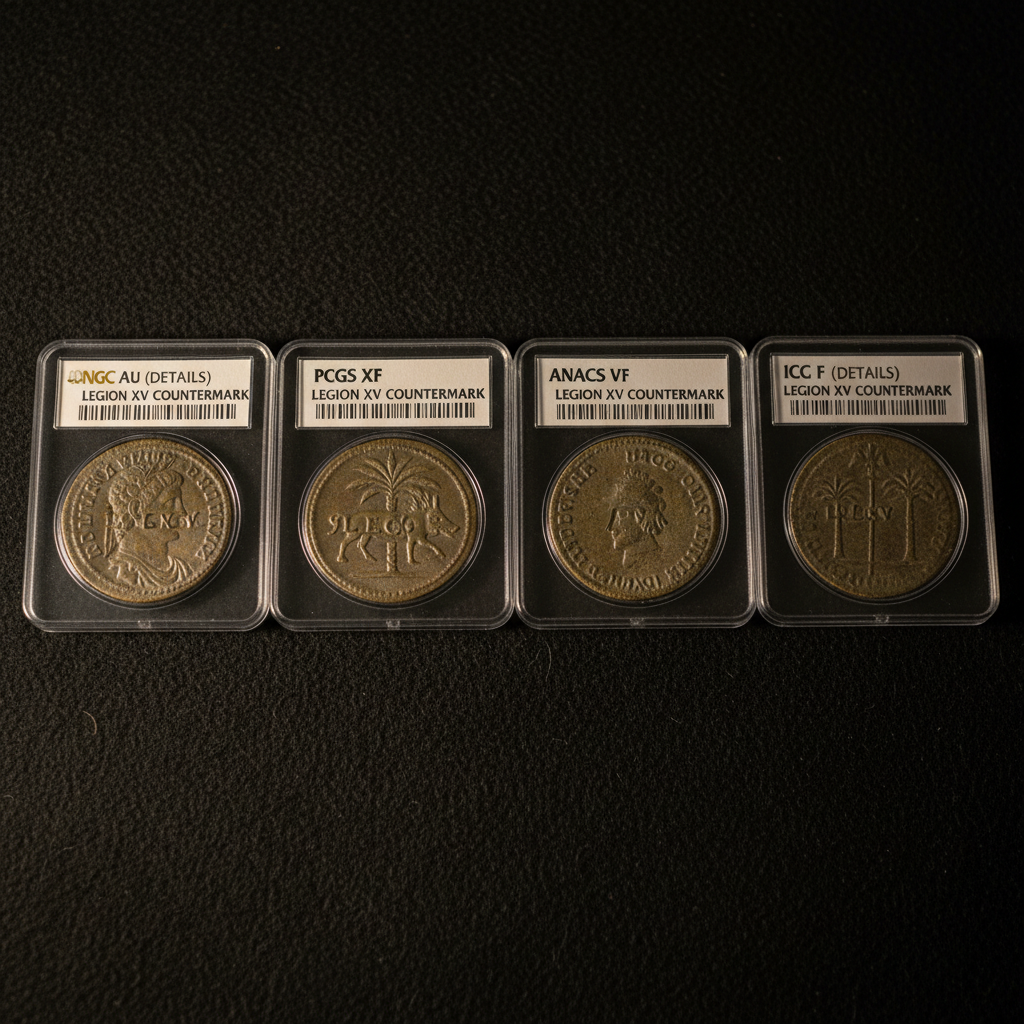
Four small bronze coins may be about to rewrite a chapter of Roman military numismatics. New research by Andrew Caldarone of Aegean Numismatics argues that a specific group of Legion XV Apollinaris countermarks — tiny XV stamps punched into circulating bronze — should be dated to the Jewish War of AD 66–70, not to later Flavian campaigns as previously assumed. If the evidence holds, it shifts how collectors and historians read an already rare and historically loaded class of ancient coinage.
Countermarks are among the most underappreciated artifacts in ancient numismatics. They aren't coins in themselves — they're bureaucratic decisions pressed into existing currency. A legion needed coinage in the field, supply was short, and commanders authorized the restamping of whatever bronze was available. The result is a tiny, often crude stamp that encodes a specific military moment in metal. For collectors, that specificity is everything.
What the Evidence Shows
Caldarone's case centers on four bronze coins bearing the XV countermark associated with Legion XV Apollinaris, one of the four legions deployed under Vespasian and Titus during Rome's brutal suppression of the Jewish revolt. The argument is stratigraphic and typological: the host coins — the bronzes being countermarked — and the style of the stamp itself are consistent with Judaean circulation during the late Neronian and early Flavian period, not with the legion's later postings in Cappadocia under the Flavians.
This distinction matters enormously in the specialist market. Countermarks tied to the Jewish War carry a provenance narrative that commands serious collector attention. The conflict produced some of Roman numismatics' most historically resonant material — Judaea Capta bronzes, the famous IVDAEA CAPTA sestertii of Vespasian and Titus, and the Jewish shekel series struck by the rebels themselves. Situating the Legion XV countermarks within that same historical moment elevates their significance considerably.
The population of authenticated Legion XV countermarked bronzes is already small. These don't appear in major auction house catalogs with any regularity — Heritage Auctions and Stack's Bowers handle Roman provincial material routinely, but legionary countermarks of this specificity surface perhaps a handful of times per year across all major platforms combined. When they do appear, condition and historical attribution drive pricing far more than grade alone.
Reading the Market for Legionary Countermarks
Ancient coins don't operate on PSA or NGC population report logic, but the scarcity math is comparable. A well-attributed legionary countermark on a recognizable host coin — say, a Claudian or Neronian provincial bronze with a clear, centered stamp — can fetch anywhere from $300 to well over $2,000 depending on the legion, the host type, and how cleanly the countermark reads. Legion XV material with solid provenance and a credible Jewish War attribution would sit at the upper end of that range, potentially beyond it if the Caldarone research gains traction in the specialist literature.
The broader market for Roman military bronzes has been quietly firm. Collector interest in coins tied to specific historical events — rather than generic imperial portraits — has grown steadily over the past decade, driven partly by a generation of collectors who came to ancients through historical reading rather than traditional numismatic channels. They want the story as much as the metal. A countermark that places a specific Roman legion at one of antiquity's most documented conflicts delivers exactly that.
NGC Ancients, the dominant third-party grader for ancient coinage, encapsulates countermarked bronzes regularly, and their notes on strike and surface preservation carry real weight at auction. A Legion XV bronze with an NGC strike rating of 4/5 and a clear countermark attribution to the Jewish War context would be a genuinely compelling lot. Right now, no such piece exists in the public auction record with Caldarone's specific dating — which is precisely why this research matters to the market, not just to the academy.
Why Chronology Is the Whole Game
In ancient numismatics, attribution is valuation. The same physical coin, with the same grade and the same countermark, can be worth dramatically more or less depending on where scholars place it in history. A Legion XV bronze dated to a routine Cappadocian garrison posting is interesting. The same coin placed at the siege of Jerusalem is a primary source artifact.
Caldarone's work hasn't yet triggered a broad reattribution — that takes peer review, auction catalog adoption, and eventually the slow consensus of specialist dealers and cataloguers. But the process has started. Collectors tracking this category should watch for how major auction houses begin describing Legion XV countermarks in upcoming Roman provincial sales. The moment Heritage or Stack's Bowers starts citing the Jewish War attribution in lot descriptions, the pricing will follow.
Four coins. One small stamp. The entire weight of a war.