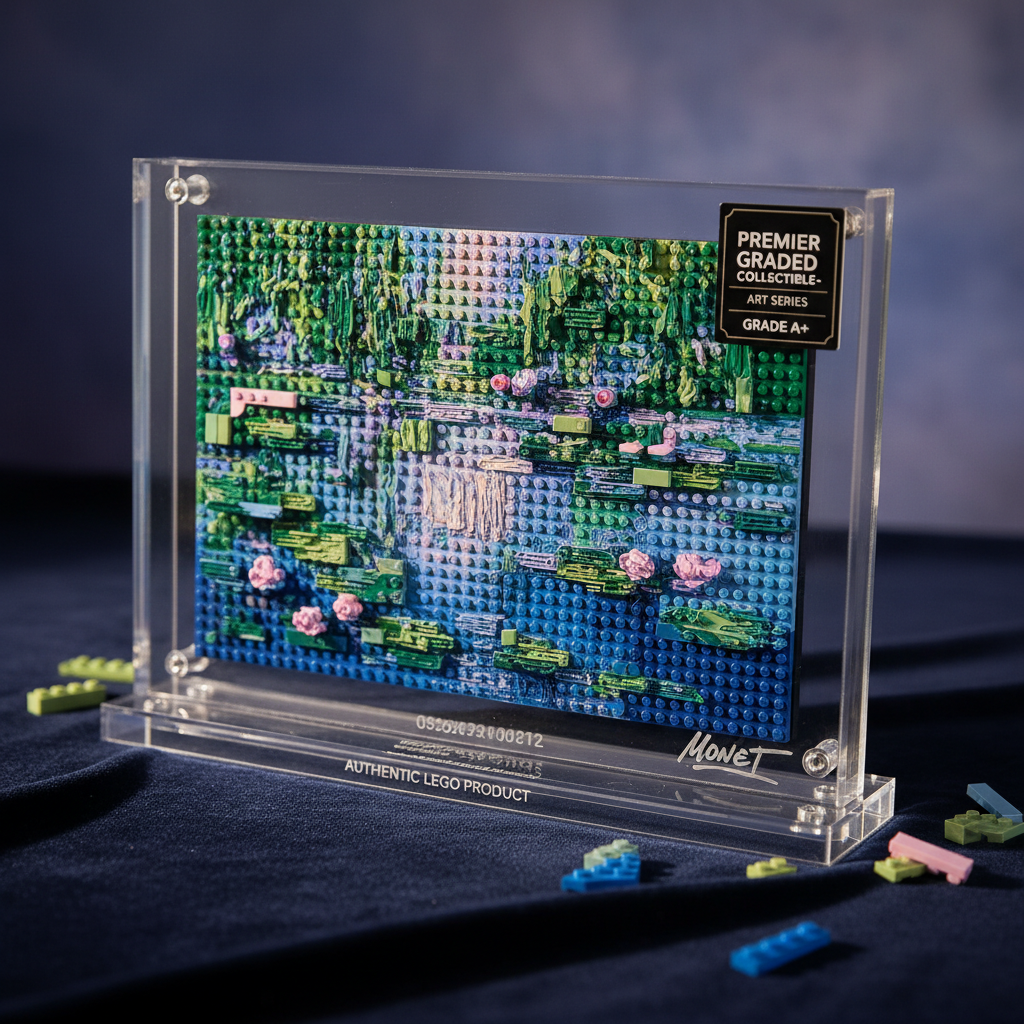
LEGO has spent the last decade aggressively courting adult collectors, and its latest release makes the pitch in the most literal way possible: a 3,000-plus-piece mosaic set recreating Claude Monet's iconic water lilies series. This isn't a plaything. It's a wall piece — a framed, displayable interpretation of one of the most reproduced paintings in Western art history, rendered in plastic bricks.
The move is calculated. LEGO's 18-and-older product line, marketed under the broader Creator Expert and Art umbrellas, has become one of the company's most reliable growth segments. The Monet set follows a pattern the Danish company has refined over several years: take a culturally unimpeachable subject, engineer a satisfying build experience around it, and price it at a point that feels aspirational without being exclusionary.
The Art Angle Is More Than Marketing
Monet's water lilies aren't just famous — they're structurally well-suited to a mosaic format. The impressionist style, built on loose, fragmented brushwork, translates surprisingly well to the pixelated logic of LEGO's 1×1 round plates and flat tiles. The original paintings, many housed at the Musée de l'Orangerie in Paris and the Art Institute of Chicago, were themselves conceived as immersive, room-scale environments. A large-format LEGO interpretation doesn't feel like a stretch.
LEGO's Art line launched in 2020 with sets themed around Andy Warhol's Marilyn Monroe prints and a series of iconic musicians. Those early releases averaged around $120–$150 at retail and moved quickly. The secondary market told an interesting story: sealed Warhol sets were trading at 20–35% premiums within 18 months of retirement, a modest but real return for patient holders. The Monet set, with its higher piece count and broader cultural appeal, enters that ecosystem with more upside potential — assuming LEGO keeps production limited enough to sustain scarcity.
Piece count matters in this market. The 3,000-plus figure puts this set in the same tier as LEGO's most ambitious adult releases — the Eiffel Tower at 10,001 pieces sits at the extreme end, but sets in the 2,000–4,000 range consistently hold value better than smaller releases. More pieces means a longer build, a larger finished display, and a higher retail price that filters out impulse buyers.
Where LEGO Collectibles Actually Trade
The secondary market for sealed LEGO sets has matured considerably. BrickLink remains the dominant peer-to-peer platform, but Heritage Auctions and even Goldin have catalogued high-value sealed LEGO lots in recent years, particularly for retired Star Wars and Creator Expert sets. A sealed LEGO Millennium Falcon (set 75192) — the 7,541-piece behemoth released in 2017 — has traded between $800 and $1,200 in recent auction cycles, against an original retail of $799.99. Not spectacular appreciation, but stable.
The Art line sets operate differently. They're smaller, cheaper at retail, and their value is tied more to cultural moment than engineering prestige. The Monet release has the advantage of tapping into a collector demographic that overlaps only partially with traditional LEGO enthusiasts — art collectors, interior design-conscious buyers, and gift-market participants who wouldn't know a minifigure from a Technic pin. That crossover audience is genuinely new demand.
Grading for LEGO sets remains informal compared to trading cards or coins. There's no PSA equivalent for sealed bricks — condition is assessed by box integrity, seal authenticity, and the absence of yellowing or crush damage. Serious sealed-set collectors treat the outer box the way numismatists treat coin holders: any crease is a deduction.
The Bigger Trend This Set Represents
LEGO isn't the first toy manufacturer to chase the adult collector dollar, but it's been the most systematic about it. The company's Adults Welcome positioning has shifted what was once a niche into a core revenue driver. Competitors have noticed — Mega Construx, Oxford Bricks, and various Chinese manufacturers have all launched adult-oriented mosaic sets at lower price points, but none have matched LEGO's brand premium in the secondary market.
The Monet set also arrives at a moment when the broader collectibles market is sorting itself out after the pandemic-era bubble. Sports cards have corrected sharply from 2021 highs. Funko Pops never recovered their cultural momentum. Sealed LEGO, by contrast, has shown resilience — partly because the product has genuine utility (you can actually build it), and partly because the audience isn't speculative in the same way card flippers were.
For collectors evaluating the Monet set as an asset rather than a hobby purchase, the calculus is straightforward: buy at retail, store sealed in climate-controlled conditions, and wait for retirement. LEGO typically retires sets within 2–4 years of launch, at which point secondary market prices begin their climb. The Monet's cultural subject matter — Impressionism doesn't go out of style — gives it a longer tail than a licensed set tied to a film or franchise.
Monet spent the last decade of his life nearly blind, painting water lilies from memory and sensation. The irony of his most tactile, sensory work being reproduced in the most modular, systematic medium imaginable is either a desecration or a compliment, depending on your tolerance for the art world's long history of reproduction and reinterpretation. Either way, LEGO is betting collectors won't overthink it.