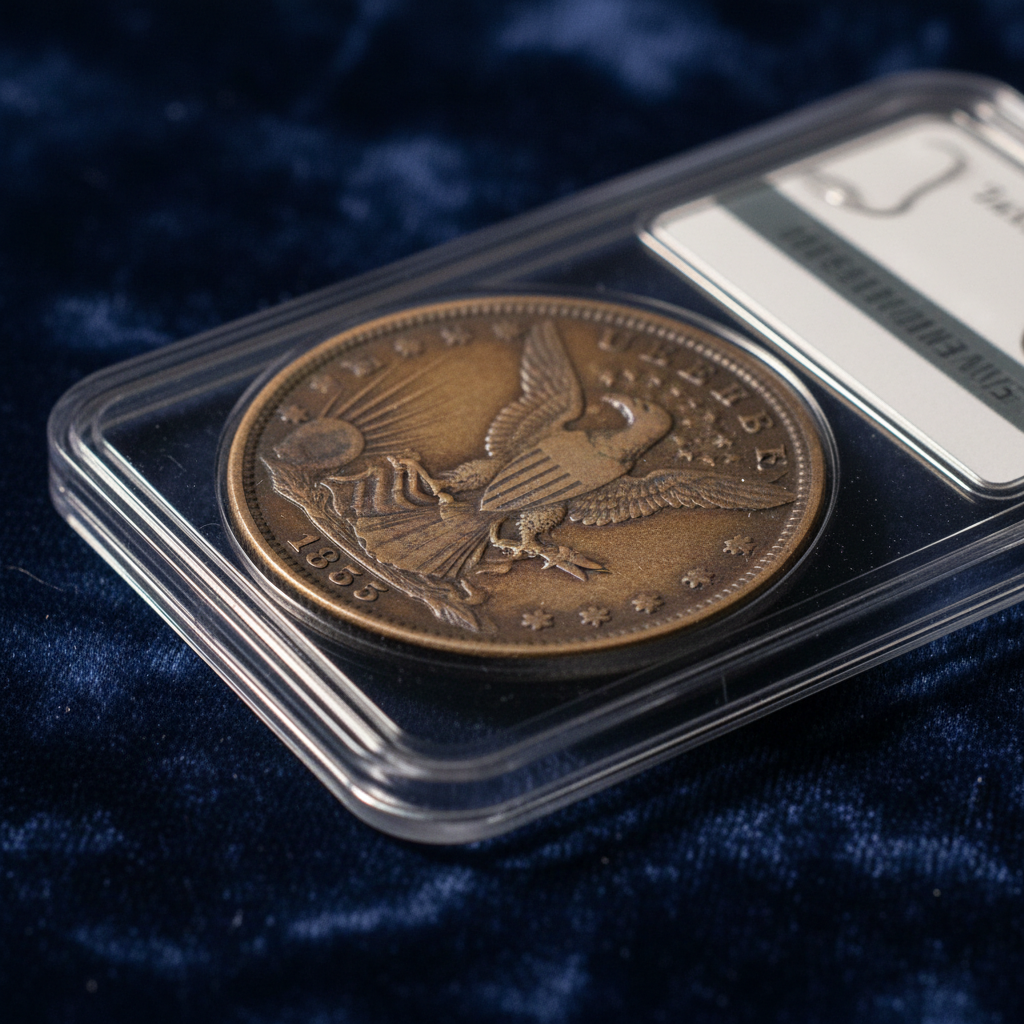
When California gold flooded eastern markets in the early 1850s, it didn't just reshape the American economy — it broke the U.S. Mint's existing weight standards for silver coinage. The Liberty Seated Half Dollar with Arrows at the Date, struck only in 1854 and 1855, is the direct numismatic consequence of that disruption. Two small arrowheads flanking the date mark a legislative correction, a monetary crisis, and one of the shortest production windows in 19th-century American coinage. For serious collectors, that compressed history makes these coins far more interesting than their relatively modest auction prices might suggest.
The Economic Shock Behind the Design Change
The mechanics of the crisis are straightforward. Gold flooded U.S. markets after 1848, depressing the metal's value relative to silver. By the early 1850s, the silver content in coins like the half dollar was worth more than face value on commodity markets — which meant people were melting them. Hoarding and melting drained silver coinage from circulation at an alarming rate.
Congress responded with the Coinage Act of 1853, which reduced the silver content of most subsidiary coinage. The half dollar's authorized weight dropped from 206.25 grains to 192 grains — a reduction of roughly 6.9%. To signal the change to the public and prevent confusion with the heavier pre-Act coins, the Mint added arrows to either side of the date. Rays were briefly added to the reverse eagle as well, though those disappeared after 1853. The arrows remained for 1854 and 1855 before being quietly removed, leaving the reduced-weight standard in place without further annotation.
The result is a two-year type coin with clear historical stakes. It's not a novelty or a commemorative — it's a monetary policy instrument stamped in silver.
Mintages, Mints, and the Market Today
Production was substantial by mid-19th-century standards. The Philadelphia Mint struck roughly 2.98 million half dollars in 1854 and approximately 759,500 in 1855. New Orleans added meaningful volume as well — around 5.24 million in 1854-O and 3.69 million in 1855-O. San Francisco entered the picture with the 1854-S, a low-mintage issue at just 129,950 coins that commands serious collector attention and significant premiums in higher grades.
The 1854-S is the key date of the series without question. In circulated grades — VF-20 through EF-45 — examples regularly bring $800 to $2,500 at auction depending on eye appeal and surface quality. Push into AU territory and prices climb steeply. A certified AU-55 example sold through Heritage Auctions in recent years for north of $4,000, and Mint State examples are genuinely rare. PCGS and NGC combined populations for 1854-S in MS-60 and above remain thin enough that a single strong specimen can reset market expectations.
The Philadelphia and New Orleans issues are far more accessible. A problem-free 1854 Philadelphia in VF-30 typically trades in the $60–$120 range, making this an entry point for type collectors who want a historically significant 19th-century silver coin without committing four figures. The 1855-O is similarly affordable in circulated grades, though original luster survivors in AU-58 or better attract competitive bidding at Stack's Bowers and Goldberg sales.
Grading Considerations and What to Watch For
Liberty Seated coinage presents consistent grading challenges. The high points of Liberty's figure — her head, knee, and the shield — wear first and wear fast. On half dollars that saw genuine circulation, these areas often show significant flatness even when the fields retain moderate luster. Buyers should treat any coin graded EF-40 or above with scrutiny: cleaned examples are common in the series, and the large silver surface area makes whizzing and hairlines easy to introduce and sometimes difficult to spot under casual examination.
Strike quality also varies by mint. New Orleans coins from this era are frequently softly struck at Liberty's head and on the eagle's breast feathers on the reverse. That's not damage — it's a production characteristic — but it can suppress grades and create buying opportunities for collectors who understand the distinction. A softly struck 1854-O graded MS-62 by NGC or PCGS will trade at a discount to a sharply struck Philadelphia example at the same grade, even though the New Orleans coin may be considerably scarcer in true Mint State.
For registry set builders or type collectors chasing the finest known, the population data tells the real story. PCGS has certified fewer than a dozen 1854-S examples across all Mint State grades combined. That scarcity, paired with the coin's historical significance, makes it one of the more compelling pursuits in 19th-century American silver — not because it's flashy, but because it's genuinely hard to find in original, problem-free condition.
Two years. One monetary crisis. A design change that lasted less than 730 days before the Mint quietly moved on. The Liberty Seated Half Dollar with Arrows at the Date doesn't announce itself loudly, but the collectors who understand what those arrowheads actually mean tend to hold onto them.