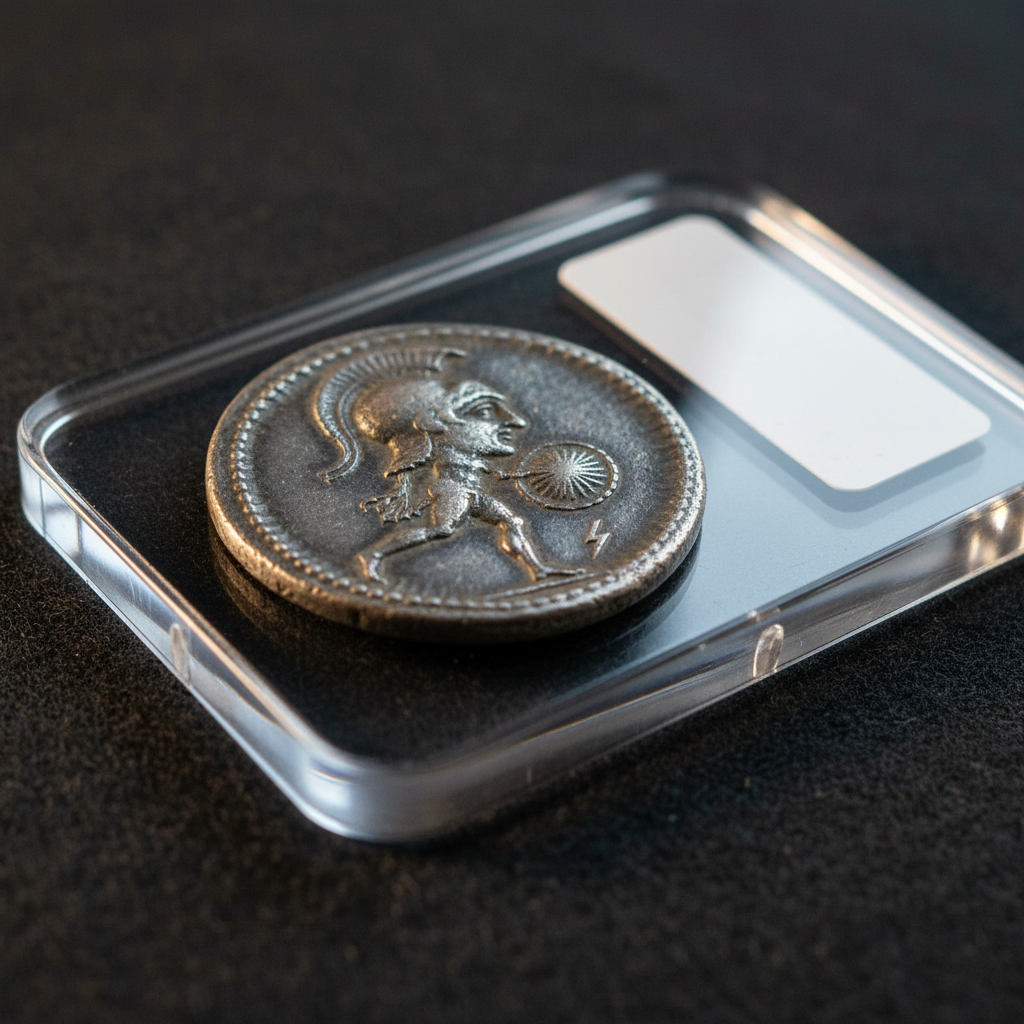
A small, rocky territory on the Greek mainland produced some of antiquity's most compelling coinage — and the Colosseo Collection is making the case that collectors have been sleeping on it for decades.
Opus was never a power center. The Lokrians who inhabited this coastal strip of central Greece were hemmed in by larger, more aggressive city-states, and their land was notoriously poor. Yet from roughly the fifth century BCE onward, they minted a silver coin series that stands among the most mythologically rich of the ancient Greek world — anchored almost entirely by the figure of Ajax the Lesser, the Lokrian hero whose story is equal parts triumph and catastrophe.
The research, compiled by Russell A. Augustin of AU Capital Management, LLC for the Colosseo Collection, digs into why a marginal polis chose this particular hero as its civic identity — and what that choice tells us about the market value of narrative in ancient numismatics today.
Ajax, Lokris, and the Weight of Myth
Ajax the Lesser — not to be confused with the towering Telamonian Ajax of Homeric fame — was a Lokrian, born in Opus. He led the Lokrian contingent to Troy, fought with distinction, and then committed one of antiquity's most notorious acts of sacrilege: dragging Cassandra from the statue of Athena during the sack of Troy. The gods did not forget. His fleet was destroyed on the voyage home, and Ajax himself was drowned — or, depending on the source, struck by lightning — at the Gyraean Rocks.
For the Lokrians, this was not a story of shame. It was a story of ownership. Ajax was theirs, flaws included, and they memorialized him on their coinage with a specificity that most city-states reserved for Olympian gods. The coins typically depict Ajax in a striding pose, armed with helmet and spear, occasionally shown in the act of combat. The reverse frequently carries the Lokrian ethnic inscription alongside symbols tied to the region's agricultural and religious life.
From a numismatic standpoint, the series spans multiple denominations — staters, triobols, and obols — across a production window that stretches from approximately 450 BCE to 300 BCE. The stylistic evolution across that 150-year arc is substantial, and for type collectors, it represents a genuinely tractable series: deep enough to reward serious pursuit, but not so vast that it becomes financially prohibitive.
What the Market Is Actually Doing With These Coins
Ancient Greek coinage occupies a peculiar corner of the collectibles market. It lacks the pop-culture accessibility of sports cards or the institutional momentum of U.S. type coins, but it commands serious money at the top end. A high-grade Syracusan dekadrachm — the benchmark for ancient Greek numismatic achievement — routinely clears $500,000 to over $1 million at major auction houses including Heritage Auctions and Stack's Bowers. Lokrian silver sits far below that stratosphere, but the trajectory is worth watching.
Mid-grade Lokrian staters — think NGC-certified examples grading Fine to Very Fine — have traded in the $800 to $2,500 range at recent auction. Exceptional strike quality or strong provenance pushes that ceiling considerably higher. The Colosseo Collection itself, assembled with scholarly intent, represents the kind of curated provenance that tends to add a meaningful premium when material eventually comes back to market.
The broader ancient coin market has shown resilience through the same inflationary pressures that rattled other collectibles categories in 2022 and 2023. Partly that's because the collector base skews older, wealthier, and less speculative than the trading card crowd. Partly it's because supply is genuinely finite — no new Lokrian staters are coming out of the ground legally in any volume that moves prices.
NGC's ancient coin certification program has done meaningful work normalizing the category for buyers who might otherwise find the authentication process opaque. Certified ancient coins now routinely outperform raw examples at auction, sometimes by 30 to 50 percent on equivalent material — a premium that reflects not just authentication confidence but the liquidity that standardized grading provides.
Why the Lokrian Series Deserves a Second Look
The Augustin research frames the Lokrian coinage not just as historical artifact but as deliberate civic propaganda — a small state using the weight and permanence of silver to assert cultural legitimacy it couldn't claim through military or economic power. That framing resonates with serious collectors because it transforms the coins from pretty objects into primary sources.
For the collector building an ancient Greek thematic set around mythology or hero cults, the Lokrian Ajax series is one of the few where a complete or near-complete type collection is actually achievable. The major varieties are documented. The auction records exist. The scholarly literature, while not exhaustive, is substantive enough to support serious research.
The Colosseo Collection's approach — pairing rigorous provenance documentation with mythological context — is increasingly the model for how serious ancient coin holdings get built and, eventually, sold. When this material comes to auction, the story travels with it. And in a market where narrative drives premiums, that matters more than most buyers realize.
Ajax the Lesser drowned on the rocks because he defied the gods. His coins have survived 2,500 years. The irony is not lost on anyone paying attention.