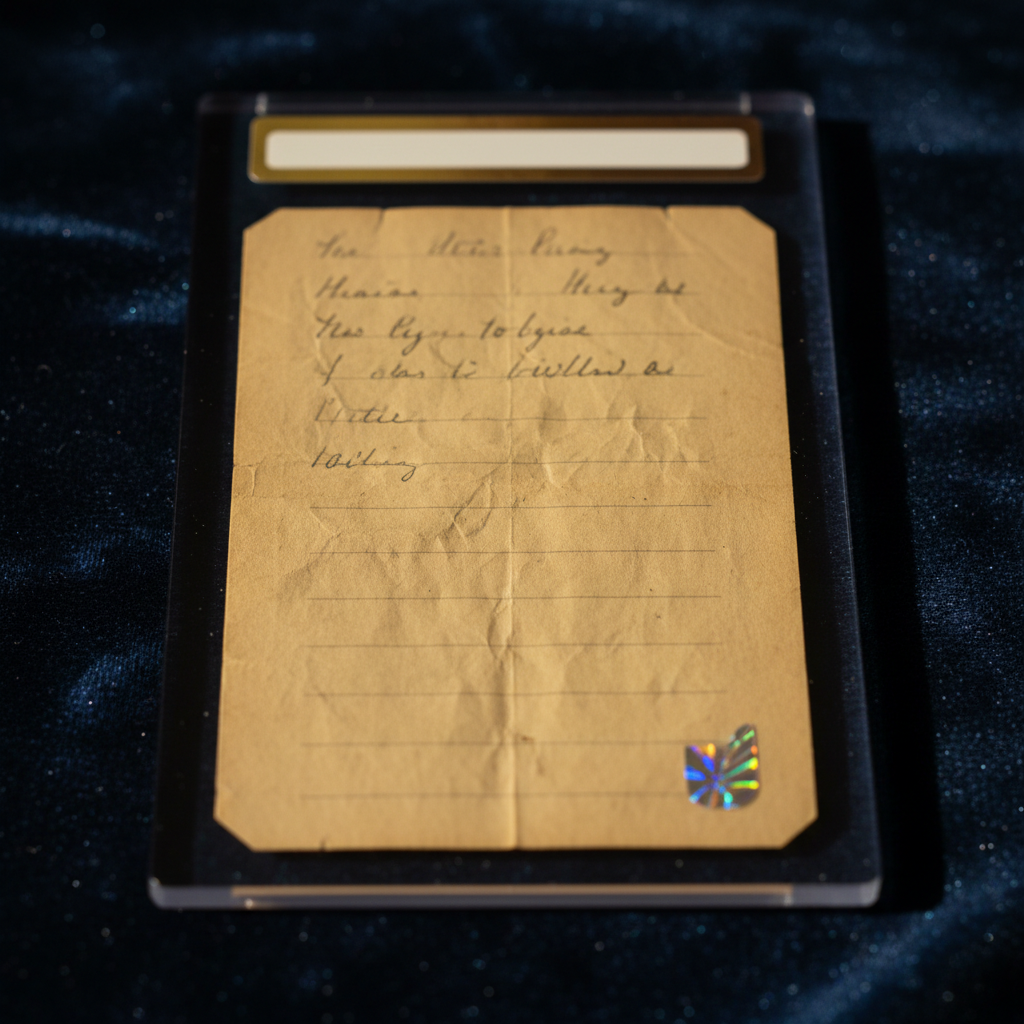
A handwritten page of working lyrics from one of Bob Dylan's most celebrated songs has surfaced after decades of quiet obscurity — tucked inside a friend's book, of all places. The draft is now consigned for auction, and if comparable Dylan manuscript sales are any guide, bidders should expect a serious fight.
The discovery is the kind of thing that makes the music memorabilia market stop and pay attention. Working drafts — not clean final copies, but actual in-progress manuscripts showing a writer's process — consistently outperform finished documents at auction because they offer something a pressed concert ticket or signed album never can: a window into creative decision-making at the highest level.
What the Market Will Bear
Dylan manuscript sales have established a formidable pricing floor over the past decade. In 2014, a handwritten draft of Like a Rolling Stone sold at Sotheby's for $2.045 million, setting the benchmark for Dylan working documents. That sale remains the most significant Dylan manuscript transaction on record, but it didn't exist in a vacuum — it reflected a broader surge in rock-and-roll ephemera that has only deepened since.
More recently, the broader music memorabilia segment has posted consistent gains. Heritage Auctions' music catalog sales have grown substantially year-over-year, with handwritten lyric pages from canonical artists routinely clearing six figures regardless of condition. A working draft — with cross-outs, margin notes, and visible revision — commands a premium over a clean copy precisely because the messiness is the point. Collectors and institutions aren't just buying words. They're buying proof of labor.
The provenance here is particularly compelling. Found inside a friend's book suggests a casual, personal exchange — the kind that happened constantly in Dylan's orbit during his most prolific periods. That informality, paradoxically, tends to strengthen authenticity arguments. It's a more plausible chain of custody than a document that passed through a dozen dealer hands.
Dylan's Manuscripts as Cultural Artifacts
Bob Dylan occupies a category of one in the music memorabilia world. The 2016 Nobel Prize in Literature didn't create his collectibility — it ratified it. Institutions from the Morgan Library to the Bob Dylan Archive at the University of Tulsa have spent years acquiring his papers, which means serious private collectors are competing not just against each other but against endowed cultural institutions with acquisition budgets.
That institutional demand creates a price floor that doesn't exist for most rock memorabilia. A handwritten page from a celebrated Dylan song isn't just a collectible — it's a primary literary document. That framing matters at auction. It pulls in a different class of bidder: university libraries, private foundations, literary estates. When those buyers enter the room, ceiling estimates become suggestions.
The specific song in question will drive the final number dramatically. A working draft from Blowin' in the Wind, The Times They Are a-Changin', or Mr. Tambourine Man carries an entirely different weight than a deep cut from a mid-period record. The auction house handling this lot will market accordingly, and the pre-sale estimate will signal how significant they believe the song identification to be.
Condition, Authentication, and the Road to Sale
For a document like this, authentication is everything. The leading third-party authenticators for music and literary manuscripts — PSA/DNA, Beckett Authentication, and JSA — each have established protocols for handwritten documents, though the real heavy lifting on a Dylan draft will likely involve forensic document examination and cross-referencing against known examples from the Dylan Archive.
Paper aging, ink composition, and handwriting analysis are all in play. Dylan's handwriting across different periods is reasonably well-documented given the volume of material in institutional collections, which actually works in a legitimate document's favor — there's a robust comparison set.
Condition will matter, but not in the same way it does for trading cards or coins. A lyric draft with coffee stains and fold lines isn't damaged — it's authenticated by its own wear. Buyers in this category aren't chasing mint. They're chasing real.
Wherever this lands — Heritage, Sotheby's, Christie's, or a specialist music auction house — the bidding will reflect a market that has never been more serious about rock-and-roll manuscripts as long-term cultural investments. Dylan's Nobel designation effectively reclassified his papers. A working draft of a celebrated song, with solid provenance and clean authentication, isn't a curiosity. It's a rare document. And the market prices rare documents accordingly.