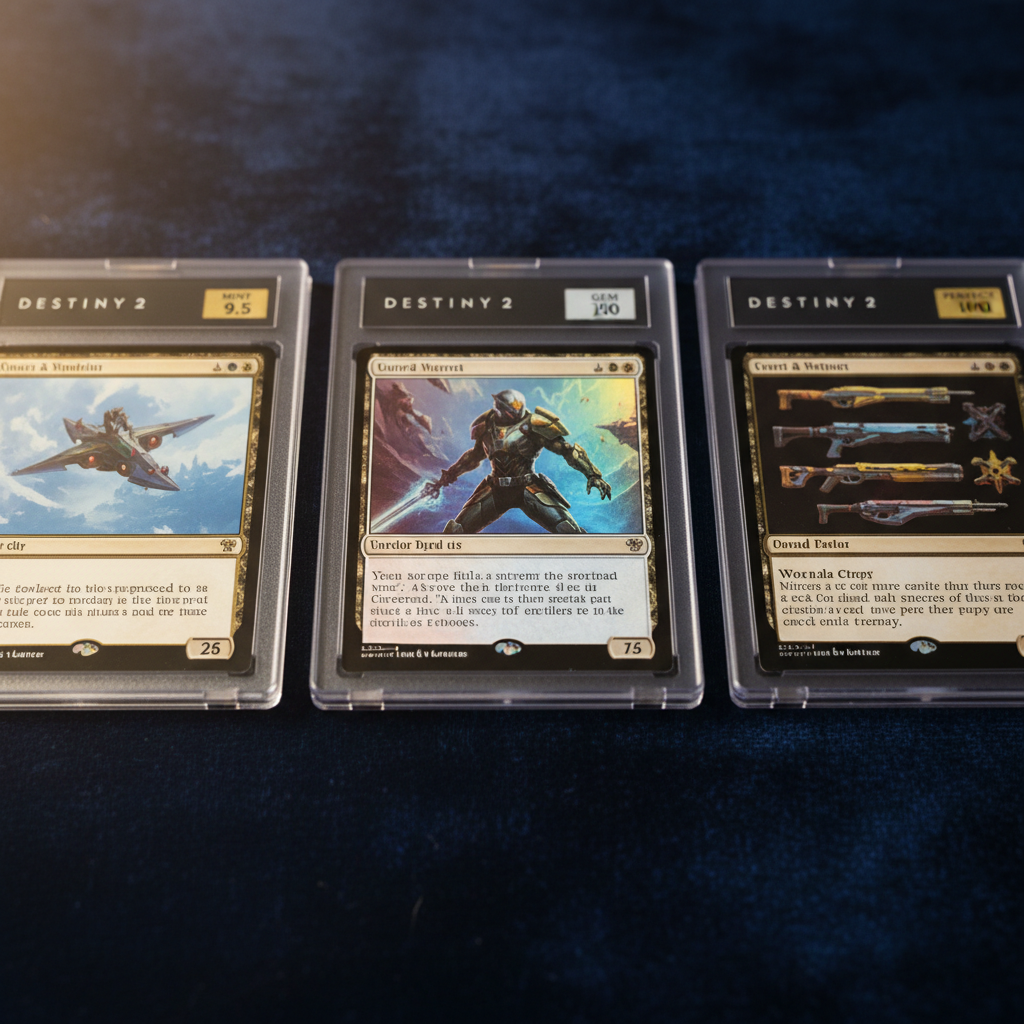
Wizards of the Coast and Bungie are launching a full-scale cross-media collaboration on March 24, 2026, dropping Magic: The Gathering's iconic Planeswalker aesthetic directly into Destiny 2's looter-shooter universe. The timing is deliberate — the launch coincides with Destiny 2's annual Guardian Games event, maximizing player engagement across both fanbases simultaneously. For collectors tracking Magic's licensing trajectory, this is less a surprise than a confirmation of where the brand is heading.
Magic has been aggressively expanding beyond cardboard for years. The Secret Lair program normalized crossover IP, Universes Beyond brought in Warhammer 40,000, The Lord of the Rings, and Fallout as fully legal card sets, and now the franchise is planting its flag inside a live-service video game. Each move has been more ambitious than the last. The Destiny 2 collaboration is the most direct integration yet — not a card set inspired by a video game, but Magic's visual identity transplanted into a completely different medium.
What the Eververse Collection Signals for the Market
The collaboration's primary consumer-facing product is the Eververse Collection, Destiny 2's in-game cosmetic storefront. Bungie has used Eververse to monetize limited-run crossover content before, and those digital items — while not physical collectibles — have historically created downstream demand for related physical products. When Destiny 2 ran its previous high-profile collaborations, secondary market interest in associated merchandise spiked measurably in the weeks surrounding launch windows.
The more significant question for Magic collectors is what this partnership means for physical product. Wizards has a consistent pattern: major IP collaborations almost always generate a Secret Lair drop or a Universes Beyond set to capture the card-buying audience. A Destiny 2-themed Secret Lair, featuring Guardian-class characters rendered in Magic's card frame, would be entirely consistent with how Wizards has handled every comparable crossover since 2020. No such product has been officially announced — but the absence of an announcement at launch is not unusual. Wizards typically staggers reveals to sustain momentum.
Secondary market prices for high-grade Magic crossover cards have been volatile but directionally upward for the most sought-after entries. A BGS 10 Pristine copy of the serialized The One Ring from the Lord of the Rings: Tales of Middle-earth set — the only 1-of-1 ever printed — sold for $2 million at private sale in 2023. That's an outlier, but it established a ceiling that legitimized the entire Universes Beyond product line in the eyes of serious investors. Even non-serialized LTR cards in PSA 10 have held premiums of 30-50% over comparable standard-set cards with similar population counts.
The Licensing Bet Wizards Is Making
This collaboration is a signal, not just a product launch. Hasbro, Wizards' parent company, has been explicit in earnings calls about leaning into licensing as a revenue stabilizer as the core TCG market normalizes post-pandemic. The strategy is straightforward: Magic's art style and Planeswalker lore are recognizable enough to function as a brand asset inside other entertainment properties, not just on cardboard.
Destiny 2's player base skews older and has demonstrated willingness to spend on premium cosmetics — Bungie's annual revenue from microtransactions has consistently exceeded $100 million. That's an audience with disposable income and a pre-existing comfort with collectible-adjacent spending. Wizards isn't targeting the casual Destiny player with this crossover. They're targeting the 28-year-old who already owns a Commander deck and just needs a reason to re-engage with Magic's ecosystem.
Whether that re-engagement translates into card sales, digital product purchases, or simply brand awareness depends entirely on execution. The Guardian Games window gives the collaboration a natural promotional arc — roughly two to three weeks of elevated in-game visibility before the event concludes. That's a tight runway.
What Collectors Should Watch
Three things are worth monitoring closely as March 2026 approaches. First, any Secret Lair announcement tied to the collaboration — those drops have shown consistent sell-through rates above 85% during pre-order windows, and foil variants of crossover Lairs routinely trade at 2-3x issue price within six months of shipping. Second, population data from PSA and BGS on any physical Magic product released under this banner; early population scarcity on high-grade copies is where the real upside lives. Third, whether Bungie introduces any physical collectible component — a challenge coin, a pin set, a numbered card — as part of the Guardian Games event itself.
Bungie has done limited physical merchandise drops tied to in-game events before, and a Magic-branded physical item distributed through Destiny 2's ecosystem would be genuinely novel territory. Novel territory, in this market, tends to get expensive fast.
The broader takeaway is that Magic's future looks increasingly like a licensing portfolio with a card game attached — and for collectors who got in early on Universes Beyond, that future has already been profitable.