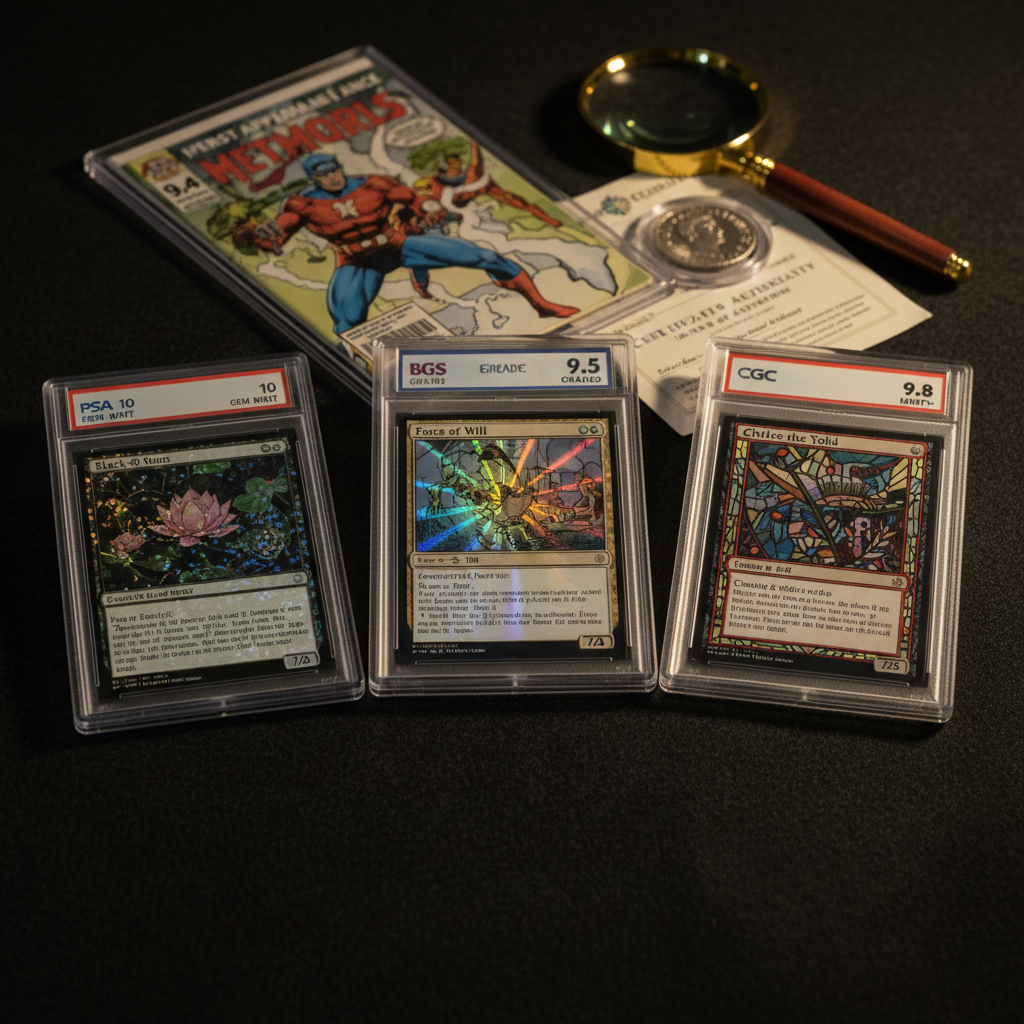
There is a peculiar corner of the Magic: The Gathering market where competitive value and collectible value have almost nothing to do with each other. Cards that would never survive a tournament cut — cards that experienced players would politely describe as unplayable — are quietly commanding real collector attention based entirely on the strength of their artwork. Call it the beautiful chaff phenomenon, and it deserves more serious treatment than it typically gets.
MTG has always occupied an unusual space in the broader trading card market. Unlike sports cards, where a card's desirability is almost entirely tied to the athlete depicted and the card's scarcity, Magic cards carry a dual identity: gameplay asset and art object. Wizards of the Coast has commissioned thousands of original paintings over the game's 30-plus year history, and a meaningful percentage of that artwork ended up on cards that were mechanically irrelevant from day one.
The Binder-Builder Economy
Collectors who build for aesthetics rather than competitive play represent a genuine and growing segment of the MTG market. The rise of Commander as the dominant casual format has softened the hard line between playable and unplayable — but even within Commander's generous 100-card singleton structure, there are cards so mechanically weak that no deck rationally includes them. Those are the cards in question here.
What makes this segment interesting from a market standpoint is the pricing dislocation. A card with stunning artwork but no competitive application can sit at bulk pricing — sometimes as low as $0.10 to $0.25 in raw form — while an equivalent card with identical scarcity but top-tier tournament relevance trades at multiples of that. The artwork premium, when it exists at all in the secondary market, tends to be modest unless the card also carries a specific set pedigree, artist signature, or graded population story.
That dynamic is shifting, slowly. PSA and BGS have both seen increased MTG submission volume over the past three years, and a portion of those submissions are explicitly art-driven rather than value-driven. Collectors are grading cards they love to look at, not cards they expect to flip at a premium. It is a different psychology than the sports card grading rush of 2020-2021, and arguably a healthier one.
Where the Art Premium Actually Shows Up
The clearest expression of artwork value in MTG is the original art market. Pieces by Christopher Rush, Rebecca Guay, Terese Nielsen, and John Avon have sold at auction for figures ranging from several thousand to well over $100,000 — with Rush's original Black Lotus painting famously selling for $511,000 at PWCC in 2021. That sale established a ceiling that the broader MTG art market has been recalibrating around ever since.
But original art is a separate market from the cards themselves. The more accessible play for collectors interested in the beautiful-chaff category is graded card collecting with an art focus. A PSA 10 copy of a visually stunning common from a beloved early set — think Ice Age, Mirage, or Tempest — can be had for a fraction of what a mechanically powerful rare from the same set commands, while offering the same tactile graded-slab experience and, arguably, more visual impact on a shelf.
Population data reinforces the opportunity. Many of these aesthetically significant but mechanically weak cards have extremely thin PSA 10 populations — sometimes in the single digits — simply because no one has bothered to submit them. Scarcity at the top of the grading scale is already there. The collector demand just hasn't fully caught up.
Reading the Long Game
The broader collectibles market has repeatedly demonstrated that art-driven demand is durable in ways that hype-driven demand is not. The 2020-2021 MTG card boom, fueled by speculation and pandemic-era liquidity, inflated prices on powerful staples and left the beautiful chaff largely untouched. When that market corrected — and it did correct, sharply — the chaff stayed cheap. There was nothing to deflate because there had been no inflation.
That stability is actually an argument for the category, not against it. Collectors building art-focused MTG collections today are not chasing a wave. They are acquiring undervalued assets in a market that has consistently underpriced aesthetic merit relative to mechanical utility.
MTG recently crossed its 30th anniversary, and the nostalgia premium on early-set cards — playable or not — is only going to increase as the original player base ages into higher disposable income. The card that wrecked your opponent in 1997 matters to tournament historians. The card that made you stop and stare at the art in 1997 matters to everyone else. That is a much larger audience, and the market has not fully priced it in yet.