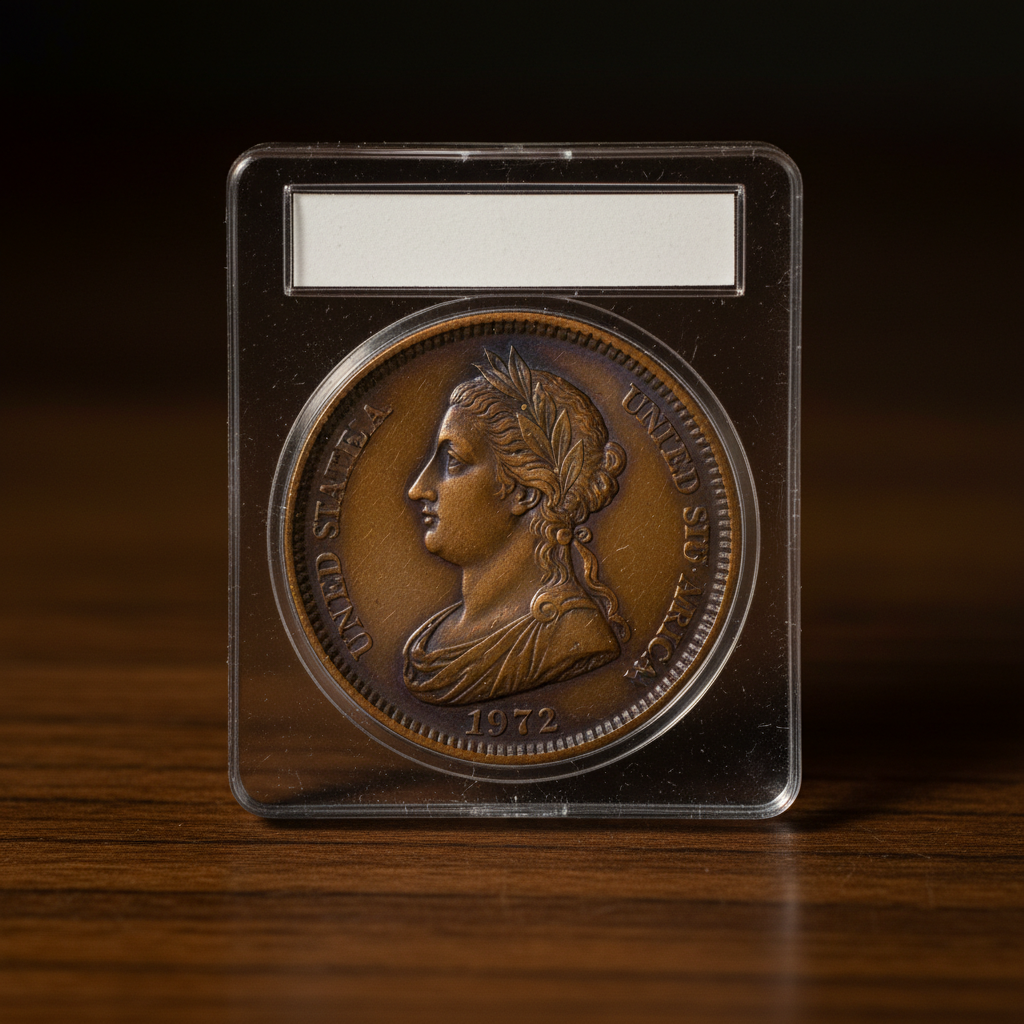
It came out of a bag of cents. Not a heritage auction lot, not a major collection dispersal — a routine bag of circulating coins. And inside was a test piece that rewrites a small but fascinating chapter of U.S. Mint history.
The coin in question is a Martha Washington cent, struck circa 1999–2000, believed to be directly tied to the experimental trial strikes the Mint conducted while developing the Sacagawea dollar. It is, by all current accounts, unique.
Why the Mint Was Experimenting in the First Place
The backstory begins with a mandate. When Congress authorized the new golden dollar in 1997, the Mint faced a practical engineering problem: the coin had to be distinguishable by touch from a quarter for visually impaired users, yet identical in size and weight to a dollar coin. Getting the electromagnetic signature right — critical for vending machine compatibility — required extensive metallurgical testing.
To run those tests without tipping off the public or disrupting production schedules, the Mint used existing dies and planchets in unconventional combinations. Martha Washington had already served as a test portrait on experimental coinage in the 1960s and 1970s, making her a natural stand-in when anonymity mattered. Her image carried no legal tender implication and was already part of the Mint's internal experimental vocabulary.
What makes this particular piece extraordinary is the substrate: a cent-sized planchet. Most known Sacagawea trial pieces were struck on dollar-sized blanks or on planchets borrowed from other denominations in the dollar-coin range. A cent-format test piece suggests the Mint was examining how the alloy and surface finish behaved at smaller scale — or testing die characteristics before committing to full production runs.
The Accidental Discovery and What It Tells Us
The find echoes one of the most celebrated accidental discoveries in modern U.S. coinage: the 2000-P Sacagawea dollar / Washington quarter mule, which also surfaced unexpectedly and confirmed that experimental mixing of dies and planchets was happening inside the Mint during exactly this period. That mule — with only 19 confirmed examples — has traded as high as $75,000 at major auction. The Martha Washington cent test piece, being singular, operates in a different pricing universe entirely: the one-of-a-kind market, where comparables are nearly impossible to establish and value is largely a negotiation between rarity and demand.
For context, the handful of known Martha Washington experimental pieces from the 1960s — the so-called 1965 SMS test pieces — have individually realized anywhere from $10,000 to over $40,000 depending on denomination, surface quality, and provenance. A unique specimen with a documented connection to the Sacagawea program would almost certainly command a premium above that range, assuming it reaches a major auction platform like Heritage Auctions or Stack's Bowers.
Grading will be the first critical step. A submission to PCGS or NGC with a full attribution and designation as an experimental or pattern piece would anchor its legitimacy and set the stage for any future sale. Both services have graded Martha Washington test pieces before, though population reports for this specific type are effectively nonexistent — because there's nothing to populate.
Pattern Coins and the Collector Market
Pattern and experimental coinage occupies a peculiar corner of numismatics. The collector base is smaller than for regular-issue coins, but the buyers who do pursue this material are deeply serious — and deep-pocketed. The Judd reference (United States Pattern Coins by Dr. J. Hewitt Judd) catalogs thousands of experimental and trial pieces, but items tied to modern programs like the Sacagawea dollar are still being documented and don't always have established Judd numbers at the time of discovery.
That absence of a catalog number isn't a liability. If anything, it adds to the intrigue. New attributions generate collector attention, specialist scrutiny, and media coverage — all of which build auction momentum.
The broader Sacagawea dollar collecting market has remained quietly strong. Key dates, error coins, and varieties within the series attract consistent bidding, and the program's early years — 2000 and 2001 in particular — remain the most heavily scrutinized for production anomalies. A test piece from that precise developmental window lands squarely in the highest-interest zone of the series.
Coins don't often rewrite history. This one might not rewrite it either — but it fills in a sentence that was previously blank, and in numismatics, that's usually worth quite a lot.