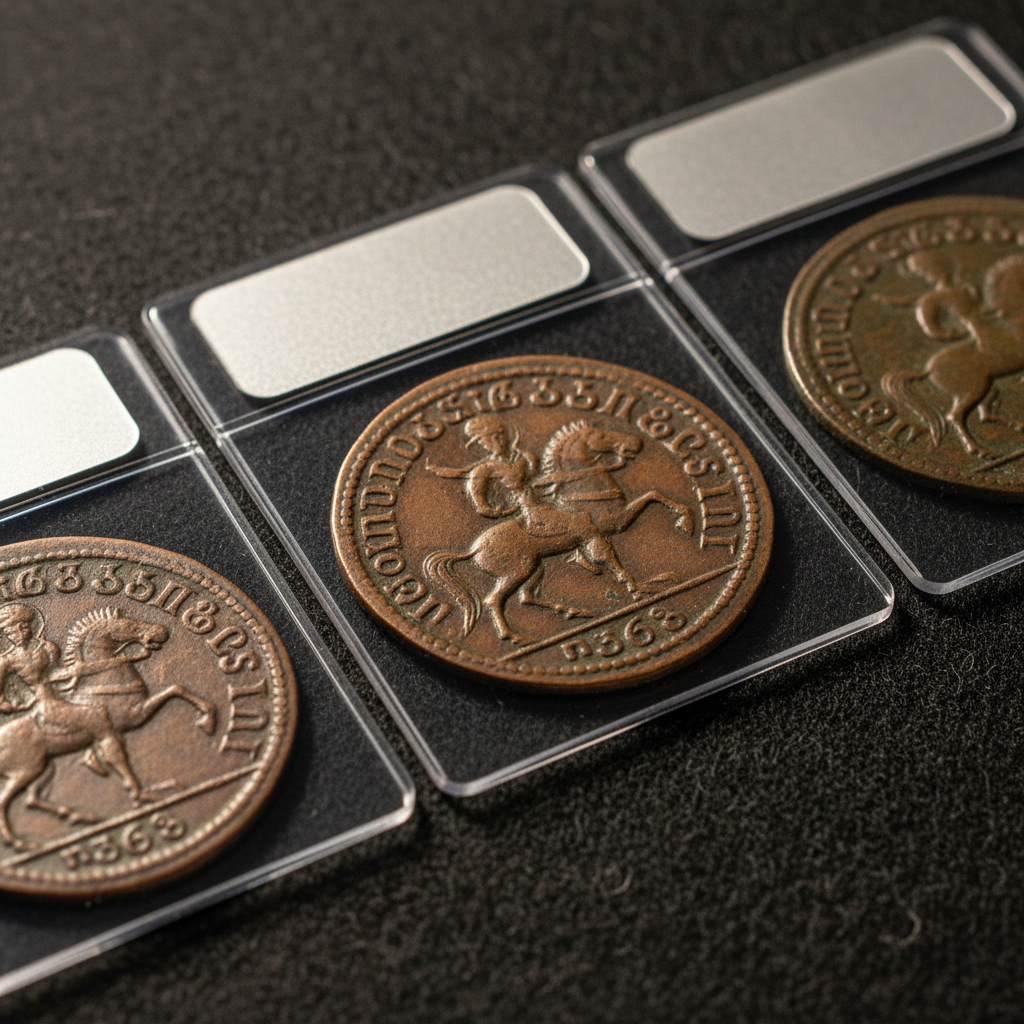
Few numismatic categories reward the curious collector quite like medieval Georgian coinage — a corpus of copper, silver, and occasional gold that served as the monetary expression of a kingdom perpetually caught between civilizational giants. Byzantine Christianity to the west. Abbasid and later Seljuk Islam to the south. Persian administrative tradition threading through everything. And eventually, the Mongol yoke pressing down from the north. Every coin Georgia struck between roughly the 9th and 15th centuries absorbed something from each of those forces.
That's not metaphor. It's legible on the coins themselves.
A Monetary System Built at the Intersection of Worlds
Georgian rulers — the Bagrationi dynasty chief among them — issued coins that are visually unlike anything else in medieval numismatics. A typical tetri or copper puli from the reign of Queen Tamar (r. 1184–1213), arguably the kingdom's greatest monarch, might carry Georgian script on one face and Arabic calligraphy on the other. This wasn't capitulation to Islamic convention — it was commercial pragmatism. Trade with Muslim merchants demanded legibility in Arabic. Faith demanded the cross and Georgian ecclesiastical script. Both got their side of the coin.
The golden age of Georgian coinage corresponds almost exactly to the political golden age of the kingdom. Under Tamar and her immediate predecessors and successors, Georgia controlled territory stretching from the Black Sea coast to parts of modern Azerbaijan and northern Iran. The coinage expanded accordingly, with silver tetri circulating across a wide regional trade network alongside the base-metal issues that handled everyday commerce.
Byzantine influence shows up structurally — the concept of a centralized royal mint, the use of religious imagery as legitimizing iconography — while the weight standards and some design vocabulary borrowed from Islamic dirhams. The result is a hybrid tradition that modern scholars find fascinating precisely because it doesn't resolve cleanly into either parent tradition. It's distinctly Georgian.
The Mongol Disruption and What Followed
The Mongol invasions of the 1220s shattered the political architecture that had sustained Georgian monetary production at its height. Genghis Khan's campaigns, and later those of his successors under the Ilkhanate, reduced Georgia to a vassal state. The coinage from this period reflects the humiliation in cold metal: Georgian royal titles survive on some issues, but Mongol overlords increasingly dictated weight standards, and the quality of silver issues deteriorated measurably.
Collectors who specialize in this transitional period — roughly 1220 to 1320 — are working some of the most historically charged material in medieval numismatics. These coins document, coin by coin, the negotiation between a subjugated Christian kingdom and its Mongol administrators. Some issues show deliberate archaism, Georgian rulers invoking earlier royal imagery as a form of cultural resistance. Others show straightforward accommodation. The politics are right there in the iconography, if you know how to read it.
After Mongol power fragmented in the 14th century, Georgian rulers reasserted independence — and their coinage briefly recovered some of its earlier ambition before Ottoman and Safavid pressure in the 15th and 16th centuries finally ended the independent Georgian monetary tradition.
The Market for Medieval Georgian Coins Today
This is a category that remains dramatically underpriced relative to its historical depth. A solid mid-grade copper issue from the reign of George III (r. 1156–1184) — Tamar's father — can be acquired at auction for under $100. Even well-attributed silver tetri from the kingdom's peak period routinely sell in the $200–$600 range at dealers specializing in world ancients. Heritage Auctions and Stack's Bowers both handle Georgian material occasionally, though it appears more frequently through specialist dealers in European medieval coins.
NGC and PCGS both certify medieval world coins, and slabbed Georgian examples do appear on the market, though the population in certified holders remains thin — which cuts both ways. Attribution can be genuinely difficult given the bilingual legends and the number of short-reigning monarchs in the later medieval period, so a correctly attributed, certified example carries a meaningful premium over raw material.
For collectors building a thematic world collection around the Silk Road, Byzantine succession states, or medieval Islamic coinage, Georgian issues are the connective tissue that ties those narratives together. They are, in a very literal sense, the coins of a kingdom that had no choice but to speak multiple monetary languages simultaneously — and did so with more sophistication than the history books typically credit.
The category is quiet. That won't last forever.