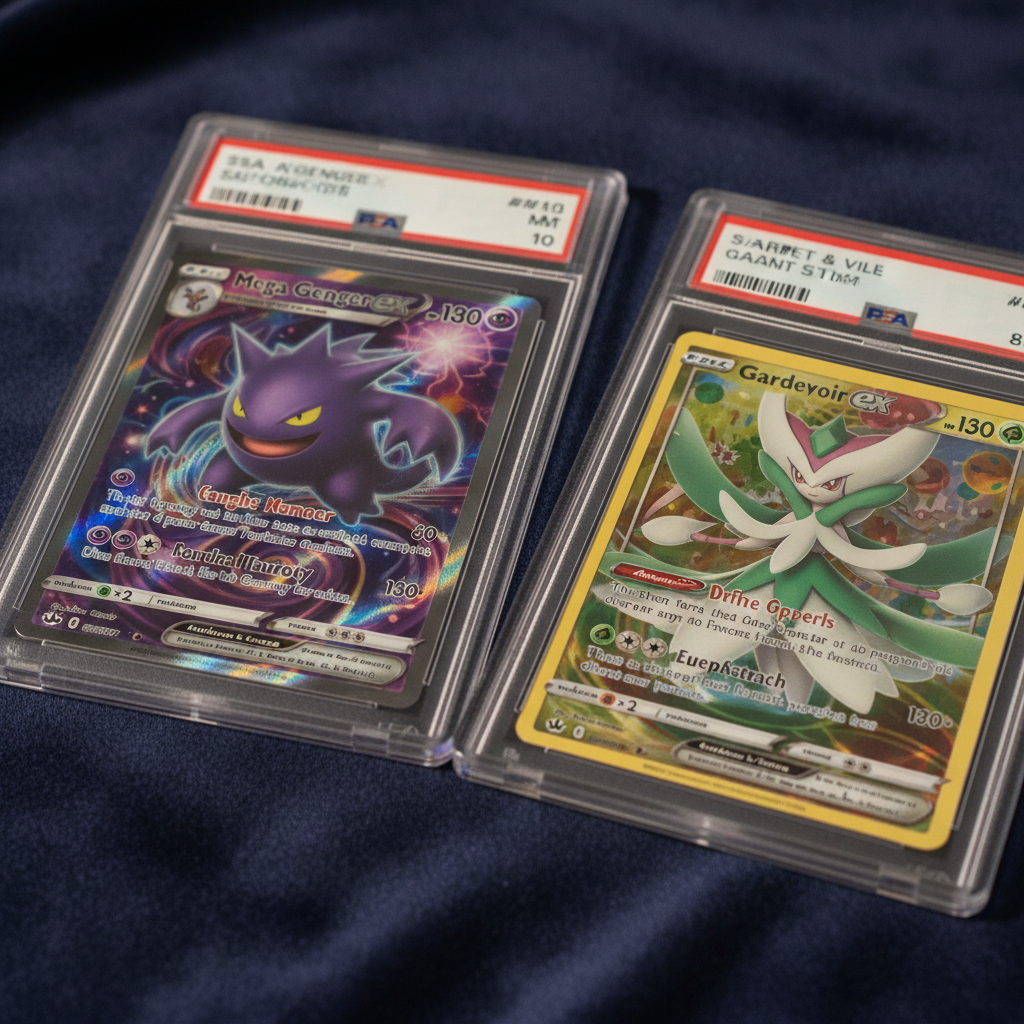
The Pokémon TCG secondary market is splitting in two — and the fault line running through this week's action tells you everything about where collector and player money is moving in 2026.
On one side: Mega Evolution cards riding a competitive wave. On the other: legacy icons getting a 30th-anniversary lift. And caught in the middle, Gardevoir ex — a former darling quietly getting left behind as the meta moves on.
The Mega Evolution Trade Is Real
Mega Gengar ex (Ascended Heroes #284) has emerged as the card to own right now. After weeks of steady upward pressure, it has officially crossed into heavyweight territory on the secondary market, driven almost entirely by its role in the new Mega Evolution meta. This isn't speculative buying — it's demand anchored in tournament relevance, which historically produces the most durable price floors.
Mega Zygarde ex is running alongside it, and the pairing matters. When two cards from the same mechanical archetype surge simultaneously, it signals that the market is pricing in the archetype's staying power, not just a single card's breakout. Dealers who moved inventory on Zygarde ex three weeks ago are watching that call age well.
For graded copies, the calculus gets interesting. PSA 10 populations on both cards remain relatively thin — Ascended Heroes is a recent enough set that graded supply hasn't flooded the market. That scarcity premium on high-grade examples could compress quickly if submission volumes spike over the next 60 days, so collectors sitting on raw copies should be thinking about timing.
Nostalgia Is Doing Heavy Lifting for the Originals
The 30th-anniversary effect is no longer a prediction. It's a price chart.
Pikachu and Blastoise — in their various vintage and anniversary-adjacent forms — are both seeing renewed buying interest that has nothing to do with competitive play and everything to do with the calendar. 2026 marks three decades since the Pokémon Trading Card Game launched in Japan, and the collector community is treating that milestone the way the sports card world treated the 1952 Topps anniversary cycle: with open wallets.
Vintage Base Set Blastoise holos in PSA 9 have been trading with more frequency at Heritage and Goldin over the past month, with strong comps reinforcing the floor. A PSA 9 Base Set Unlimited Blastoise has historically traded in the $300–$500 range depending on centering and eye appeal — but anniversary momentum has a way of compressing that range upward, at least temporarily. The 1st Edition market for Blastoise remains its own conversation entirely, where PSA 10 copies have cleared $20,000+ at auction in recent cycles.
Pikachu's story is more fragmented. There are dozens of Pikachu cards across sets and eras, and anniversary buying tends to scatter across all of them rather than concentrate in one SKU. The Illustrator Pikachu remains the headline trophy card for that character — a PSA 10 copy sold for $5.275 million at Goldin in 2022, a comp that still anchors the entire Pikachu narrative in collector consciousness. The anniversary cycle won't replicate that number, but it keeps the character top-of-mind for new buyers entering the hobby.
Gardevoir ex and the Shelf Life Problem
Gardevoir ex is cooling, and the reason is straightforward: its competitive lifespan is closing out. This is the most predictable price dynamic in the entire TCG secondary market — when a card rotates out of relevance, player-driven demand evaporates almost immediately, leaving only collector demand to support the price. For most cards, that's not enough.
Gardevoir ex had a strong run. It was a format-defining card during its peak, which means graded PSA 10 copies were trading at premiums that reflected both play value and collector interest. That dual-demand premium is now unwinding on the play side, and the question is how much collector sentiment can absorb.
The honest answer: not much, at least in the short term. Gardevoir ex doesn't carry the legacy weight of a Base Set icon or the anniversary tailwind of a Pikachu. It's a modern competitive card losing its primary use case. Sellers who've been holding should be watching the bid side carefully — once the player floor drops out, the next support level is purely speculative.
The broader lesson here is one the market keeps teaching and collectors keep relearning: cards with dual demand — competitive play and collector appeal — command the most durable premiums. When one leg of that stool disappears, price discovery gets uncomfortable fast.
This week's market is essentially a clean case study in that dynamic, running three different storylines in parallel. Mega Gengar ex has both legs. Blastoise and Pikachu have one very strong one. Gardevoir ex is down to zero.