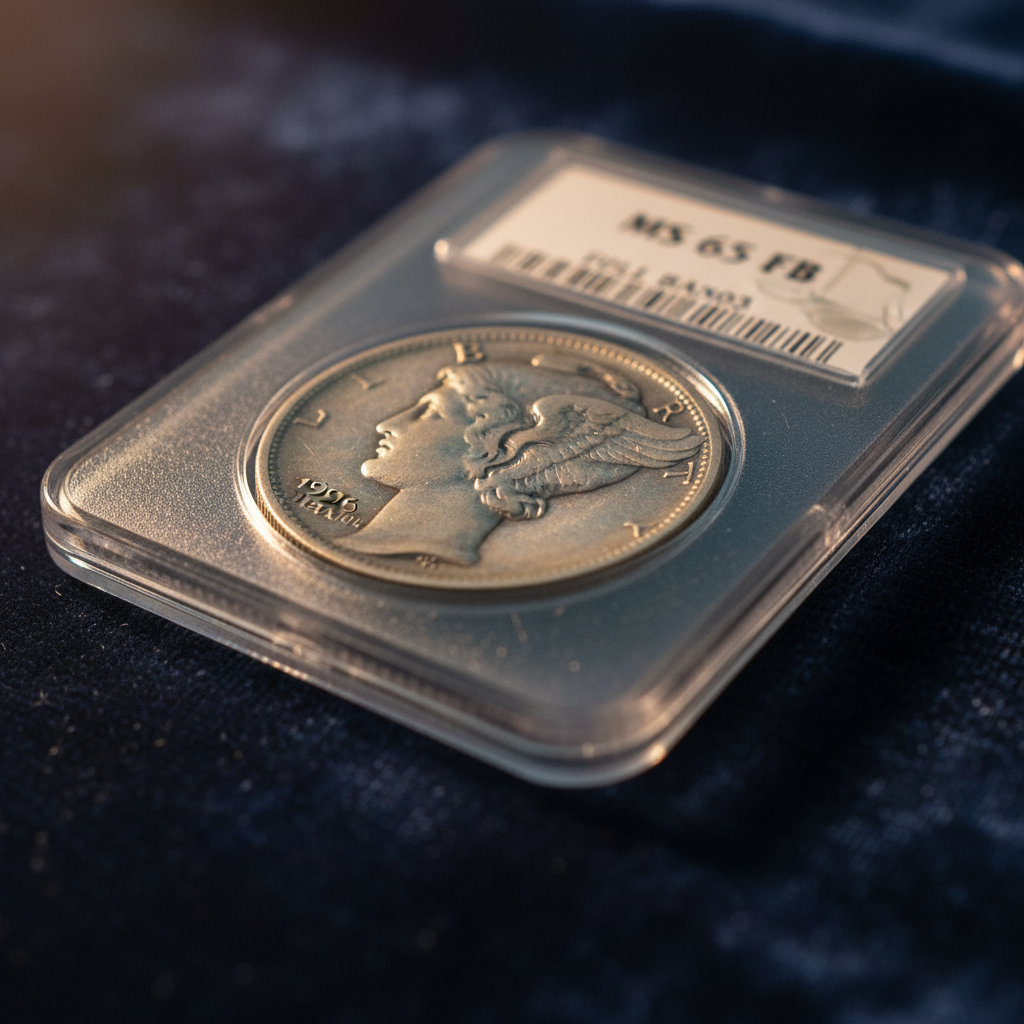
Few American coins have earned their reputation as thoroughly as the Mercury dime. Struck for nearly three decades across two world wars and the Great Depression, the Winged Liberty Head dime — misidentified as Mercury almost from day one — remains one of the most collected, most graded, and most hotly contested series in all of U.S. numismatics. The market for high-grade examples has only deepened that legacy.
The story begins with bureaucratic timing. The Mint Act of 1890 mandated that U.S. coin designs could be changed every 25 years, and by 1916, that clock had run out on Chief Engraver Charles E. Barber's utilitarian dime, quarter, and half dollar. Mint Director Robert W. Woolley didn't just commission a replacement — he invited three of the era's most accomplished sculptors to compete for the work. The result was a design renaissance that produced some of the most artistically ambitious coinage the U.S. Mint has ever issued.
Sculptor Adolph A. Weinman won the dime commission. His obverse features Liberty wearing a winged Phrygian cap — the wings symbolizing freedom of thought, not the Roman god Mercury. The public made the Mercury connection almost immediately, and the name stuck. The reverse, a fasces bound with an olive branch, carries its own symbolism: military preparedness paired with the pursuit of peace. In 1916, that imagery was pointed. By 1917, with the U.S. entering World War I, it was prescient.
The Keys, the Conditionals, and Where the Real Money Lives
The Mercury dime series runs from 1916 through 1945, covering Philadelphia, Denver, and San Francisco mint issues. The undisputed key date is the 1916-D, with a mintage of just 264,000 — the lowest of any regular-issue Mercury dime by a wide margin. A circulated example in Fine-12 can fetch $800–$1,200 at auction; a PCGS or NGC MS-65 Full Bands example has cleared $30,000 in recent Heritage and Stack's Bowers sales. Counterfeits and altered-date coins (typically 1916-P pieces with an added D mintmark) are rampant in this series. Buy nothing without a major third-party holder.
The Full Bands designation — awarded when the horizontal bands on the reverse fasces are fully separated and sharply struck — is the grading distinction that separates casual Mercury dime collecting from serious investing. A coin graded MS-65 without Full Bands might bring $80. The same date and grade with Full Bands can command $800 or more. That's a 10x premium on a single designation, and it reflects how strike-sensitive this series is across its entire run.
Other conditional rarities worth tracking:
- 1921 and 1921-D — low-mintage post-WWI issues, scarce in all grades above VF
- 1926-S — notoriously weakly struck; Full Bands examples are legitimately rare
- 1942/41 and 1942/41-D overdate errors — among the most recognizable overdates in 20th-century U.S. coinage, with strong demand at every grade level
- 1931-D — Depression-era low mintage of 1.26 million; underappreciated relative to its scarcity
The 1942/41 overdate deserves particular attention. These are not obscure varieties requiring a loupe and a reference book — the overdate is visible to the naked eye on a decent example, and collector awareness is high. A PCGS MS-65 Full Bands 1942/41 has sold for north of $14,000. Even circulated examples in VF-20 routinely bring $400–$600 at major auction houses.
Market Dynamics in a Mature Series
Mercury dimes occupy an interesting position in the current market. They're neither undervalued sleepers nor overheated speculative plays. What they are is stable — the kind of series where a well-assembled set in MS-65 Full Bands represents genuine numismatic achievement and holds value across market cycles.
PCGS population data tells part of the story. For many mid-series dates, MS-65 FB examples number in the dozens, not hundreds. The 1945 Micro S variety — a late-series mintmark curiosity — has seen renewed bidding activity at Heritage sales over the past 18 months, with MS-65 FB examples pushing past $1,800 regularly.
The broader rare coin market has cooled somewhat from its 2021–2022 highs, and Mercury dimes have not been immune. But the correction has been modest in this series compared to the volatility seen in Morgan dollars or early American copper. Collectors who bought quality — meaning certified, Full Bands, from reputable auction sources — have largely held their ground.
Weinman's design ran until 1945, when the Roosevelt dime replaced it following Franklin D. Roosevelt's death. The timing gave the Mercury dime a clean bookend: born at the edge of one world war, retired at the close of another. That historical arc, combined with genuine artistic merit and a grading structure that rewards deep study, is exactly why this series continues to attract serious numismatists more than 75 years after the last one rolled off the press.