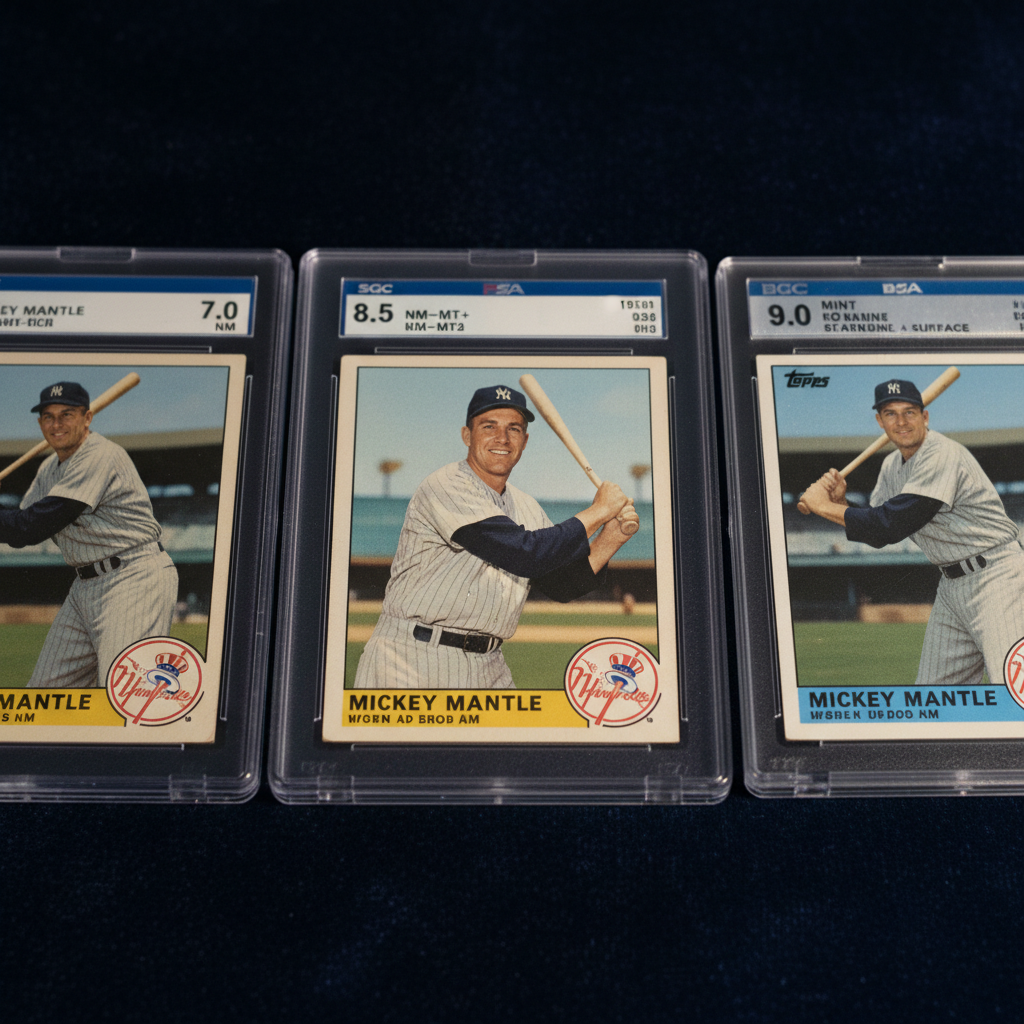
Sixty-eight years after it was printed, the 1956 Topps Mickey Mantle (#135) remains one of the most actively traded vintage baseball cards on the market — not because it's the rarest Mantle, but because it sits at the precise intersection of affordability and iconic status that serious collectors find irresistible. This is the card from Mantle's Triple Crown season. The numbers back up the reverence.
The Card Itself: What You're Actually Looking At
The 1956 Topps set introduced a portrait-plus-action format that gave the flagship issue a more dynamic feel than its predecessors. Mantle's card features a close-cropped portrait alongside a batting-stance action shot — both images set against a two-tone color block that defined the era's aesthetic. The card measures the standard 2-5/8" x 3-3/4" and carries Mantle's stats through his 1955 campaign, the year before he would hit .353 with 52 home runs and 130 RBI to claim the Triple Crown.
The detail most collectors overlook until they're deep in the hobby: the gray back versus white back variation. Topps printed the 1956 set with two distinct cardstock types — gray backs are the more common variant, while white backs are significantly scarcer and command a meaningful premium at every grade level. The difference is visible to the naked eye when you flip the card over, and it matters substantially at auction.
On a white back example, expect to pay roughly 20 to 40 percent more than the gray back equivalent at the same PSA grade. That spread widens at the top of the population. A PSA 8 gray back has traded in the $8,000–$12,000 range in recent Heritage and Goldin auctions, while white back 8s have pushed past $15,000 in competitive sales. The PSA population for white backs at NM-MT 8 and above is thin enough that even a single strong auction result can reset the market.
Grading Realities and the Population Problem
PSA has graded well over 4,000 copies of the 1956 Topps Mantle across both back variants combined — making it far more accessible than the 1952 Topps #311 or the 1953 Topps #82, but the grade distribution tells the real story. The vast majority of raw copies circulating at shows and on eBay present with centering issues, print defects, or handling wear that caps them at PSA 4 or 5. Genuine PSA 7s are the sweet spot for value-conscious buyers. PSA 9s are legitimately rare — fewer than a dozen gray back examples have earned that grade — and a PSA 10 is essentially theoretical.
BGS graders have slabbed the card as well, and a BGS 8.5 with strong subgrades is competitive with a PSA 8 on the open market, though PSA remains the dominant certification for this era among serious bidders at the major houses. When Heritage or Goldin feature a high-grade example, the PSA holder consistently draws more aggressive bidding.
One practical note for buyers evaluating raw copies: the 1956 Topps print run was prone to a specific centering problem that pushes the image left, cutting into the left border. Cards with even moderate left-right centering are genuinely harder to find than the population numbers suggest, because many technically ungraded copies in private collections haven't been submitted. There's still raw inventory out there — but the easy finds at PSA 6 and above have largely been absorbed.
Where This Card Lives in the Mantle Hierarchy
The Mantle rookie card — technically the 1951 Bowman #253, though the 1952 Topps carries more cultural weight — operates in a different financial universe. A PSA 8 example of the '52 Topps Mantle fetches north of $300,000. The 1956 Topps, by contrast, is a card that a disciplined collector with a five-figure budget can actually acquire in high grade. That accessibility is not a weakness — it's the card's defining market characteristic.
Among Mantle's Topps issues, the hierarchy runs roughly: 1952 at the apex, followed by 1953, 1954, and 1955 in descending order of scarcity and price. The 1956 sits sixth chronologically but arguably second in cultural recognition, largely because the Triple Crown season gives it a narrative anchor that the earlier cards — issued before Mantle had fully cemented his legacy — can't match in the same way.
The 1957 Topps Mantle (#95) is often compared to the '56 as a near-peer, but the '56 holds a slight premium in most grades, partly due to the dual-image format and partly because collectors simply respond to the year. 1956 means something. The numbers prove it every time a high-grade example hits the block.
For anyone building a vintage Mantle run, the 1956 Topps is not optional. It's the card that anchors the middle of the collection — accessible enough to own in respectable grade, significant enough to hold value through market cycles, and historically grounded in the single greatest season of his career.