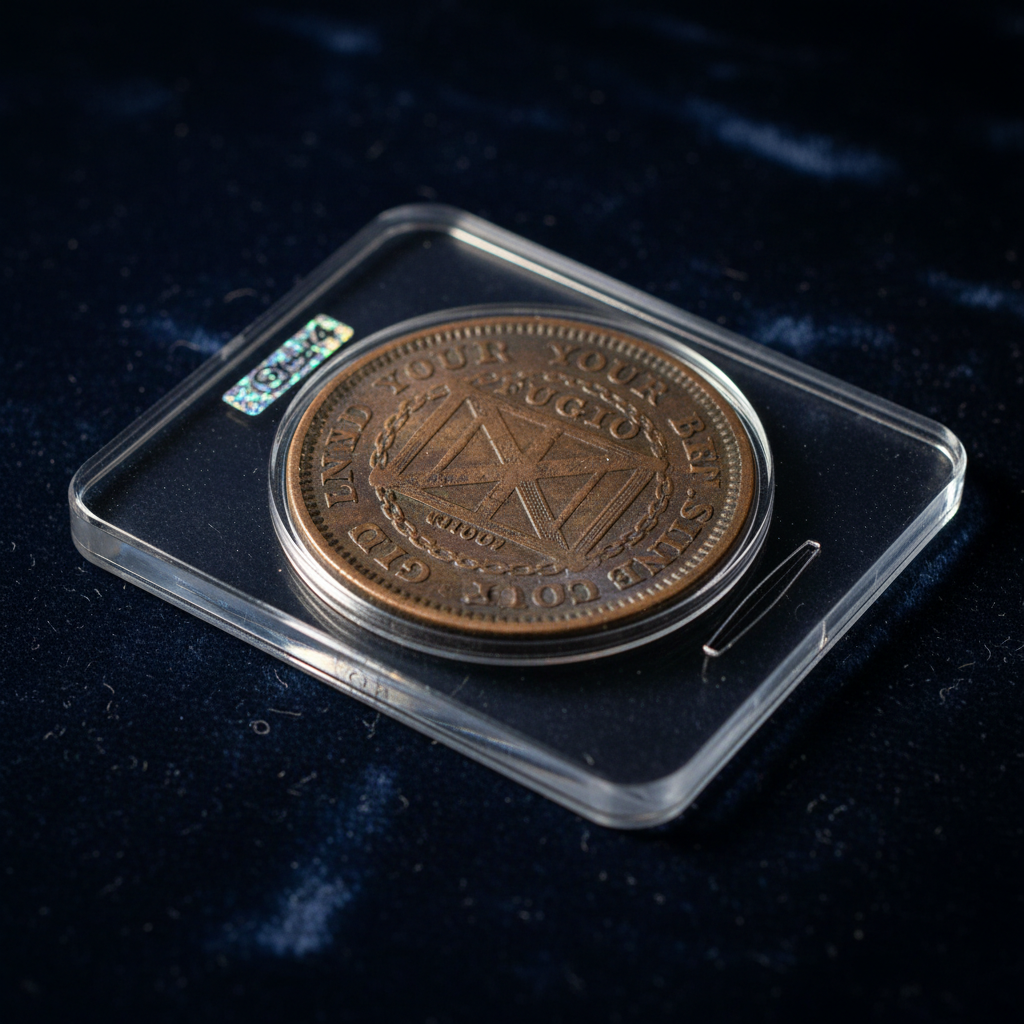
America's first federally authorized coin just got more complicated — and considerably more valuable. A 1787 Fugio cent has emerged in what appears to be Mint State condition carrying a dramatic double-strike error, a combination so rare it may represent the earliest known error coin in United States numismatic history.
Let that sink in. Not just a high-grade Fugio. Not just an error Fugio. Both. On the same coin.
Understanding What You're Looking At
The Fugio cent — designed with Benjamin Franklin's fingerprints all over it, bearing the sundial motif and the legend Mind Your Business — was struck in 1787 under a congressional resolution, making it the first coin officially sanctioned by the United States government. Roughly 400 tons of copper went into the production run, yet surviving examples in any meaningful grade are genuinely scarce. The coin's composition and the era's primitive striking conditions meant that most Fugios that survived two-and-a-half centuries did so in circulated, often heavily worn states.
A Mint State example alone commands serious money. PCGS and NGC combined have certified only a handful of Fugio cents at MS-60 or above across all die varieties, and when they do appear at auction, they routinely clear five figures. A PCGS MS-64 example sold through Stack's Bowers for over $70,000 in recent years. The population at that grade level sits in the single digits.
Now layer a double-strike error onto that equation. A double-strike occurs when a planchet receives a second blow from the dies after the first impression — sometimes rotated, sometimes off-center, sometimes nearly aligned — leaving overlapping or ghost imagery across the coin's surface. On a modern coin, a double-strike is a curiosity. On an 18th-century copper cent struck under contract by James Jarvis and his New Haven associates using inconsistent equipment and oversight, it is a window into the chaotic birth of American coinage infrastructure.
The Error Coin Market at This Level
Error coins have never been hotter. The broader error market has seen sustained appreciation over the past decade, driven partly by registry collectors and partly by a new generation of buyers who prize uniqueness over population-driven rarity. Major auction houses including Heritage Auctions and Goldin have reported strong results on error material across all eras, but pre-federal and early American errors occupy a category almost entirely to themselves — there simply aren't enough of them to establish a reliable price curve.
That scarcity cuts both ways. It makes valuation genuinely difficult, but it also means that when a specimen like this Fugio surfaces, the ceiling is largely theoretical. Comparable early American error coins — think off-center 1793 Chain cents or double-struck 1794 Liberty Caps — have sold for multiples of their non-error counterparts when certified and properly attributed. The error premium on pre-19th-century copper can run 200% to 500% above a straight example in the same grade, depending on the drama of the error and the depth of the bidder pool on auction day.
The Fugio's historical position amplifies everything. This isn't a mid-series variety or a transitional type coin. It's the starting point. The origin. If the double-strike attribution holds up under full numismatic scrutiny — and the images suggest it will — the argument for calling this the first error coin in U.S. history is not a stretch. It's a reasonable editorial conclusion drawn from the historical record.
What Happens Next
Certification will be the decisive step. A coin making this kind of claim needs a PCGS or NGC holder with explicit error attribution on the label, not just a grade. Both services have the expertise to document double-strike mechanics, and the population of certified Fugio cents with error designations at major services is, as far as the available registry data shows, effectively zero. A first-of-its-kind designation would not be unprecedented — both services have issued similar notations on landmark discoveries — but it would require thorough examination and likely expert consultation from early American specialists.
Once certified, the auction routing almost writes itself. A coin at this intersection of American history, error numismatics, and Mint State rarity belongs in a marquee sale — a Stack's Bowers American Numismatic Association auction or a Heritage Platinum Night session where the collector base is deep and the bidding is serious.
The Fugio cent was minted with the motto Time Flies pressed into its copper face. For this particular coin, time has apparently been very, very kind.