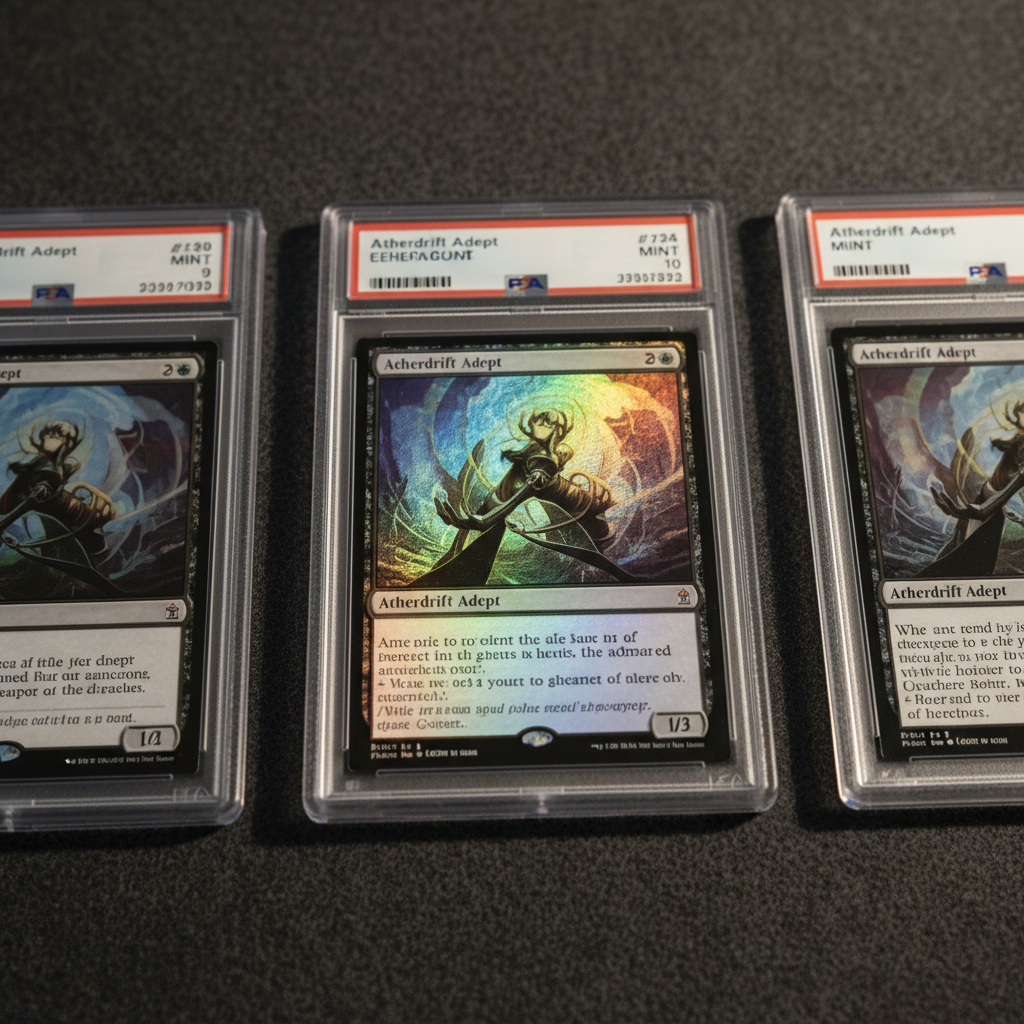
Tax season is doing what tax season always does to the Magic: The Gathering secondary market — it's injecting liquidity at exactly the moment format dynamics are already in flux. The week of March 23, 2026 is delivering a sharp split between Aetherdrift's aggressive new Standard toolkit and a quiet but accelerating run on Premodern staples, and the divergence tells a bigger story about where MTG collector money is actually flowing right now.
Aetherdrift's Breakout Card — and Why It's an Uncommon
The headline mover this week is Stock Up, an uncommon sorcery out of Aetherdrift that has quietly become the format's most-discussed blue spell. In a set built around high-velocity speed strategies, Stock Up is doing something that blue card selection hasn't done in Standard in several years: it's functioning as a genuine engine rather than a tempo tool. That distinction matters enormously for both competitive demand and long-term collector interest.
Uncommons don't usually drive secondary market conversation. The economics of pack distribution keep their raw supply high, which typically suppresses ceiling prices. But when an uncommon becomes a four-of in multiple Tier 1 archetypes simultaneously, the math shifts fast — especially if graded copies start entering the ecosystem before the market has priced in the demand. That appears to be exactly what's happening with Stock Up right now.
Aetherdrift as a whole has been the defining release of early 2026, fundamentally reorienting how blue decks operate in the current Standard environment. Stock Up is the clearest expression of that design philosophy in a single card, and its uncommon status means it has broader accessibility — which historically correlates with higher PSA and BGS submission volumes as the competitive spike sustains itself over weeks rather than days.
The Premodern Surge Isn't a Coincidence
Running parallel to the Aetherdrift momentum is something that experienced MTG investors will recognize immediately: a tax-return-driven rotation into older, fixed-supply cards. Premodern staples — the format covers sets from Fourth Edition through Scourge (1995–2003) — are seeing elevated search and transaction volume this week, and the timing is not accidental.
Fixed-supply assets in Magic behave differently from Standard-legal cards. There are no reprints coming. The population of PSA 9s and 10s for key Premodern pieces is finite and well-documented. When discretionary income enters the hobby in a concentrated window, as it reliably does each March and April, collectors with a longer time horizon tend to move toward cards that can't be diluted by future print runs.
This is the same dynamic that has historically driven spikes in heavily played Alpha and Beta staples, Reserved List cards, and old-border foils. Premodern occupies a slightly more accessible price tier than power-9 territory, which makes it a logical destination for collectors working with $500–$2,500 budgets — a demographic that grows meaningfully during tax refund season.
The format also has genuine competitive infrastructure behind it now. Premodern tournaments run regularly across Europe and North America, providing ongoing demand pressure that keeps the market from being purely speculative. Cards with both playability and scarcity don't need a catalyst to appreciate — they just need time and sustained interest, both of which appear to be present.
What's Cooling Down
The flip side of any hot list is instructive. The cards losing momentum this week are largely those that benefited from early Aetherdrift hype but haven't found a stable home in the evolving metagame. Pre-release speculation tends to price in best-case scenarios; when those scenarios don't materialize across the first few weeks of competitive play, the correction is swift. Any Standard-legal card that was moving on potential rather than proven performance is a sell candidate in this environment.
Collectors holding raw copies of speculative Aetherdrift rares should be paying close attention to metagame results from major events over the next two weekends. If Stock Up and the speed strategies around it continue to dominate, the cards that don't fit those archetypes will face sustained downward pressure as attention and capital concentrate further.
Two formats, two timelines, two entirely different investment theses — and both are active simultaneously. The MTG market in late March 2026 is rewarding collectors who know which clock they're playing on.