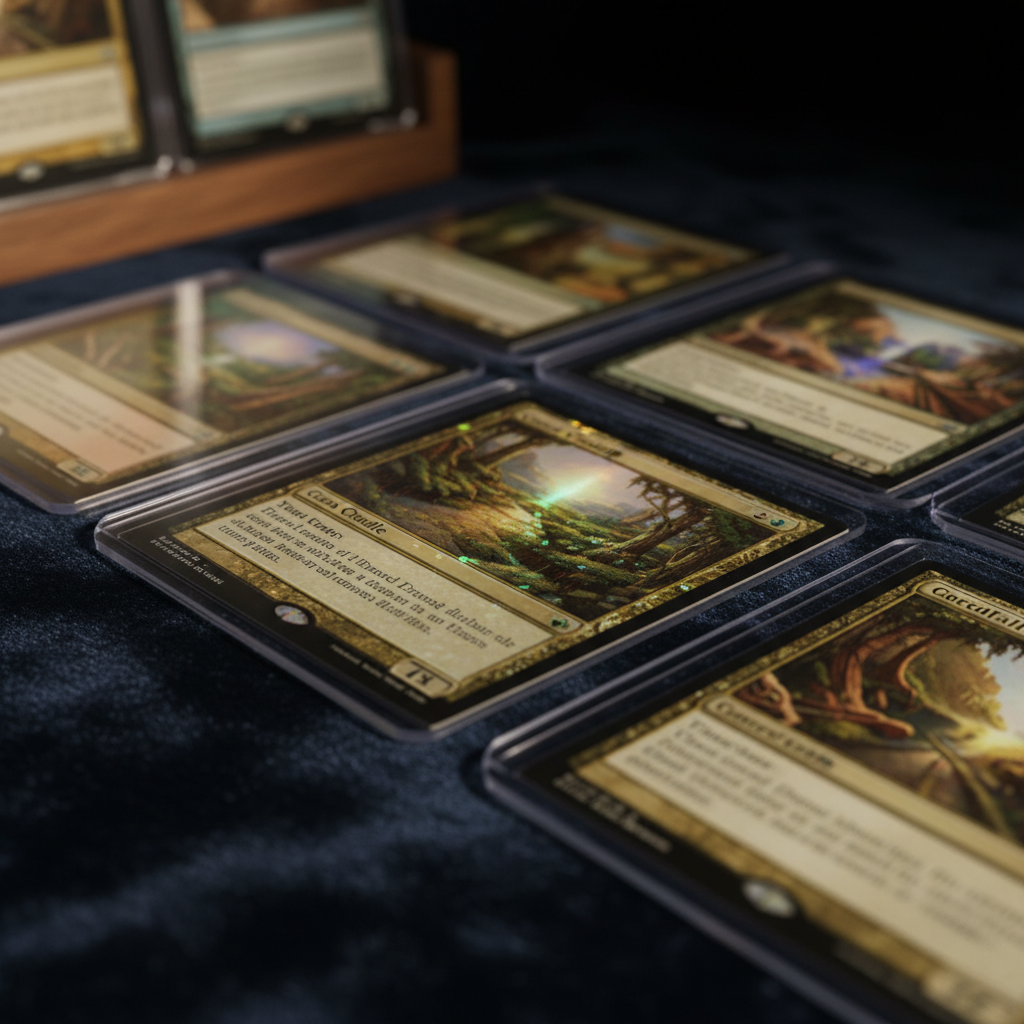
Fifteen years after its debut in Zendikar (2009), Magic: The Gathering's Landfall mechanic remains one of the most influential design decisions Wizards of the Coast has ever made — and its fingerprints are all over the secondary market.
Landfall is deceptively simple: whenever a land enters the battlefield under your control, something happens. A creature gets bigger. A token appears. You draw a card. That elegance is precisely why it endures. But from a collector and investor standpoint, Landfall is more than a gameplay mechanic — it's a recurring demand engine that keeps original Zendikar cards in rotation and drives prices on key staples every time a new Landfall-heavy set drops.
From Zendikar to Omnipresence
When Zendikar launched in October 2009, Landfall was the set's marquee mechanic. Cards like Steppe Lynx and Plated Geopede defined the aggressive Standard metagame of that era, but it was Lotus Cobra — a rare that turned each land drop into a mana floater — that became the breakout financial story. Lotus Cobra has traded anywhere from $8 to $45 over its lifetime depending on reprint cycles and format demand, and its original Zendikar printing in Near Mint condition routinely fetches a premium over later reprints.
Wizards returned to Zendikar twice — in 2013's Zendikar vs. Eldrazi Duel Deck and then in the full-block return of Battle for Zendikar (2015) and Oath of the Gatewatch (2016) — before bringing the plane back again in Zendikar Rising (2020). Each return reinvigorated Landfall demand. Zendikar Rising in particular introduced Moraug, Fury of Akoum and Felidar Retreat, both of which spiked hard in Commander demand through 2021 and 2022.
The mechanic has since appeared in sets ranging from Ixalan to The Lost Caverns of Ixalan (2023), cementing its status as a returning evergreen mechanic rather than a one-plane novelty.
The Cards That Move Markets
For collectors and investors, Landfall's value story is concentrated in a handful of high-demand staples — most of them Commander-legal and frequently played in competitive formats.
- Scute Swarm (Zendikar Rising, 2020) — A bulk rare on release, this insect token generator became a Commander staple and has held $4–$8 in raw form, with showcase and extended art versions commanding $15–$25.
- Lotus Cobra (original Zendikar, 2009) — The original printing in PSA 10 condition has sold for $60–$80 at auction, a meaningful premium over the $12–$18 range for later reprints in equivalent grade.
- Omnath, Locus of Creation (Zendikar Rising, 2020) — Banned in Standard and Historic shortly after release, this four-color Landfall payoff spiked to $40+ before settling around $15–$20 for the standard version. Collector Booster and borderless variants have held stronger, trading in the $30–$45 range.
- Aesi, Tyrant of Gyre Strait (Commander 2021) — A direct-to-Commander Landfall engine that draws cards on land drops. Steady demand has kept it in the $8–$14 range with minimal price erosion despite multiple printings.
The pattern is consistent: first printings of high-impact Landfall cards carry a premium that reprints erode only partially. Collectors who target original Zendikar and Zendikar Rising showcase variants are playing a defensible long game, particularly on cards with Commander staple status.
Why Landfall Keeps Printing Money
Commander is the engine here. With an estimated 60–70% of all Magic product purchased with Commander play in mind — per Wizards' own public statements at various MagicCons — any mechanic that thrives in 100-card singleton formats has structural, recurring demand. Landfall thrives in Commander because land-heavy decks are both accessible to new players and scalable to competitive power levels. That accessibility broadens the buyer pool considerably.
The mechanic also benefits from synergy stacking. Fetch lands — particularly the Zendikar fetch cycle (Arid Mesa, Misty Rainforest, Scalding Tarn, Verdant Catacombs, Marsh Flats) — trigger Landfall twice per activation. Those fetches have been among the most consistently valuable non-Reserved List cards in the game, with Misty Rainforest and Scalding Tarn in original Zendikar printings graded PSA 10 selling in the $150–$250 range. Their value is partly metagame-driven, but their interaction with Landfall is inseparable from their demand story.
Every time Wizards announces a return to Zendikar or a new Landfall-forward set, watch the original Zendikar fetch lands. They move first, and they move fast. That's not speculation — it's a pattern that has repeated across three set returns and shows no signs of breaking.