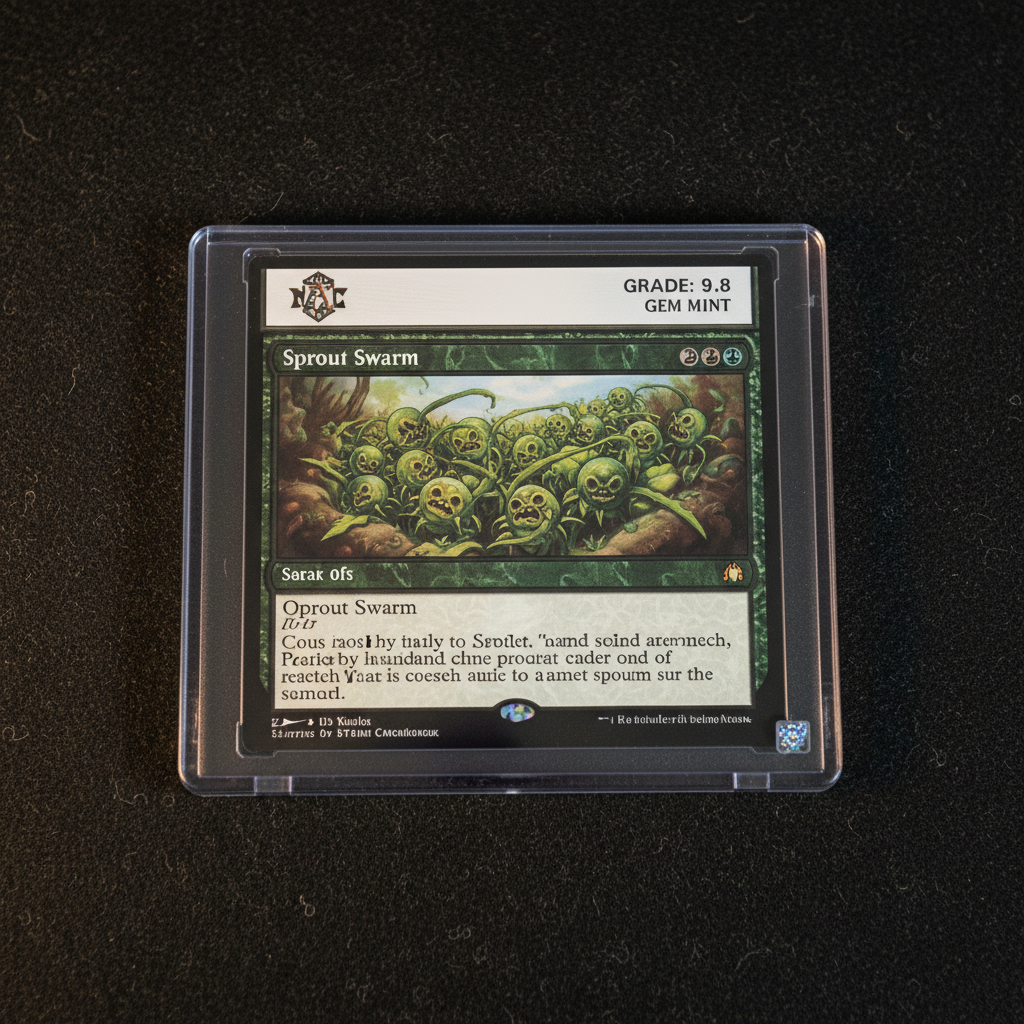
A leaked dragon card has done what few cards manage: it made a 2006 common from Future Sight financially relevant. Sprout Swarm is the breakout mover of the week ending March 30, 2026, its price spiking sharply after the MTG community identified a synergy with an as-yet-unreleased dragon whose details circulated via social media before any official announcement. That's the kind of catalyst that turns a $0.50 bulk rare into a card dealers are suddenly pulling from their commons boxes and repricing overnight.
The broader secondary market this week is a study in contrast. On one side, community-driven formats and leak-fueled speculation are pushing fringe cards into the spotlight. On the other, a wave of Secret Lair fulfillments hitting doorsteps has done exactly what it always does — softened demand for high-end staples as supply floods back into the market simultaneously.
The Hot Side: Leaks, Legacy, and a Social Media Surge
Sprout Swarm's spike is the most technically interesting move on this week's list. The card generates Saproling tokens at instant speed with a convoke mechanic that allows it to essentially chain into itself under the right board conditions. The leaked dragon — whose name has not been officially confirmed — apparently enables a loop or critical mass scenario that the competitive community immediately recognized. Whether the leak is accurate or the card ships in its current form, the market has already priced in the possibility. That's speculative buying at its most aggressive, and it cuts both ways: if the card releases differently or gets templated away from the interaction, Sprout Swarm retraces fast.
More durable is the movement on Dandân from Arabian Nights. This is a 1993 card from Magic's first expansion, a set that commands serious collector premiums in any grade. The original Arabian Nights print run was small by any modern standard, and high-grade copies — PSA 8 and above — have always carried meaningful premiums over mid-grade examples. Dandân is not a competitive powerhouse, but it's a piece of Magic history, and renewed interest in the card suggests either format-specific play activity in Vintage or Old School 93/94, or simply collector accumulation of an undervalued Arabian Nights entry. Either way, the underlying scarcity argument for Arabian Nights cards remains one of the strongest in the MTG collectibles space.
Declaration of Naught rounds out the hot list with a social-media-driven surge that has the hallmarks of a short-term spike rather than a structural repricing. The card, a blue enchantment that names a card and counters all spells of that name, has niche applications in specific Commander builds and fringe competitive contexts. When a content creator or prominent streamer highlights a card like this, volume spikes within 48 hours and then often plateaus or retreats. Buyers chasing this one should be watching sell-through rates closely before committing at peak pricing.
The Cold Side: Secret Lair Fulfillment Does Its Thing
Bloodletter of Aclazotz and Klauth, Unrivaled Ancient are both dropping, and the mechanism is straightforward. When Secret Lair shipments arrive in bulk, the secondary market absorbs a concentrated supply hit. Collectors who pre-ordered receive their copies and some percentage immediately lists on TCGPlayer, Card Kingdom, or eBay, compressing prices across the board. This is not a signal of weakening demand for either card in isolation — it's a predictable, cyclical event that experienced MTG investors account for when timing their exits.
Bloodletter of Aclazotz had been holding strong as a Commander staple, its life-loss doubling effect finding homes in black-heavy drain strategies. The dip is a buying opportunity for anyone who wanted the card for play purposes and was waiting out the post-release premium. Klauth, similarly, is a powerful mana-generating dragon whose price had been supported by genuine Commander demand. A temporary supply bump doesn't erase that underlying utility.
The pattern here is worth internalizing: Secret Lair drops create predictable price windows. The weeks immediately following fulfillment are historically the worst time to buy the featured cards at retail and the best time to acquire them on the secondary market if you're patient. The market corrects, demand reasserts, and prices stabilize — usually within four to six weeks of the fulfillment wave completing.
What the Week Tells Us About the Current MTG Market
The MTG secondary market in early 2026 is operating on two distinct timelines simultaneously. Competitive and Commander-driven demand is real and ongoing, but it's increasingly being shaped by information velocity — leaks, social posts, and content creator attention moving prices before product even officially exists. Meanwhile, the collectibles side of the market, exemplified by Arabian Nights cards like Dandân, continues to operate on fundamentals: scarcity, condition, and historical significance.
Sprout Swarm spiking on a leaked card that hasn't shipped is a reminder that the MTG market rewards fast information and punishes hesitation — but it also punishes buyers who act on unconfirmed data. Arabian Nights Dandân moving quietly in the background is a reminder that the oldest cards in the game don't need a content cycle to justify their value. They just need time.
The gap between those two dynamics is where most of the market's volatility lives right now.