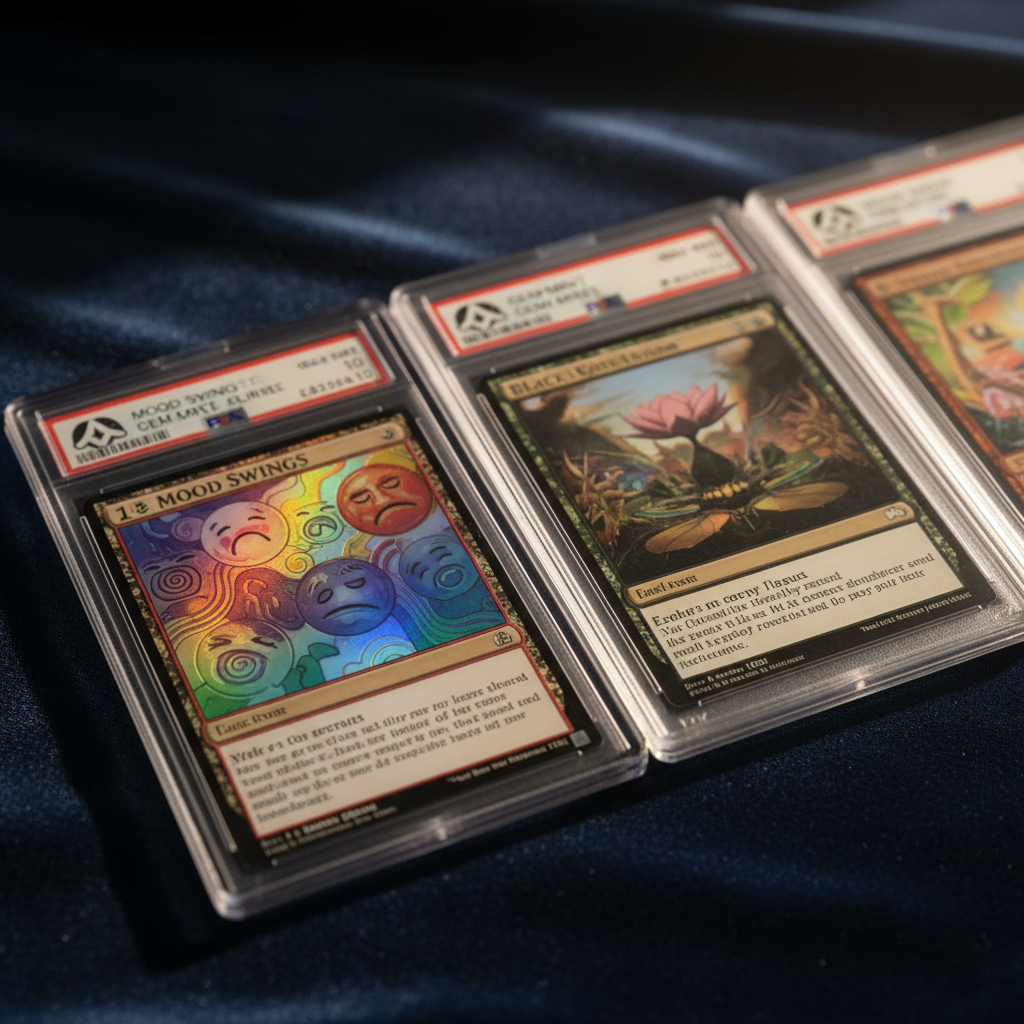
Mark Rosewater has been shaping Magic: The Gathering for three decades. Now he's building something entirely his own. The head designer of the world's most complex trading card game announced Mood Swings, an original TCG he describes as a love letter to the genre — a project that has been gestating since 1998.
That's not a typo. Twenty-eight years of design thinking, distilled into a single game.
The Weight of That Timeline
To understand why this announcement landed differently than a typical TCG reveal, you need to appreciate what 1998 meant for Magic. Rosewater joined Wizards of the Coast in 1995 and was already deep in the creative machinery of a game that had launched in 1993 and detonated the collectibles market. By 1998, Magic had survived its first secondary market bubble, weathered the Reserved List controversy that still haunts the hobby today, and was cementing itself as the dominant force in tabletop gaming. That's the moment Mood Swings began.
Whatever this game is, it isn't a weekend side project. It's a parallel creative life.
Rosewater's tenure at Wizards spans sets from Urza's Saga through the modern era — a body of work that includes some of the most financially consequential cards ever printed. A PSA 10 Black Lotus from Alpha recently cleared $540,000 at auction. Rosewater didn't design that card, but he has spent his career in the shadow of it, and in many ways, building beyond it. His design philosophy — layered complexity, emotional resonance, deep mechanical identity — is baked into every rare that serious collectors chase.
That philosophy is now being applied to something he owns completely.
What Mood Swings Actually Is
Details remain limited, but the framing Rosewater has used publicly is instructive. He's positioned Mood Swings not as a Magic competitor or a simplified alternative, but as a distillation — an attempt to capture the best elements of collecting, trading, and strategic gameplay simultaneously. That's a harder design problem than it sounds.
Most modern TCGs optimize for one of those three pillars. Pokémon leans into collecting, with chase cards driving secondary market prices that have made a PSA 10 Charizard Base Set worth north of $300,000. Competitive games like Yu-Gi-Oh! and Magic itself skew toward strategy, with the secondary market following tournament viability more than pure aesthetics. Trading — actual peer-to-peer exchange as a core mechanic — has been largely abandoned by the industry in favor of booster pack economics.
If Rosewater has genuinely threaded that needle after 28 years of iteration, Mood Swings could be the most consequential new TCG launch since Flesh and Blood disrupted the market in 2020 and produced a PSA 10 Cold Foil Tunic that sold for over $45,000 within two years of the game's release.
That's the benchmark for a breakout TCG in the current market. New games can generate serious secondary market heat — but only when the design is tight, the community is passionate, and the print runs are managed intelligently. Flesh and Blood's early scarcity was partly accidental. Rosewater, with nearly three decades of Wizards institutional knowledge, presumably understands print-run economics better than almost anyone in the industry.
The Collector Calculus
Here's the question serious collectors and speculators should be sitting with right now: does Rosewater's involvement de-risk this launch, or does it create unrealistic expectations?
The case for optimism is straightforward. He is, without exaggeration, one of the most respected designers in the history of the hobby. His name alone will generate press coverage, community interest, and retail attention that most indie TCG launches never see. First-edition sealed product from a Rosewater-designed game will move. The question is whether it holds value.
The case for caution is equally real. The TCG graveyard is full of games backed by credible names and genuine enthusiasm — Doomtown, Netrunner, Ashes: Rise of the Phoenixborn — that built passionate communities and still collapsed under the weight of distribution challenges, publisher instability, or simple market saturation. Rosewater is a designer, not a publisher. Who prints and distributes Mood Swings matters enormously for its long-term collectibility.
Twenty-eight years in the making. The hobby will find out soon enough whether that was time well spent.