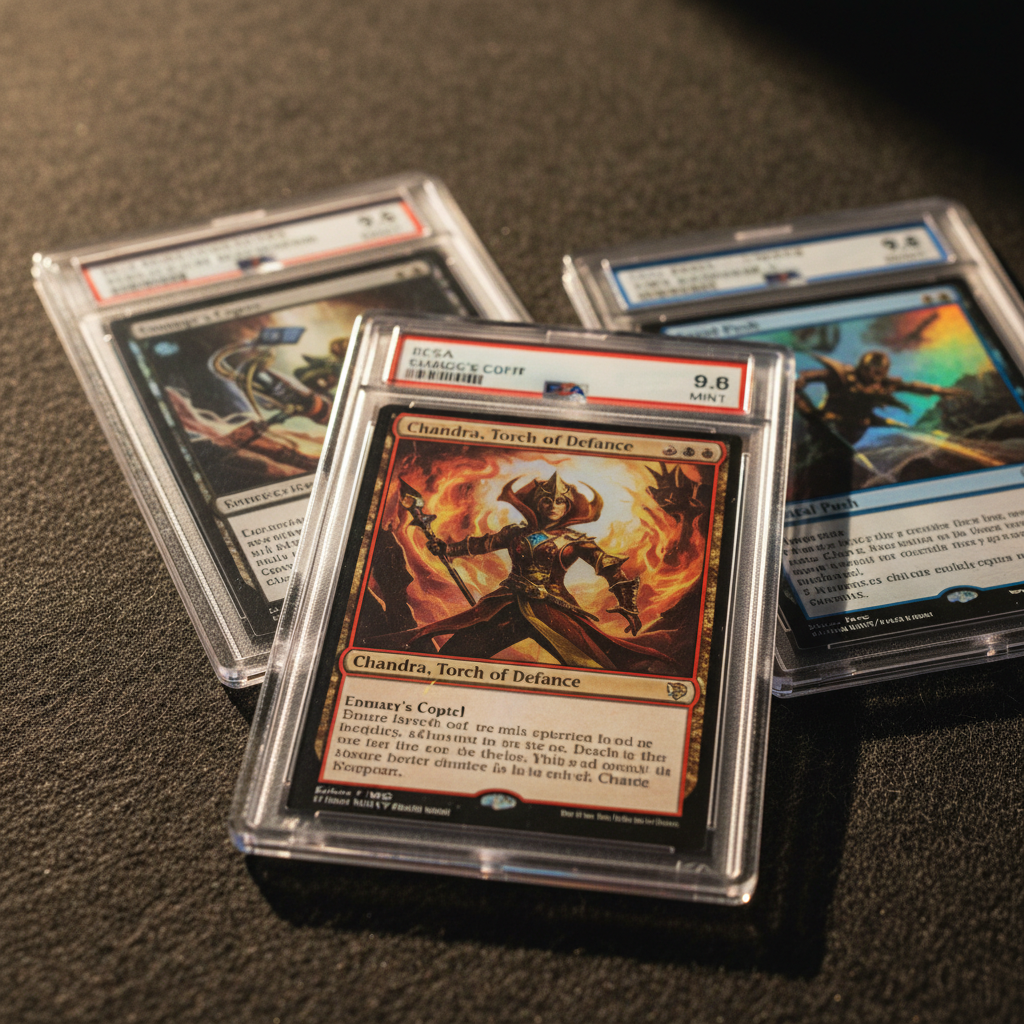
Magic: The Gathering's Standard format has rarely looked this crowded — or this affordable. The back-to-back releases of Lorwyn Eclipsed, the Teenage Mutant Ninja Turtles crossover set, and the Avatar: The Last Airbender collaboration have injected genuine diversity into the competitive meta, and for once, the floor on entry hasn't climbed alongside the ceiling. Functional, tournament-viable decks are sitting in the $50–$100 range. That's not a fluke — it's a structural feature of how the current market is pricing Magic product.
The mechanism driving this is worth understanding, because it's the same dynamic reshaping collectible card game economics broadly: serialized premium variants are absorbing the speculative premium that used to inflate staple prices across the board.
How Serialized Cards Are Subsidizing Your Deck
When Wizards of the Coast prints a /500 serialized Mox Amber, that card becomes the lightning rod for high-end collector demand. Buyers chasing the rarest version — the one that will eventually land in a BGS 9.5 slab and sit in a portfolio — are funneling their dollars into that single SKU. The result? The non-serialized, functionally identical version of the same card gets left behind at a price point that actually reflects its gameplay utility rather than its scarcity as an object.
This isn't a new phenomenon. It mirrors what happened in the Pokémon market when the alt-art and gold card tiers started commanding $300–$1,000+ at auction while the playable uncommon version of the same effect sat at bulk. The collectible premium and the gameplay premium have decoupled — and for players, that's a gift.
For dealers and investors, the serialized chase cards are where the action is. A /500 serialized Mox Amber in a PSA 10 holder, assuming population stays thin, could realistically comp against other low-pop serialized MTG artifacts that have traded at Heritage and Goldin in the $800–$2,500 range depending on the card's format relevance. The floor on those comps has held even through broader TCG market softness in 2024–2025.
Building Competitive on $50–$100 in 2026
The three new sets have created an unusually wide meta. Lorwyn Eclipsed reintroduces tribal synergies that reward tight, low-curve builds — the kind of deck where your most expensive card might be a playset of rares at $4–$6 each. The TMNT and Avatar crossover sets bring pushed uncommons and rares that are priced as novelty items by casual buyers but are quietly overperforming in competitive play.
That mismatch — novelty pricing on competitively relevant cards — is exactly where budget builders find their edge. A card that casual buyers dismiss as a licensed crossover piece and price accordingly can anchor a winning strategy at an FNM or a local PPTQ. Smart players have always known this. The current Standard environment just happens to have an unusually high concentration of those opportunities.
The $50–$100 budget ceiling also matters because Standard's rotation clock enforces discipline. Cards rotate out of the format roughly every two years, which means the expected value ceiling on any Standard staple is structurally capped — and the market prices that in. A card that would be a $30 Modern staple might sit at $8–$12 in Standard simply because its competitive window is finite. For players, that's the format's best feature. For investors, it's a reason to stay cautious on Standard-only cards unless they have obvious eternal format upside.
The Collector Angle on Crossover Sets
The TMNT and Avatar sets deserve a separate look from the collector side. Licensed crossover sets have a complicated history in the MTG secondary market. The Universes Beyond line — which includes previous collaborations with Warhammer 40,000, Lord of the Rings, and Doctor Who — has produced some of the format's most volatile secondary market cards. The One Ring from the Lord of the Rings set, a true 1-of-1, sold for $2.64 million at Fanatics in 2023, setting the single-card record for a modern MTG release.
That sale recalibrated expectations for serialized Universes Beyond inserts entirely. Whether the TMNT or Avatar sets produce a comparable chase card remains to be seen, but the collector infrastructure — grading services, dedicated auction house categories, a liquid secondary market — is now firmly in place for MTG in a way it wasn't five years ago. PSA and BGS both have established MTG submission pipelines, and population reports on key rares from recent sets are being tracked the way sports card pops are.
The budget player and the high-end collector are, somewhat counterintuitively, operating in the same ecosystem right now — just at opposite ends of it. One is benefiting from the other's appetite for scarcity. That balance rarely holds forever, but for the moment, Standard in 2026 is one of the more accessible entry points the format has offered in years.