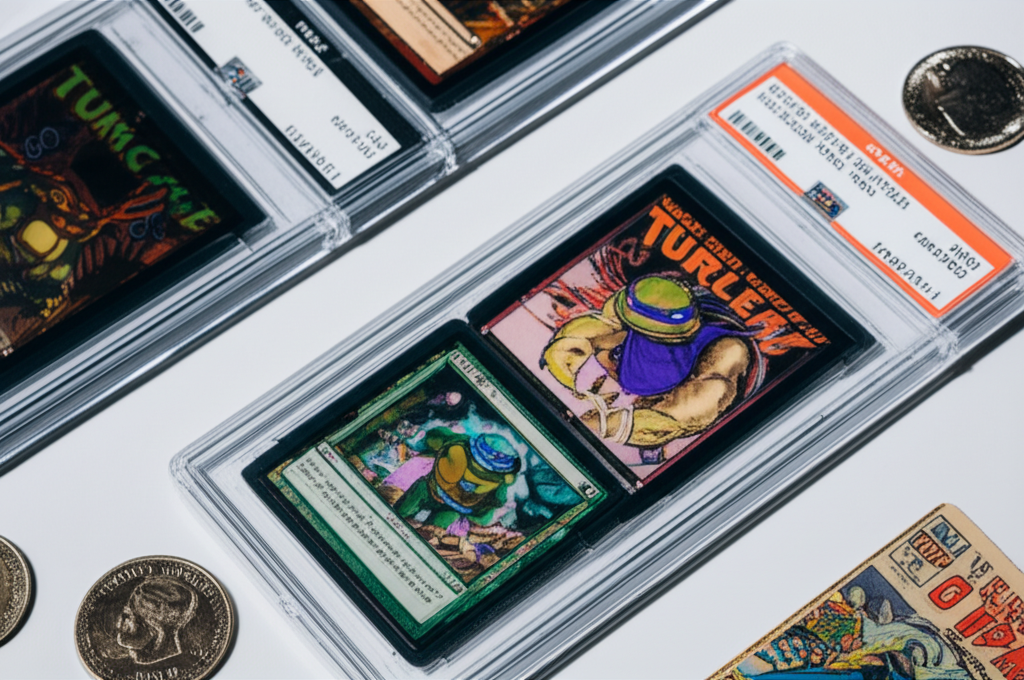
Magic: The Gathering's Teenage Mutant Ninja Turtles expansion doesn't just borrow the IP's aesthetic — it builds a mechanical identity around it. The Mutagen token, a colorless artifact representing the franchise's signature green ooze, sits at the center of that identity, and it's already drawing attention from both competitive players and collectors eyeing the set's long-term value.
For a crossover product, that's a meaningful distinction. Too many licensed MTG sets lean on nostalgia and deliver mechanically thin gameplay. The TMNT expansion appears to be doing something more deliberate.
How the Mutagen Token Actually Works
At its core, a Mutagen token is a colorless artifact with the Mutagen subtype. The functional text follows a tap-and-sacrifice pattern — pay one generic mana, tap the token, and trigger an effect tied to the creature it's modifying. The mechanic is designed to scale: the more Mutagen tokens you accumulate, the more dramatic the transformation your creatures undergo.
This isn't a passive counter system. It's an active resource with tempo implications. Players who build around Mutagen generation can create compounding board states that casual opponents won't see coming. That kind of mechanical depth tends to drive secondary market demand — players want the cards that generate tokens most efficiently, and those cards become the set's financial anchors.
In recent MTG crossover history, the mechanically relevant cards consistently outperform the purely cosmetic ones at auction. The Secret Lair x Stranger Things release saw Eleven, the Mage — a card with a genuinely playable ability — hold values well above comparable cosmetic-only reprints for more than 18 months post-release. The pattern is reliable enough to treat as a baseline.
The Collector Angle: Crossover Cards and the Grading Market
MTG crossover products have carved out a distinct grading niche over the past four years. PSA and BGS both saw submission spikes following the Walking Dead Secret Lair in 2020 and the Transformers crossover in 2022's The Brothers' War. Collectors who moved early on high-grade copies of mechanically relevant crossover cards — particularly those with low population counts in PSA 10 — captured significant upside as casual demand caught up to the IP's fanbase.
TMNT carries a broader mainstream footprint than most MTG crossover properties. The franchise has been a collectibles juggernaut since the late 1980s, with vintage Playmates action figures and original cartoon-era merchandise commanding serious prices on the secondary market. A first-edition TMNT comic from 1984 in CGC 9.8 has traded above $50,000. That existing collector base doesn't automatically translate to MTG demand — but it creates a discovery funnel that purely gaming-adjacent crossovers lack.
The Mutagen mechanic matters here specifically because it gives TMNT fans a reason to engage with the cards beyond decoration. A token mechanic that generates actual gameplay decisions is the kind of thing that keeps cards in binders rather than bulk bins, and it's the kind of thing that sustains secondary market prices over a 12-to-24-month horizon.
- Mechanically central cards — the ones that generate or abuse Mutagen tokens — are the primary grading targets
- Foil and serialized variants will carry the highest ceiling for raw speculation
- Population scarcity in PSA 10 or BGS 9.5 will likely define value within 6 months of release
- Crossover IP appeal extends the potential buyer pool beyond MTG's core demographic
Reading the Early Market Signals
MTG crossover products have a complicated track record at retail. Some — like the Lord of the Rings: Tales of Middle-earth set released in mid-2023 — exceeded expectations dramatically, with the serialized One Ring card selling for $2.64 million through PWCC in August 2023. Others have faded quickly once the IP hype cycle ran its course.
The TMNT expansion sits somewhere between those poles. It's a beloved property with multigenerational reach, but it doesn't carry the literary gravitas of Tolkien or the competitive format dominance that drives sustained MTG card values. What it does have is a mechanic — Mutagen — that rewards skilled play and creates memorable game states. That's a better foundation than most licensed sets start with.
The collectors who profited most from MTG crossover products weren't the ones who bought everything. They were the ones who identified the two or three mechanically indispensable cards early, graded them before population counts climbed, and held through the IP's second wave of mainstream attention. With TMNT, the Mutagen-generating engines are the obvious targets. Get there before the rest of the market figures out which ones those are.