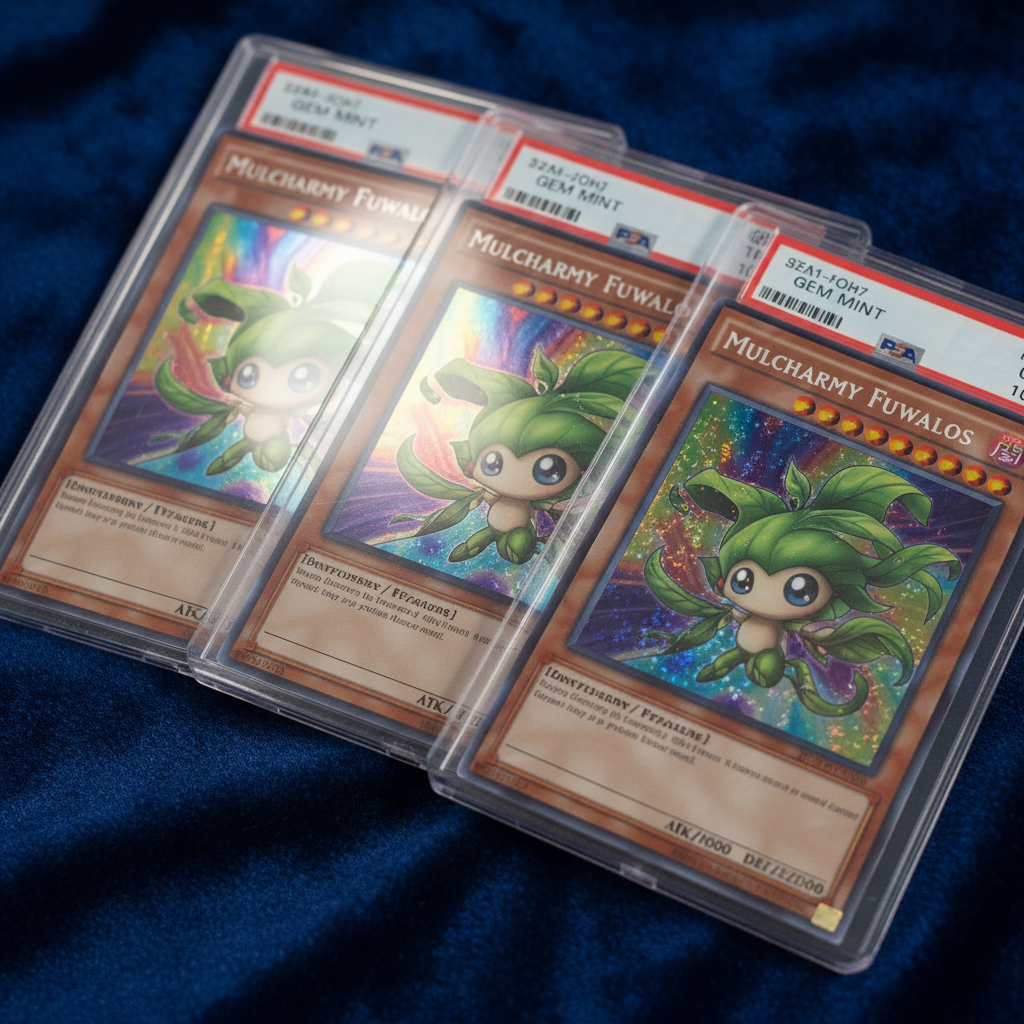
A common card shouldn't cost $30 to play at three copies. Yet here we are. Mulcharmy Fuwalos — printed as a common in the Legendary Modern Decks 2026 (L26D) set — is sitting at roughly $10 per copy on the secondary market, making a full playset a $30 commitment for a card that nearly every competitive deck wants to run. For a format that has historically leaned on cheap hand traps to keep entry costs manageable, this is a structural problem, not just a pricing blip.
The Mulcharmy archetype was designed with a specific purpose: to punish the kind of relentless special summoning loops that have defined modern Yu-Gi-Oh! at the highest levels of play. Fuwalos in particular functions as a hand trap that draws cards when your opponent special summons excessively from the Extra Deck, creating a soft check on combo-heavy strategies. In theory, that's healthy game design. In practice, the card is so universally applicable that demand has overwhelmed supply even after the common reprint — and the market hasn't corrected.
Why a Common Reprint Didn't Fix the Problem
Reprints at the common rarity are supposed to democratize access. That's the entire point. When Konami slots a staple into a widely distributed product at common rarity, the expectation — from players, dealers, and the secondary market alike — is that prices normalize toward the $1–$3 range within a few weeks of release. Fuwalos hasn't followed that script.
The L26D product itself is part of the issue. Legendary Modern Decks 2026 isn't a traditional booster set with deep pack-per-box ratios flooding the market with copies. It's a curated product with controlled distribution, which means the reprint volume, while real, isn't sufficient to meet demand from a playerbase that needs three copies per deck across multiple archetypes. The math simply doesn't work in the player's favor.
Compare this to how Ash Blossom & Joyous Spring was eventually driven down to bulk rare territory through aggressive reprints across multiple products over several years. Fuwalos is early in that cycle — if it ever gets there at all. Right now, it occupies an uncomfortable middle ground: reprinted enough that collectors know a cheaper version exists, but not reprinted enough that $10 feels unreasonable to sellers.
The Budget Alternatives Filling the Gap
Competitive players who can't or won't absorb a $30 hand trap package are doing what they've always done — finding functional substitutes that accomplish similar goals at a fraction of the cost. The current metagame offers a few viable paths.
- Mulcharmy Purulia — The other Mulcharmy hand trap, which triggers on Normal Summon spam rather than Extra Deck activity. Less universally applicable than Fuwalos, but relevant against specific strategies and currently available at a significantly lower price point.
- Effect Veiler — A format staple for over a decade that has been reprinted into near-bulk status. It doesn't replicate Fuwalos's draw effect, but it stops monster effects during the opponent's main phase and costs almost nothing.
- Nibiru, the Primal Being — Still one of the most punishing hand traps ever printed against combo decks, and available at accessible prices thanks to multiple reprints. The token it generates can swing games on its own.
- D.D. Crow — Graveyard disruption that trades one-for-one and remains cheap. Situationally powerful against graveyard-reliant strategies that Fuwalos wouldn't address anyway.
None of these cards do exactly what Fuwalos does. That's the honest answer. The draw effect is unique, and in a game where card advantage compounds rapidly, replacing Fuwalos with cheaper options is a real concession — not a lateral move. But competitive play on a budget has always required concessions, and the alternatives above are legitimate cards, not desperation picks.
What This Tells Us About the Modern TCG Market
The Fuwalos situation is a useful lens for understanding where the Yu-Gi-Oh! secondary market stands in 2025. The game's power ceiling has risen sharply over the past two years, and the hand traps required to compete have risen with it. When a common reprint can't push a staple below $10, it signals that either demand is genuinely outpacing supply at an unusual rate, or that the product delivering the reprint isn't reaching enough of the playerbase to matter.
For dealers, Fuwalos at $10 is a comfortable hold — reprints rarely crash prices overnight, and the card's competitive relevance isn't going anywhere. For players, the calculus is harder. Spending $30 on three copies of a common that could be reprinted again at any time carries real financial risk, especially when the Yu-Gi-Oh! format shifts quickly enough to rotate staples out of relevance within a single season.
The Mulcharmy dilemma, at its core, isn't really about one card. It's about whether a game that markets itself as accessible can sustain a metagame where the cheapest viable hand trap package costs more than some entire budget decks. That tension isn't new to Yu-Gi-Oh! — but Fuwalos makes it unusually visible, and unusually hard to ignore.