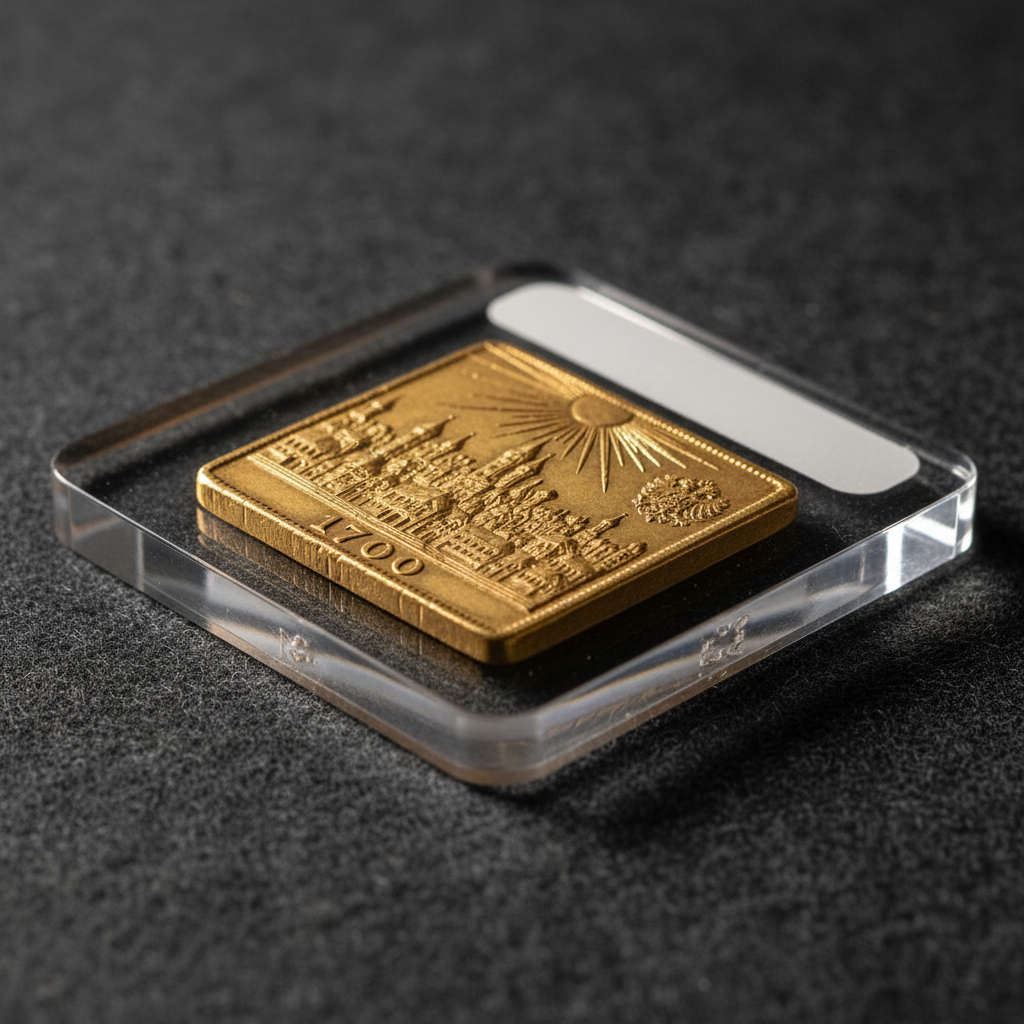
Only one exists. That's the entire population report for the Nürnberg 1700-dated gold klippe piefort of 2-ducat weight — a coin that stands apart from one of German numismatics' most celebrated series and has appeared in the public auction record exactly once, at Künker's June 2007 auction. In a field where rarity is routinely overstated, this piece earns the designation honestly.
Collectors of German gold have long prized Nürnberg's 1700-dated Paschal Lamb issues. The series is canonical — the kind of material that anchors serious collections of Holy Roman Empire coinage and commands consistent five-figure results at Heritage, Stack's Bowers, and the major European houses. But the klippe piefort sits in a different category entirely. It doesn't just belong to the series. It redefines what the series is capable of producing.
What Makes a Piefort — and Why This One Is Different
A piefort (sometimes spelled piedfort) is a coin struck on a planchet of double or greater thickness than a standard issue, typically produced as a presentation piece, a die trial, or a gift for dignitaries and mint officials. They were never meant for circulation. The klippe format — a square or diamond-shaped flan rather than a round one — adds another layer of deliberate distinction. Combined, the two characteristics signal that this coin was made to impress, not to spend.
The 2-ducat weight places it above the standard single-ducat Paschal Lamb pieces that form the backbone of the series. Nürnberg's mint in 1700 was producing coins for a city at the height of its civic pride, and the Paschal Lamb — the Agnus Dei, symbol of Christ and of redemption — was the city's most resonant numismatic emblem. A piefort klippe of this type would have been a deliberate statement: a maximum-effort production from a mint that knew exactly what it was doing.
The fact that only a single example has surfaced in the modern auction record is not surprising. Piefort klippes from this era were produced in tiny numbers by design. What is remarkable is that this one survived at all, in a condition and provenance chain sufficient to bring it to Künker's floor in 2007.
The Künker 2007 Appearance and What It Tells Us
Künker, the Osnabrück-based auction house, is the appropriate venue for a coin like this. Their German and Holy Roman Empire material routinely attracts the most serious European collectors, and their June sales have historically been among the strongest for trophy-grade German gold. The 2007 appearance of this piefort marked its entry into the documented public record — meaning any prior ownership history exists outside the verifiable auction trail.
The broader Paschal Lamb series provides useful comp context. Standard 1700 Nürnberg Paschal Lamb ducats in high grades — think NGC MS-63 or better — have traded in the $3,000 to $8,000 range depending on strike quality and eye appeal, with exceptional examples pushing higher. A 2-ducat gold piece from the same series in comparable preservation commands a meaningful premium over that baseline. A unique piefort klippe of 2-ducat weight exists in a market of one, which means price discovery is almost entirely collector-driven rather than comp-driven.
That's both the challenge and the appeal of coins like this. There is no population report to anchor expectations. No registry competition to fuel incremental bidding. The value proposition is purely about historical significance, aesthetic impact, and the simple, irreducible fact of uniqueness.
The Trophy Tier of German Numismatics
German city coinage from the late 17th and early 18th centuries occupies a specialized but deeply passionate corner of the numismatic market. The collector base skews toward serious long-term accumulators — people building thematic collections around specific cities, mints, or iconographic programs rather than chasing registry points. For that audience, a unique piefort klippe isn't a curiosity. It's the capstone.
Nürnberg's numismatic legacy is substantial. The city produced some of the most artistically ambitious coinage of the Holy Roman Empire, and the Paschal Lamb series sits near the top of that legacy. Collectors who have spent years assembling complete date runs of the standard issues know exactly what this piefort represents: the one piece that cannot be duplicated, traded laterally, or upgraded. You either own it or you don't.
The research credit here goes to Mike Byers of MintErrorNews, whose documentation of this piece keeps it visible in the numismatic conversation. Coins this rare have a way of disappearing between auction cycles — sometimes for decades. The fact that this one is being written about at all is a function of active scholarship keeping the record alive.
Wherever this klippe piefort sits today — in a European private collection, a museum cabinet, or a vault awaiting its next public moment — it remains the single most significant variant in a series that serious collectors already consider essential. One coin. No comps. No second chances.