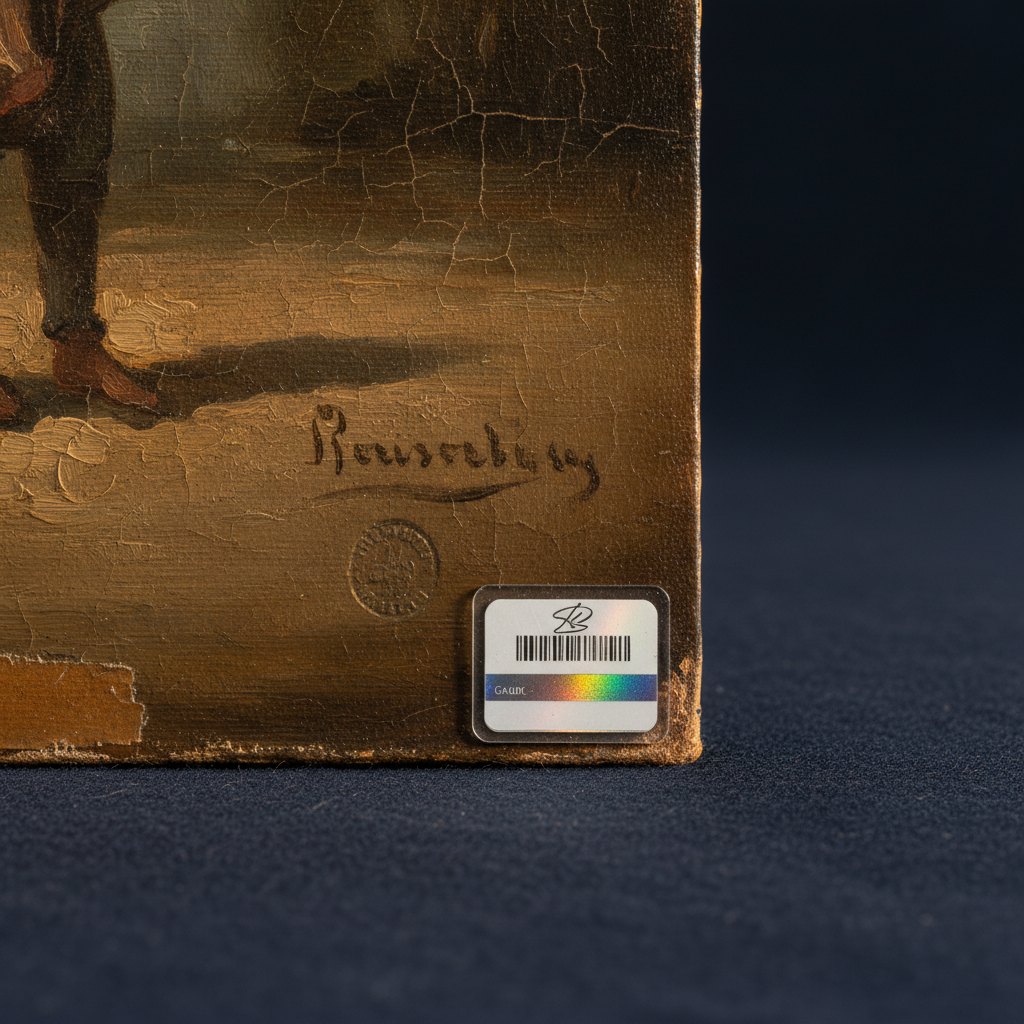
The painting had been missing for the better part of a century. Then a family started going through their own walls.
A long-lost work stolen during the Nazi regime's systematic plunder of Jewish-owned art has been identified inside the home of a descendant of the original perpetrators — a discovery that reframes what recovery in this space actually looks like. Not a dramatic auction house reveal. Not an Interpol operation. A family reckoning, quiet and devastating, that ended with a stolen masterpiece walking back into the light.
The Scale of What Was Taken
To understand why this find matters, you need to understand the scope of what the Nazis stole. Between 1933 and 1945, an estimated 600,000 works of art were looted across Europe — paintings, sculptures, drawings, decorative objects — stripped from Jewish families, cultural institutions, and private collections. The Monuments Men Foundation and the Commission for Looted Art in Europe have spent decades trying to claw that number back. Progress has been real but slow. Researchers estimate that roughly 100,000 works remain unaccounted for, scattered across private collections, forgotten storage units, and — as this case proves — the walls of ordinary homes.
The art restitution market operates differently from almost every other collectibles category. There are no PSA population reports here, no Heritage auction estimates to benchmark against. Value is almost beside the point. These are objects with legal and moral claims attached, and the paper trail — provenance documentation, pre-war exhibition records, dealer invoices, family photographs — is the only currency that matters.
Provenance research has become a discipline unto itself. Organizations like the Art Loss Register maintain databases of over 700,000 stolen, looted, and missing works, cross-referencing auction catalogues, estate sales, and dealer inventories in an effort to match objects to their rightful owners. When a match is made, the legal and emotional weight is staggering.
How These Discoveries Actually Happen
The popular image of Nazi loot recovery involves investigators, courtrooms, and reluctant museum directors. The reality is messier and often more personal. Many of the most significant restitutions in recent decades have come not from institutional investigations but from families — heirs of perpetrators, descendants of collectors, people clearing out estates — who stumbled across something they couldn't explain and chose to ask questions.
That's what appears to have happened here. A family discovery, described as shocking, led to the identification of a work that had been hidden in plain sight. The painting wasn't buried in a crate or locked in a vault. It was presumably hanging on a wall, living alongside a family that may or may not have understood its origins.
This pattern is more common than most people realize. The Cornelius Gurlitt case — the 2012 Munich discovery of over 1,400 works in a single apartment, many with looted origins — is the most dramatic example, but it's not an outlier in kind, only in scale. Smaller discoveries surface regularly, most without the media coverage that Gurlitt generated.
For collectors and dealers operating in the fine art space, this is a persistent due diligence challenge. Any work created before 1945 and passing through European hands carries provenance risk. The standard in the field — established in part by the 1998 Washington Principles on Nazi-Confiscated Art — calls for a clear ownership record covering the years 1933 to 1945. Gaps in that window are red flags. Gaps in that window combined with a Jewish original owner are, legally and ethically, a serious problem.
What Restitution Looks Like in Practice
When a looted work is identified and a rightful heir located, the resolution process varies enormously. Some cases settle privately, with the current possessor voluntarily returning the work. Others drag through courts for years, particularly when the current owner purchased in good faith and has documentation to prove it. Germany, Austria, France, and the Netherlands have all established dedicated restitution commissions with varying degrees of authority and transparency.
The financial dimension is rarely simple. A work that might fetch $500,000 at auction carries a very different set of calculations when the alternative is a restitution claim that strips it from your estate entirely. Some families negotiate. Some donate. Some fight. The outcomes are as varied as the histories behind each piece.
What doesn't vary is the significance of the moment when a stolen work is finally identified. Decades of absence, of families knowing something was taken and having no way to prove where it went — that weight is real, and no auction result captures it.
The painting found in this descendant's home is one more data point in a recovery effort that will outlast everyone currently working on it. The ledger of what was stolen is still being written. So is the ledger of what's been returned.