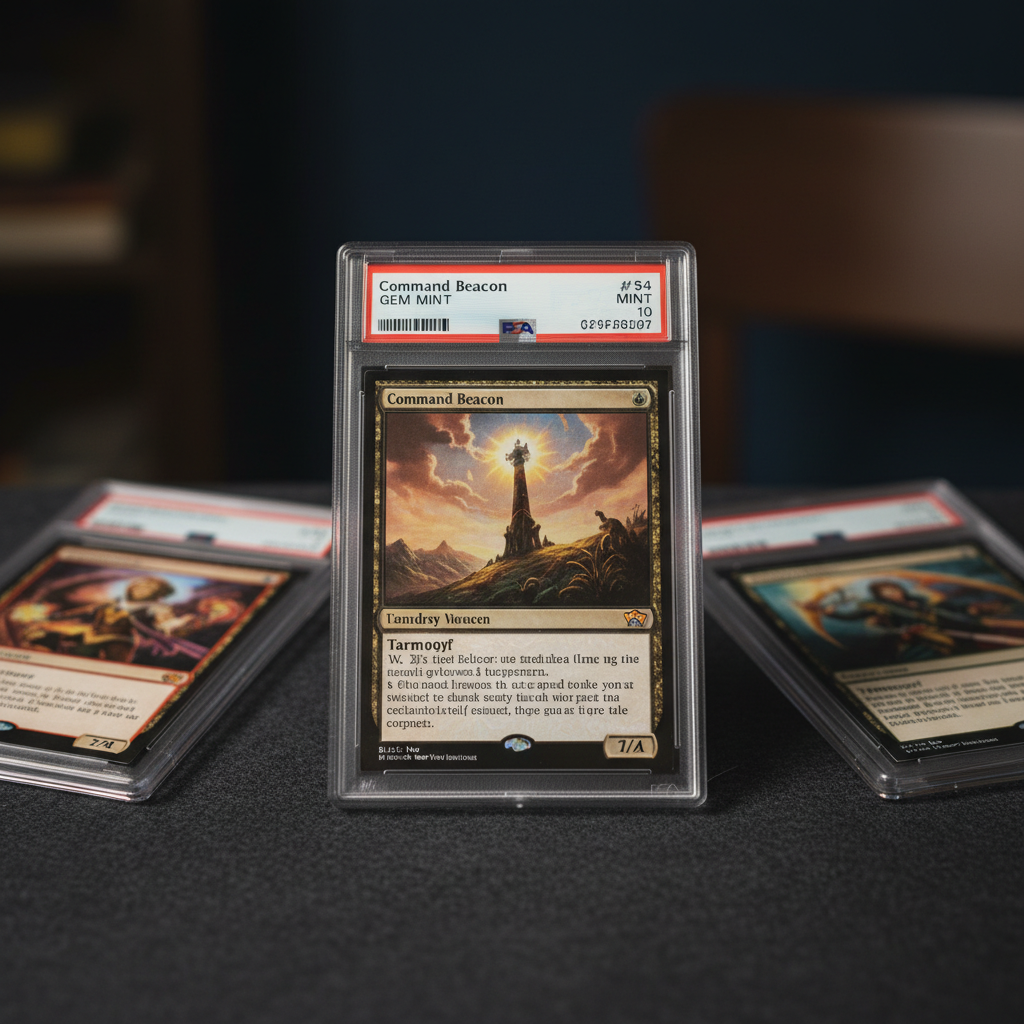
Northampton Farm has vaulted to the top of this week's Magic: The Gathering secondary market movers, driven by a sudden recognition of its Standard-legal utility that the market had been sleeping on. Meanwhile, two legacy staples are climbing on tournament speculation, and the Lorwyn-era nostalgia trade is showing its first real cracks. This week's list is less a routine pulse check and more a signal that format legality is once again the most powerful force in MTG pricing.
The Risers: Format Legality Rewrites the Valuation Map
Northampton Farm's ascent is the kind of move that makes sense only in retrospect. Players identified a specific interaction within Standard — deck protection mechanics that the card enables more efficiently than its competitors — and the secondary market responded fast. That's the pattern: competitive players find the edge, streamers and content creators amplify it, and buylist prices spike before most casual holders even check their binders.
Greater Auramancy and Mox Opal are climbing for different but related reasons. Greater Auramancy's movement is tied to a meta-game lock strategy gaining traction in higher-level bracket play, where hexproof-granting enchantments become near-unbreakable under the right build. Mox Opal's climb is more speculative — new tournament bracket structures are generating chatter about format shake-ups that could rehabilitate zero-cost mana acceleration in competitive contexts where it had been suppressed. Speculation-driven spikes are notoriously volatile, but Mox Opal has the kind of historical price floor that limits downside even if the speculation doesn't pan out. It's not a card that craters easily.
For graded card collectors, Mox Opal in particular is worth tracking in the PSA and BGS ecosystems. Near-mint Scars of Mirrodin copies — especially foils — have traded in the $180–$240 range in recent Heritage and PWCC sales for PSA 9s, with PSA 10s commanding a meaningful premium where population is thin. Any sustained competitive resurgence tightens that supply considerably.
The Lorwyn Bubble: Elvish Champion Starts to Leak
The Lorwyn correction was coming. Elvish Champion had ridden a wave of nostalgia-driven demand and casual tribal enthusiasm that pushed its price well beyond what the competitive metagame could justify. That wave is receding.
Lorwyn-block cards have been on a slow but consistent appreciation trend for the better part of two years, fueled by the same forces that drove Reserved List speculation and old-border premium pricing across the broader MTG market. The problem is that nostalgia has a ceiling when the card doesn't have a competitive home. Elvish Champion is a lord — a good one — but lord-dependent tribal strategies in formats where it sees play haven't been putting up results. When results dry up, so does the speculative premium.
This isn't a collapse. It's a deflation. Sellers who acquired Elvish Champion below its recent peak are still in positive territory. But anyone who chased the top is now looking at a card that's cooling faster than the broader Lorwyn segment, and the trajectory suggests further softening before stabilization. The graded market for this card is thin enough that a few motivated sellers can move the needle significantly — which cuts both ways.
The broader Lorwyn correction is worth watching as a macro signal. When nostalgia-era bubbles leak in MTG, they tend to do so across multiple cards simultaneously rather than in isolation. If Elvish Champion is the first domino, collectors holding other Lorwyn-era specs should be pressure-testing their exit timelines.
Reading the Week's Signal
What makes this week's list instructive isn't any single card move — it's the underlying dynamic they collectively reveal. The MTG secondary market in 2026 is being driven by two engines running at different speeds: format legality and competitive results on one track, and nostalgia and tribal speculation on the other. Right now, the first engine is pulling ahead.
Northampton Farm's rise is a format-legality story. Mox Opal's climb is a tournament-structure story. Greater Auramancy is a meta-lock story. All three are grounded in competitive play. Elvish Champion's decline, by contrast, is what happens when a card's price is built primarily on vibes and tribal enthusiasm without the competitive scaffolding to support it.
For dealers and investors, the implication is straightforward: in the current environment, cards with legitimate competitive pathways — even speculative ones — are outperforming cards whose value rests on nostalgia alone. That's not a permanent condition, but it's the condition right now, and the smart money is positioning accordingly.
The Lorwyn bubble didn't pop this week. But it started hissing.