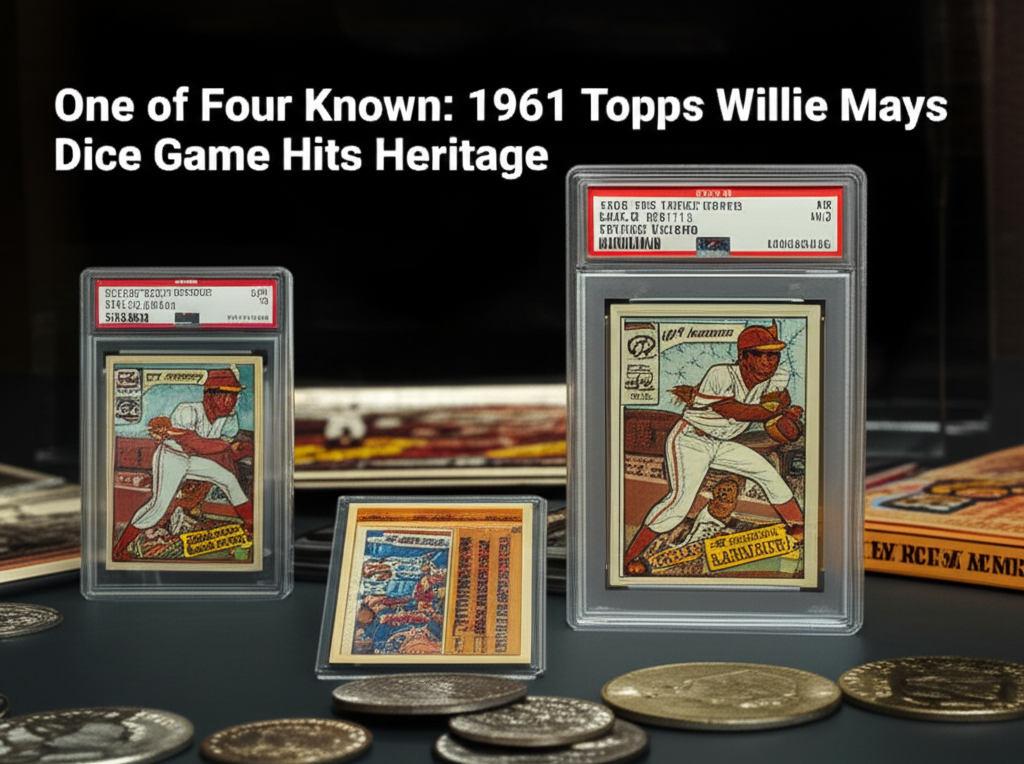
A 1961 Topps Willie Mays Dice Game test issue — one of only four known copies in existence — is heading to Heritage Auctions' Spring Sports Card Catalog Auction, marking one of the rarest single-player test issues to surface on the public market in recent memory. When a card's entire known population fits in the palm of your hand, collectors pay attention.
The Lot: What's on the Block
Heritage Auctions has consigned the card as part of its upcoming Spring Sports Card Catalog Auction, one of the hobby's premier seasonal events for high-grade and high-rarity material. The item in question is a 1961 Topps Dice Game card featuring Willie Mays — a test issue produced by Topps in extremely limited quantities as part of an experimental game format that never reached wide commercial release. Test issues from this era are among the most coveted of all vintage baseball card variants precisely because they were never intended for mass distribution, making survival rates extraordinarily low.
With a known population of just four copies, this Mays Dice Game card sits in rarefied air even by test-issue standards. The 1961 Topps Dice Game set itself is a standalone curiosity in the hobby — an oversized, game-integrated format that Topps experimented with during a period of aggressive product innovation in the early 1960s. Cards from the set featured individual player statistics designed to interact with dice rolls, blending the era's obsession with baseball statistics and parlor gaming into a single collectible format. That it starred Willie Mays — the Say Hey Kid, a consensus top-five player of all time and one of the most commercially valuable names in the vintage card market — elevates this particular copy from a niche curiosity to a serious trophy piece.
Heritage has not yet disclosed a pre-sale estimate or opening bid, but given the card's population scarcity and the star power of its subject, serious bidders should expect the final hammer to reflect the extreme rarity of the offering. Heritage's Spring Sports Card Catalog Auction draws a global bidder base, and lots of this caliber routinely attract competition from institutional-level collectors and high-end dealers alike.
Why This Card Commands the Room
Context matters enormously here. The vintage test-issue market has been on a sustained upward trajectory, driven by a collector base that has largely exhausted the high-grade mainstream vintage market and is now hunting for the genuinely scarce. 1952 Topps, T206, and E-series cards remain the blue chips of the hobby, but test issues — particularly from the 1950s and 1960s — represent the frontier. They are, by definition, low-pop and often condition-sensitive, which makes eye-appealing copies disproportionately valuable.
Willie Mays cards specifically have shown remarkable price resilience across market cycles. His 1951 Bowman rookie in PSA 9 has traded above $100,000 in recent years, and even mid-grade copies of his key vintage issues command five figures at major auction houses. The Dice Game card isn't a rookie, but its population of four makes it arguably more scarce than virtually any graded Mays rookie in the PSA or BGS registry. Scarcity, not grade, is the primary value driver here. When population reports show single-digit known copies, the traditional grading curve becomes almost secondary — you're bidding on the right to own something that almost no one else can own.
The broader test-issue category has also benefited from increased mainstream hobby awareness. High-profile auction results for 1959 and 1962 Topps test issues, regional printing variants, and proof cards have educated a new generation of collectors on the premium that genuine scarcity commands. Heritage, Goldin, and PWCC have all reported strong sell-through rates on test-issue material over the past 18 months, with multiple lots exceeding pre-sale estimates by 30% or more. This Mays Dice Game card arrives in that favorable tailwind.
Collector Takeaway
If you have the means and the mandate for true vintage rarity, this is exactly the kind of lot that warrants serious attention. A four-copy population on a Willie Mays test issue is not a talking point — it's a structural floor on value. Unlike high-grade mainstream cards that face ongoing population pressure as more copies are submitted and upgraded, a card with four known examples is immune to that dilution risk. The population isn't going up. What you're buying is permanent scarcity attached to one of baseball's immortal names.
For collectors who can't compete at that price level, the takeaway is still actionable: watch this result closely. A strong hammer here will send a signal across the entire test-issue and low-pop vintage segment. Comparable items to monitor include other 1961 Topps Dice Game cards featuring Hall of Famers, any Mays test-issue variants from the late 1950s through mid-1960s, and similar experimental Topps formats from the same era. The Spring Heritage auction will set a data point that the market will reference for years.