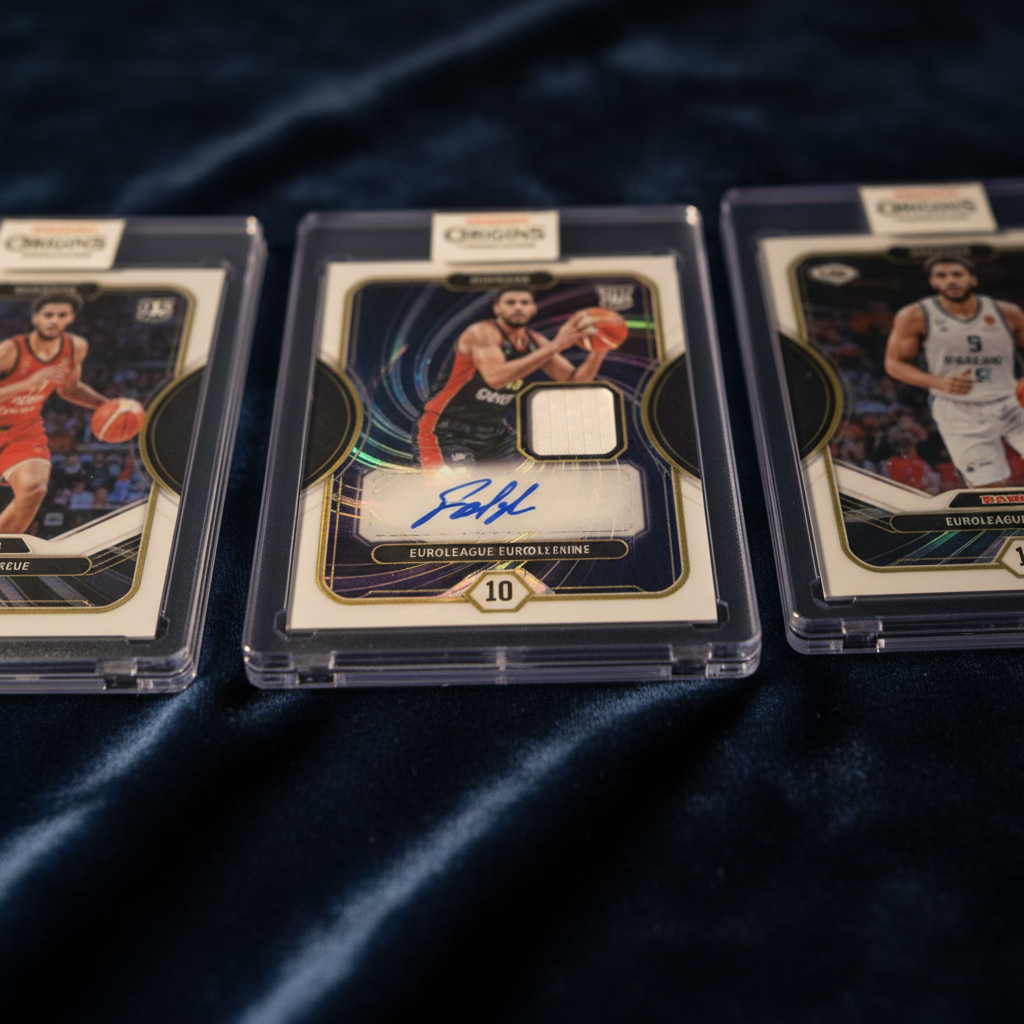
Panini is bringing its Origins treatment to EuroLeague basketball for the 2025-26 season, and the product looks built to do for European hoops what Origins has quietly done for the NBA market: deliver clean, autograph-forward releases that punch above their price point. Full checklist details, parallel structures, and box configurations are now in circulation ahead of the product's release window.
For collectors who've been watching the EuroLeague card market develop over the past three years, this is the kind of institutional commitment that matters. Panini's Origins NBA line has consistently produced some of the most liquid autographs in the modern hobby — the format is collector-friendly, the print runs are controlled, and the on-card signature rate keeps secondary market demand healthy. Extending that architecture to EuroLeague isn't a side project. It's a signal.
What's in the Box
The 2025-26 Origins EuroLeague configuration follows the premium hobby box model Panini has refined across its basketball portfolio. Collectors can expect a structured hit-per-box guarantee with autographs as the primary pull, supported by a layered parallel system that creates meaningful tiering across the checklist.
The parallel structure includes numbered tiers that compress toward the low end — the kind of scarcity ladder that drives PSA and BGS submission volume because collectors know a 1/1 or a /10 parallel holds its value in a way a base card simply doesn't. Origins NBA has demonstrated this repeatedly. A Zion Williamson Origins auto from his 2019-20 rookie year, graded BGS 9.5, has traded hands in the $800–$1,400 range depending on parallel tier — proof that the format sustains secondary market interest years after release.
The EuroLeague checklist spans the league's marquee talent pool, which in 2025-26 is deeper than it's ever been. The continued development of players who move fluidly between EuroLeague clubs and NBA rosters creates an interesting dual-market dynamic for autograph collectors — a signature pulled from this product could carry NBA crossover value depending on where a player lands.
The EuroLeague Card Market in 2025
European basketball cards have been an undervalued corner of the hobby for most of the past decade, but that's been changing. Panini's EuroLeague licensing has produced increasingly sophisticated releases, and the collector base — particularly in Spain, Greece, Turkey, and Germany — has grown sophisticated enough to support real secondary market infrastructure.
The comps are still thin compared to NBA equivalents, which cuts both ways. A collector who identifies the right EuroLeague autograph early — a player on the cusp of an NBA call-up, or a domestic legend whose cards have never had a proper premium release — can acquire it at a fraction of what a comparable NBA rookie auto would cost. The risk is liquidity. EuroLeague cards don't move as fast on eBay or PWCC as their NBA counterparts, and grading population data from PSA and BGS reflects that: submission volumes for EuroLeague product remain a fraction of NBA totals.
Origins changes the calculus slightly. When Panini puts a recognizable brand name on a product and backs it with controlled print runs and on-card autos, it attracts the kind of crossover collector — someone primarily NBA-focused — who might otherwise ignore European releases entirely.
The insert and SSP structure adds another layer of collectibility beyond the autograph chase. Short-printed base variations have become a reliable secondary market driver across Panini's modern releases, and Origins EuroLeague appears to follow that playbook. Specific SSP ratios haven't been confirmed, but the presence of that mechanic alone will push case-break demand.
Who to Watch on the Checklist
Without a finalized player checklist in hand, the smart money looks at EuroLeague's current roster of high-profile names: veterans with established European legacies whose cards have historically been underproduced, and younger players with credible NBA draft timelines. Both categories have shown they can generate sustained collector interest when the product format is right.
The EuroLeague's MVP-caliber talent — players who've spent multiple seasons as the best player in the world's second-best professional basketball league — remains criminally underrepresented in premium autograph products. If Origins delivers on-card signatures from that tier of player with print runs under /25, the secondary market response could be sharp.
Panini has the infrastructure, the license, and now the brand architecture to make EuroLeague cards a legitimate segment of the international basketball card market. Whether collectors show up in numbers large enough to sustain it is the open question — and the 2025-26 Origins release is essentially the audition.