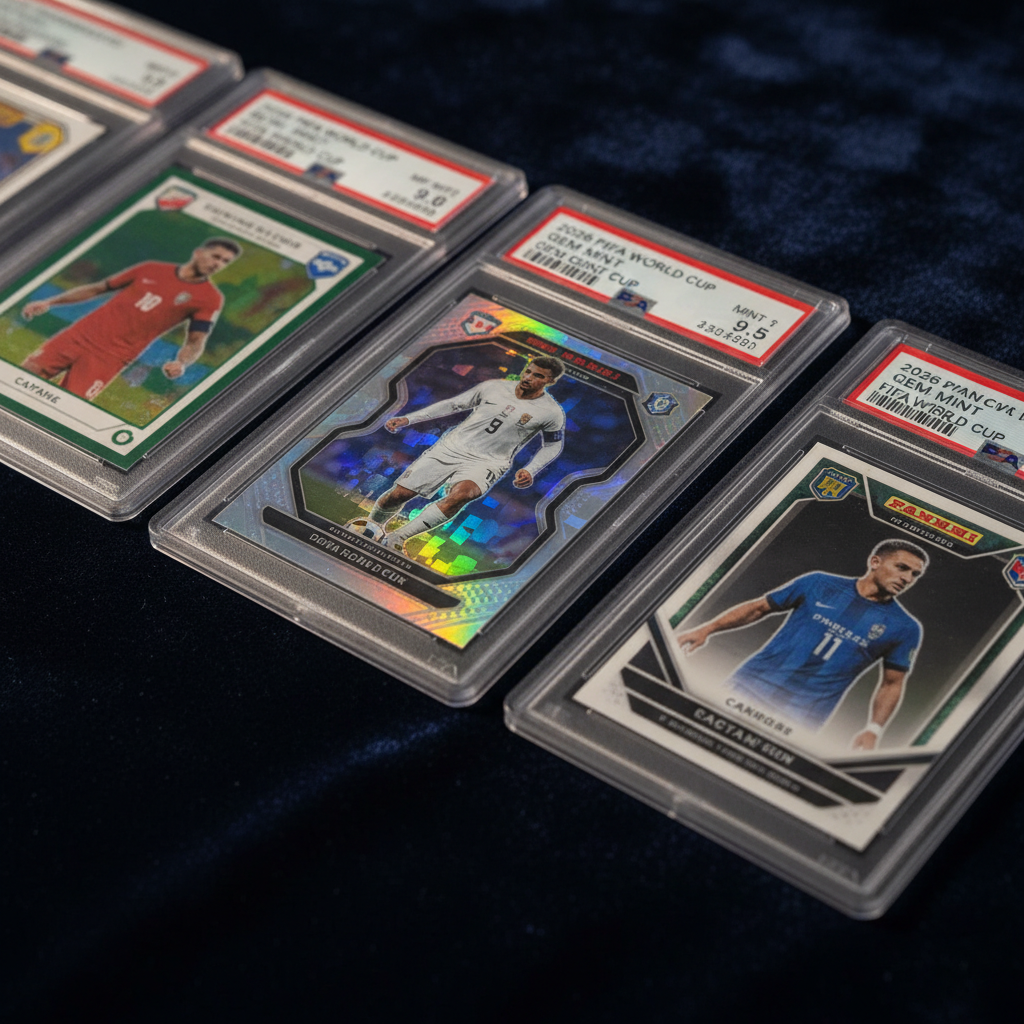
Panini is going big for the most-watched sporting event on the planet. The 2026 FIFA World Cup Sticker Collection — covering a tournament that spans three countries and 48 teams for the first time in history — is shaping up to be the most ambitious sticker release the Italian manufacturer has ever attempted, and the details now emerging confirm that this is not a casual refresh of the familiar formula.
The expanded tournament format alone changes everything. With 48 nations competing across the United States, Canada, and Mexico, the checklist is substantially larger than 2022's Qatar release, which covered 32 teams. More players, more parallels, more insert opportunities — and, inevitably, more packs needed to complete the album. Panini has built its entire sticker business model around that last point for five decades, and 2026 is no exception.
What's Inside the Collection
The core album structure follows the established Panini World Cup format: a base sticker set organized by national team, with squad photos, stadium cards, and tournament section dividers filling out the checklist alongside individual player stickers. But the 2026 edition layers in parallels and premium inserts that push this release squarely into the modern trading card era.
Parallel variants are a meaningful addition here. Shiny and foil treatments have always existed in Panini sticker collections, but the 2026 lineup expands the tiered parallel structure in ways that give the set genuine secondary-market legs. Collectors chasing a specific Lionel Messi or Kylian Mbappé variant will find themselves navigating a hierarchy of finishes — which is exactly how Panini keeps both the casual album-filler and the serious investor engaged simultaneously.
Box configurations are designed to serve multiple buyer types:
- Standard packs for retail and hobby distribution
- Starter packs bundled with the official album
- Collector tins and multi-pack configurations for gifting and bulk buying
- The Coca-Cola co-branded bottle promotion — a returning partnership that embeds exclusive stickers inside specially marked bottles, driving grocery-aisle discovery for younger collectors
The Coca-Cola integration is worth taking seriously as a market signal. Panini has used FMCG partnerships before, but embedding collectible stickers inside a global beverage brand's World Cup packaging puts this release in front of an audience that has never touched a hobby box. Some percentage of those consumers convert. That's new collector acquisition at Coca-Cola's distribution scale.
The Investment Angle
Stickers have historically been the overlooked cousin of the trading card market — dismissed by PSA-grade-obsessed investors as ephemeral paper products for children. That perception has been quietly eroding. The 2022 Qatar World Cup Panini sticker market saw genuine secondary-market heat, with rare parallels and short-printed variants trading well above issue price on eBay and European collector platforms. A Mbappé shiny variant from the Qatar set in pristine condition was pulling multiples of its face value within weeks of release.
The 2026 tournament's expanded footprint — hosted across North America, with massive domestic soccer audiences in the U.S. that simply didn't exist at prior World Cups — creates a demand environment that is structurally different from any previous Panini World Cup release. The MLS generation is now old enough to spend real money on collectibles. That's not a small thing.
Grading companies have taken notice. PSA and BGS have both graded Panini stickers with increasing frequency since 2018, and the 2022 World Cup cycle accelerated that trend. Expect grading submissions on 2026 parallels and key player stickers — particularly any Messi content, given the Argentine's status as the reigning World Cup champion heading into what will almost certainly be his final tournament — to be substantial.
Album Completion in the Modern Era
Completing the base album has always been the stated goal and the practical impossibility that drives Panini's revenue. With a 48-team checklist, the mathematics of completion get considerably more brutal. Collectors in Europe and South America have long accepted the swap-and-trade culture as part of the ritual. In North America, where that infrastructure is less developed, online swap platforms and Discord communities have filled the gap — and Panini has shown awareness of this by maintaining its online sticker exchange program.
The Coca-Cola bottle promotion adds a scarcity layer that's genuinely unpredictable. Exclusive stickers distributed through a beverage supply chain are, by definition, inconsistently available. That inconsistency creates collector urgency. It also creates the kind of regional variation that makes certain stickers disproportionately hard to find depending on where you live — which is either charming or maddening, depending on your temperament.
With the tournament kicking off in the summer of 2026, the sticker collection will hit retail well ahead of the opening match, following Panini's standard pre-tournament release cadence. The window between release and the first whistle is when the real collecting frenzy happens — before squad updates, before injury news, before the tournament's narrative takes shape and certain players become suddenly more desirable than others.
The smart money gets in before the group stage draw makes everyone a pundit.