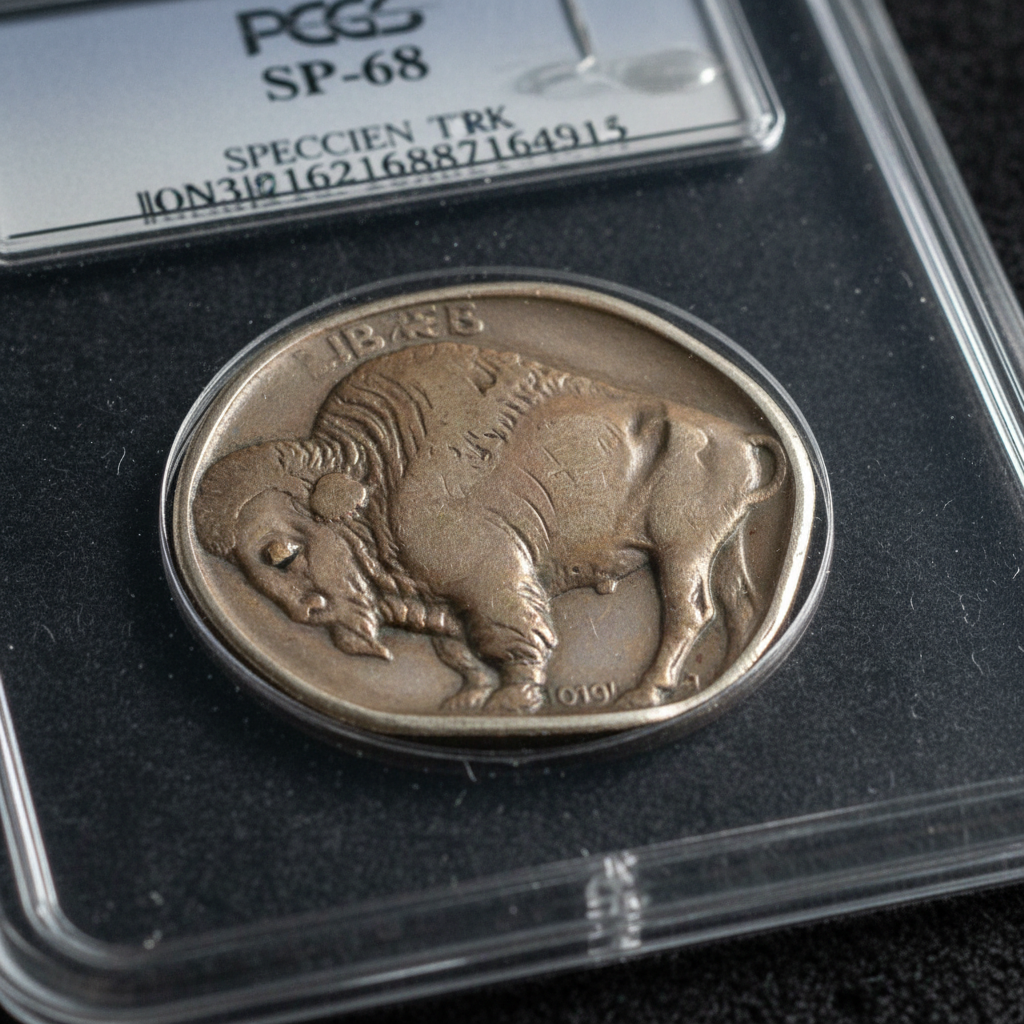
A Buffalo Nickel struck on the wrong metal just became one of the most significant mint error certifications of 2025. PCGS has authenticated and graded a Buffalo Nickel struck on a dime planchet — a wrong-planchet error of extraordinary rarity — declaring it the second-finest known example of its type. The coin emerged from a long-held private collection, the kind of old-time accumulation that still occasionally surfaces to rewrite population reports and reset market expectations.
Wrong-planchet errors occupy a rarefied corner of mint error collecting. For a Buffalo Nickel to end up struck on a dime planchet, a silver dime blank had to stray into the nickel press during production — a failure of the Mint's sorting and feeding mechanisms that quality control was supposed to prevent entirely. The result is a coin with Buffalo Nickel dies but dime-weight metal: lighter, smaller in diameter, and struck in silver rather than the standard copper-nickel composition. Every detail of that physical mismatch is immediately apparent in hand.
What Makes This Coin Exceptional
The Buffalo Nickel series ran from 1913 to 1938, and wrong-planchet survivors from this era are vanishingly rare. The combination of age, the specific planchet type involved, and the survival rate of such fragile, off-spec pieces makes any certified example noteworthy. Being ranked second-finest known by PCGS elevates this particular coin into a category where population data essentially becomes irrelevant — when the total known population can be counted on one hand, grade points matter enormously.
PCGS population reports for off-metal Buffalo Nickel errors are effectively empty by modern standards. These aren't coins that circulated in large numbers and simply went unnoticed — they were rare at the moment of production and have been aggressively sought by error specialists for decades. The fact that this example surfaced from a collection assembled over many years, rather than from a recent auction circuit, suggests it has been off the market long enough that its reappearance constitutes a genuine discovery event for the hobby.
The condition premium on a coin like this cannot be overstated. For major mint errors — particularly off-metal strikes — the difference between a problem-free mid-grade example and a top-pop specimen isn't measured in percentage points. It's measured in multiples. Comparable off-metal errors from the early 20th century in PCGS holders have realized anywhere from the low five figures to well into the six-figure range at auction, depending on series, planchet type, and grade. A second-finest designation on a Buffalo Nickel wrong-planchet error puts this coin firmly in the upper tier of that conversation.
The Market for Major Mint Errors
Mint error collecting has matured considerably over the past two decades. What was once a niche pursued by a handful of specialists — names like Fred Weinberg and Arnold Margolis built careers around cataloguing and dealing these pieces — has broadened into a recognized category with institutional collector support and consistent auction house coverage. Heritage Auctions and Stack's Bowers both maintain dedicated error coin sections, and major wrong-planchet errors routinely generate competitive bidding from both registry-focused collectors and type collectors building error sets.
The Buffalo Nickel specifically carries crossover appeal that amplifies demand. It's one of the most beloved American coin designs — James Earle Fraser's portrait of a composite Native American subject on the obverse, a American bison on the reverse — and collectors who would never identify as error specialists still covet significant examples from the series. A wrong-planchet error combines that design prestige with the inherent drama of a production anomaly. That's a powerful combination at auction.
Off-metal errors also benefit from a clarity of authentication that some other error types lack. A coin struck on the wrong planchet has a measurable, verifiable weight and diameter that either matches the host planchet or it doesn't. There's no ambiguity. PCGS certification here carries the full weight of that physical verification, which matters to buyers who might otherwise approach an unusual-looking coin with skepticism.
From Old Collection to Active Market
The provenance angle here deserves attention. Coins emerging from collections assembled in earlier decades — before the modern grading service era, before online auction platforms created price transparency — frequently arrive with no formal documentation but with the implicit credibility of long, quiet ownership. This coin wasn't cycling through dealer networks or flipping between auction appearances. It was sitting.
That kind of dormancy is increasingly rare. The error coin market has been picked over aggressively enough that genuinely fresh material is hard to come by. When a second-finest known designation lands on a coin that hasn't been seen in the market for years, serious collectors pay attention.
Whether this coin heads to a major auction house or moves through private treaty, the PCGS certification is the starting gun. The second-finest known Buffalo Nickel on a dime planchet is now officially on the market's radar — and in a field this thin, that's all it takes.