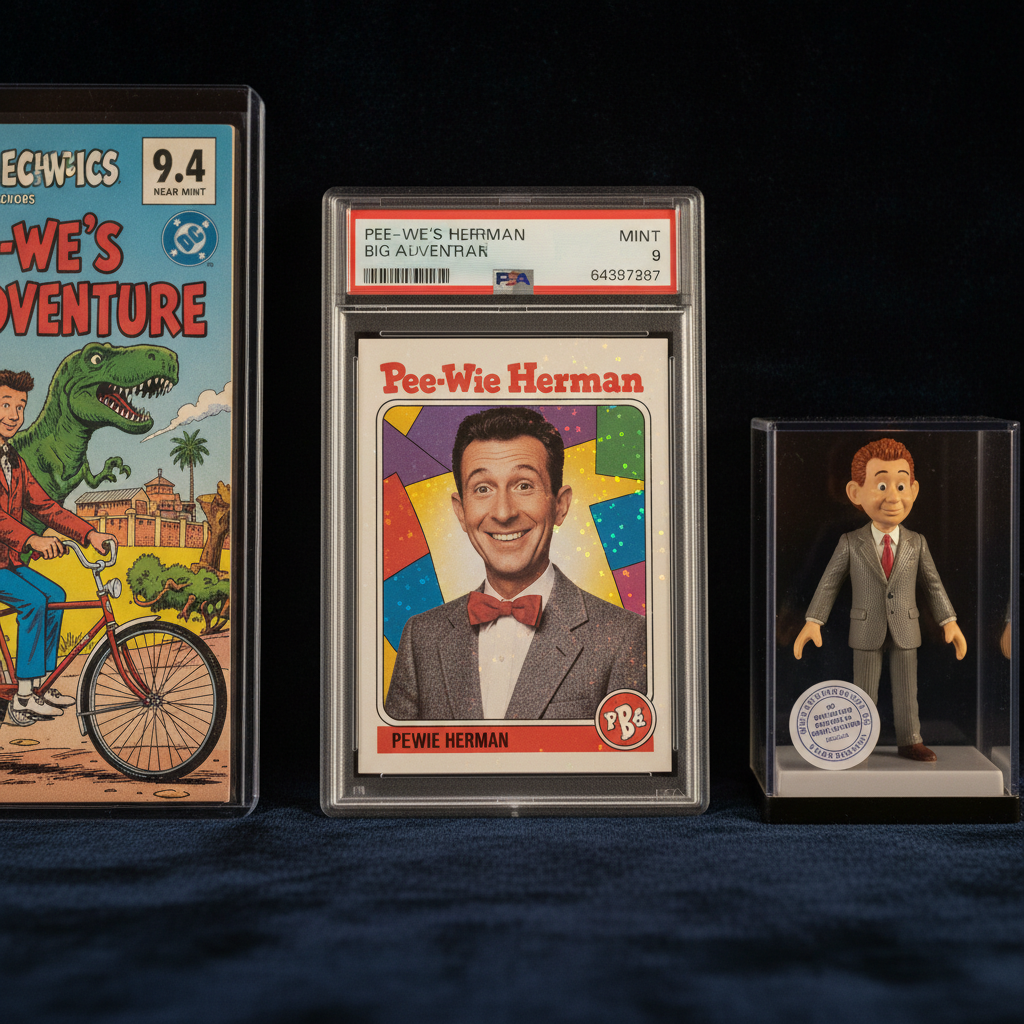
Paul Reubens died in July 2023, and the collectibles market noticed. Within weeks of his passing, completed eBay listings for Pee-wee Herman merchandise spiked sharply — a pattern that plays out almost mechanically whenever a beloved pop culture figure is lost. But unlike some posthumous surges that fade within a month, Pee-wee's market has shown more staying power, buoyed by genuine nostalgia demand, a surprisingly deep production history, and a collector base that skews toward serious accumulation rather than casual impulse buying.
The character's arc is worth understanding before you assess the collectibles. Pee-wee Herman debuted as a stage persona in 1980, broke into film with Pee-wee's Big Adventure in 1985, and reached peak cultural saturation through Pee-wee's Playhouse, which ran on CBS Saturday mornings from 1986 to 1990. That five-year television window is the primary engine of the collectibles market — it's when manufacturers flooded retail with licensed merchandise, creating the deep inventory that collectors now chase.
The Hardware: Bikes, Toys, and the Tier-One Pieces
The centerpiece of any serious Pee-wee collection is the bike. The red-and-chrome custom bicycle from Pee-wee's Big Adventure became one of cinema's most recognizable props, and licensed reproductions have commanded serious money at auction. Screen-used or production-adjacent prop pieces are exceedingly rare and, when authenticated, can reach five figures. More accessible are the vintage toy bicycles — die-cast and plastic miniatures produced in the mid-to-late 1980s — which in sealed, near-mint condition regularly trade between $150 and $400 depending on manufacturer and packaging integrity.
The toy category is where volume collectors operate. Matchbox produced a Pee-wee Herman doll in 1987 that remains one of the most recognized pieces in the category. Loose examples in played-with condition fetch $20–$40. Mint-in-box examples with tight, uncrinkled packaging and bright graphics have cleared $200 on Heritage Auctions and through established eBay power sellers. The talking version — pull-string, with Reubens' actual voice — carries a premium of roughly 30 to 40 percent over the standard release when found complete and functional.
Colorforms sets, lunchboxes, board games, and bendable figures round out the mid-tier. The 1987 Pee-wee Herman Colorforms set in excellent, unplayed condition is a legitimate $75–$125 piece. The thermos that accompanied the lunchbox is frequently separated and sold independently — a complete lunchbox-and-thermos set in Very Good or better condition is a $100–$175 transaction at current market rates.
Graded Submissions and the Authentication Question
The grading angle on Pee-wee collectibles is still developing. PSA and CGC have processed a modest volume of Pee-wee-related trading cards and printed ephemera — the 1988 Topps Pee-wee's Playhouse card set being the most submitted — but population reports remain thin enough that high-grade examples carry meaningful scarcity premiums. A PSA 9 from that set typically trades at three to four times the raw equivalent. PSA 10s surface rarely and, when they do, command collector attention disproportionate to the base price of the set.
For three-dimensional items — figures, toys, boxed games — AFA (Action Figure Authority) grading has become the relevant standard. An AFA 85 or above on a sealed Matchbox Pee-wee figure is a meaningful credential that separates investment-grade pieces from the general secondary market. Ungraded, sealed examples are increasingly being submitted as the market matures and buyers demand authentication over seller representation alone.
The broader pop culture toy market provides useful context here. Graded 1980s character toys have appreciated steadily over the past decade, with properties like Thundercats, He-Man, and Ghostbusters leading the charge. Pee-wee sits in a slightly different lane — more niche, more ironic in its appeal, and deeply tied to a specific generational memory — but the appreciation trajectory rhymes. Early movers who assembled AFA-graded Pee-wee collections five years ago are sitting on meaningful unrealized gains.
Where the Market Heads From Here
The Reubens estate has been protective of the character's legacy, and there's been no indication of a major relaunch, reboot, or licensing wave that would flood the market with new product. That supply constraint is, paradoxically, good for existing collectors. Scarcity is the foundation of value, and Pee-wee's production window was finite.
What the market lacks is a definitive price guide or population database specific to the category — the kind of infrastructure that mature markets like vintage Star Wars or G.I. Joe already have. Serious collectors currently rely on completed auction data, a handful of dedicated Facebook groups, and institutional knowledge passed between dealers. That gap creates both risk and opportunity: prices are less efficient, which means patient buyers can still find undervalued pieces, but sellers without market knowledge routinely leave money on the table.
The collector who understands that a mint, AFA-graded Matchbox talking Pee-wee doll is a $300-plus asset — not a $40 thrift store find — is the one positioned to build a collection that appreciates rather than merely accumulates. In a market this underdocumented, knowledge is still the most durable edge.