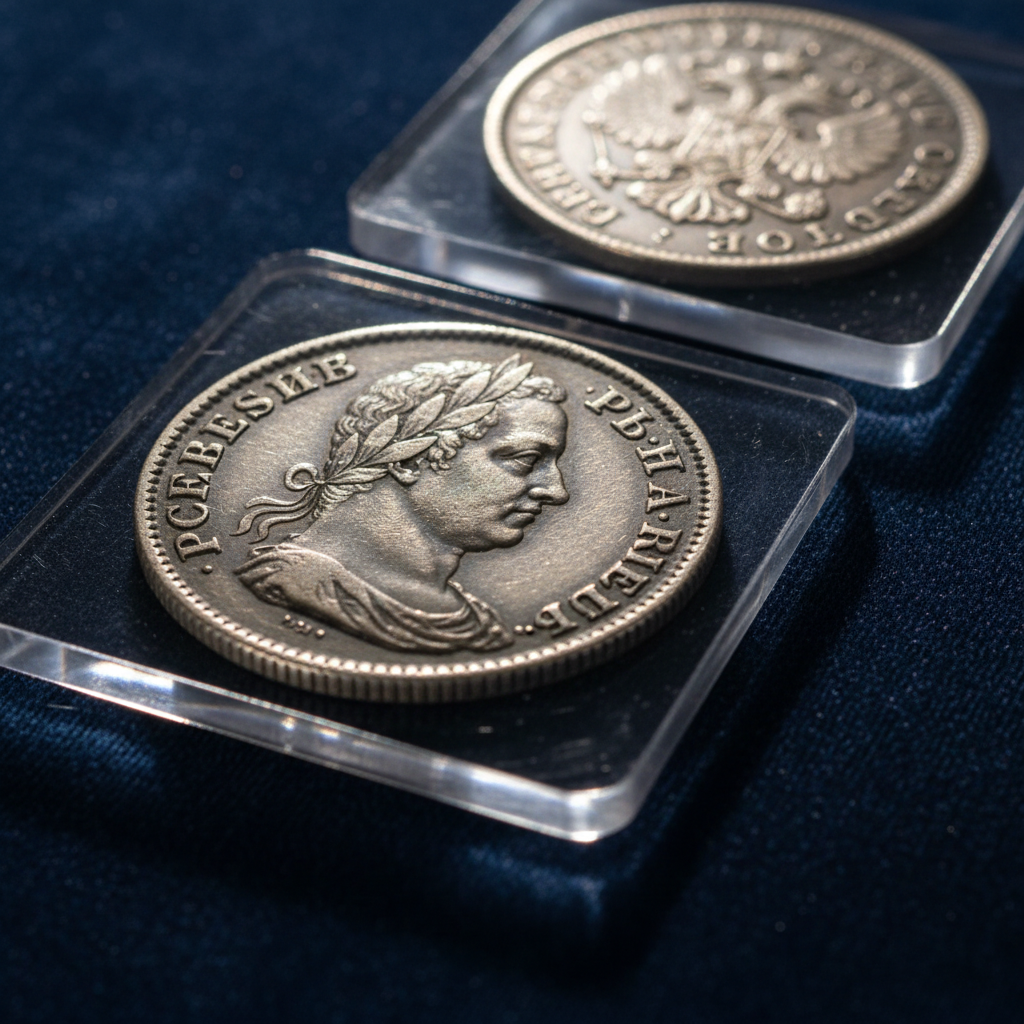
Three centuries before numismatists started slabbing everything in sight, Peter I was already reshaping the world's monetary systems — and the 1704 silver ruble is the artifact that proves it. Struck at the dawn of Russia's imperial transformation, this coin didn't just circulate. It declared war on the old order.
Peter was 32 years old in 1704. He had already toured Western Europe incognito during the Grand Embassy, returned to crush the Streltsy revolt in 1698, and forced his half-sister Sophia from power. The man was in a hurry. The monetary reform that produced the 1704 ruble was part of the same sweeping modernization agenda — a calculated effort to drag Russia into alignment with European economic and cultural norms, whether the boyars liked it or not.
The Coin as Political Statement
The 1704 ruble was the first standardized silver ruble issued under Peter's decimal monetary reform — the system that divided the ruble into 100 kopeks, a structure Russia still uses today. Before this reform, Russian coinage was a chaotic patchwork of wire money, weight-based silver pieces, and denominations that bore no rational relationship to one another. Peter abolished all of it.
The new ruble bore a Western-style portrait of the tsar — clean-shaven, in European dress, facing right. That image alone was a provocation. The Russian Orthodox tradition held that shaving the beard was a sin. Peter didn't just shave his own; he taxed the beards of those who refused to follow. The coin was a pocket-sized manifesto.
Minted at Moscow's Kadashevsky and Naberezhny yards, the 1704 ruble was struck in .729 fine silver at approximately 28 grams. The dies were cut in a Western European style, a deliberate aesthetic break from the Cyrillic-heavy, icon-influenced coinage of the previous century. Peter reportedly brought foreign craftsmen to assist — part of the same program that brought Dutch shipbuilders to Voronezh and German engineers to his nascent army.
Survival Rates and the Collector Market
Surviving examples of the 1704 ruble are genuinely scarce. Three centuries of use, wars, Soviet-era melting programs, and general attrition have thinned the population considerably. Auction House Alexander, which specializes in Russian imperial numismatics, has handled examples across the grade spectrum — from heavily circulated pieces showing the honest wear of actual commerce to higher-end survivors with sharp portrait detail and legible legends.
In the current market, problem-free circulated examples in the VF-20 to EF-40 range routinely trade in the $8,000–$18,000 range at specialist auction, depending on die variety and surface quality. Mint-state survivors — genuinely rare, not just dealer-described as such — have crossed $50,000 at major European sales. The gap between a cleaned, holed, or repaired example and a straight-graded coin is enormous here, often 40–60% of realized value. Condition sensitivity on early Russian coinage is brutal.
NGC and PCGS both encapsulate Russian imperial coinage, and their population reports for pre-1730 Russian rubles are thin by any standard. NGC's registry shows fewer than two dozen graded examples of the 1704 ruble across all grades — a population count that would make most rare coin collectors do a double-take. For context, there are more PSA 10 1952 Topps Mantle cards in existence than there are NGC-graded 1704 Peter rubles. That's not hyperbole. That's the population data.
The specialist auction market for Russian imperial coins has quietly strengthened over the past decade, driven partly by diaspora collectors and partly by a broader institutional appreciation for pre-Soviet material. Stack's Bowers and Heritage Auctions have both expanded their Russian coin offerings in recent years, though the deepest markets remain at European houses — Künker in Germany and Sincona in Switzerland regularly see strong results for Peter-era material.
Why 1704 Specifically
Among collectors of Russian imperial coinage, the 1704 ruble holds a particular status that later Peter-era issues don't quite match. It's the first year of the reformed coinage — the inaugural issue of a monetary system that would define Russia for centuries. First-year issues carry a premium in virtually every collecting category, from Morgan dollars to Pokémon base sets, and Russian imperials are no exception.
The historical weight is real, not manufactured. This coin circulated during the Great Northern War, when Peter was fighting Charles XII of Sweden for control of the Baltic. It was struck while St. Petersburg was being built from marsh and ambition on the Neva River. The men who carried these rubles in their pockets watched Russia become an empire in real time.
For the serious numismatist, the 1704 ruble isn't just old. It's a primary source — struck metal from a hinge moment in European history, when one man's obsessive modernization project reshaped a continent's eastern edge. The market hasn't fully priced that in. Yet.