The Scarlet & Violet 151 expansion just got a second life — and this time, it's not coming from tournament players. With G regulation mark cards rotating out of Standard format on April 10, the competitive case for 151 evaporated almost overnight. What's replacing it is something more durable: collector demand rooted in nostalgia, historical significance, and the Pokémon franchise's 30th Anniversary celebrations running through 2026.
The result is a measurable repricing event across the set's most iconic singles, and sealed product is tightening faster than most dealers anticipated.
From Tournament Staple to Collector Artifact
151 was never a pure competitive set — it was always a love letter to the original Kanto region. But as long as cards like Mew ex and Alakazam ex held tournament relevance, the secondary market was muddied by play-demand. Now that Standard rotation has removed that variable, the market is recalibrating around a cleaner thesis: 151 is the definitive modern tribute to the original 151 Pokémon, and collectors are pricing it accordingly.
This is a pattern the hobby has seen before. When a set loses competitive relevance but carries genuine cultural weight, the speculative froth burns off and long-term collector money moves in. The 2016 Evolutions set — itself a modern reimagining of Base Set — followed a near-identical trajectory. It was largely ignored competitively, dismissed at release, and is now one of the most sought-after modern sealed products in the hobby. Booster boxes that retailed for $100 routinely clear $400–$600 at auction today.
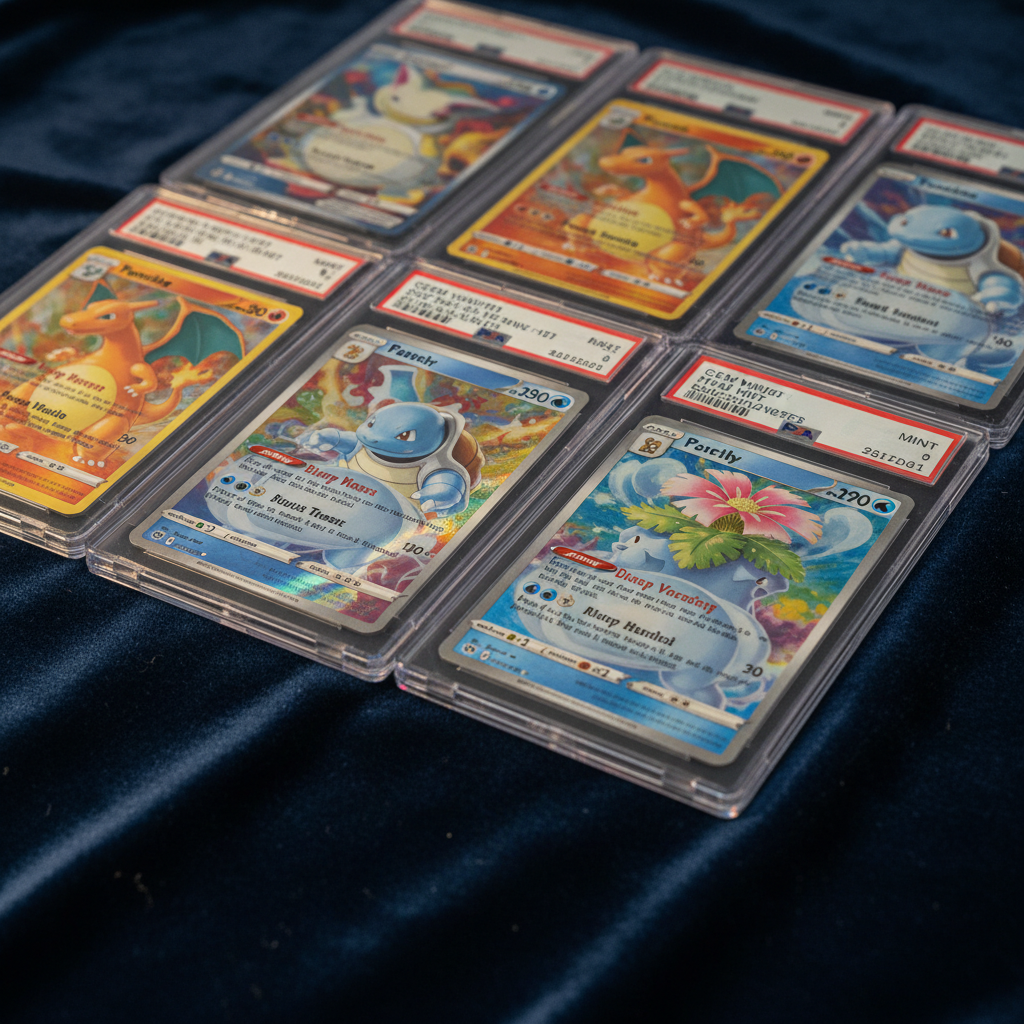
151 has a stronger foundation than Evolutions did at a comparable stage. The set includes 165 cards with full-art treatments, Special Illustration Rares, and Hyper Rares that push production quality well beyond anything from the Sword & Shield era. The chase cards — particularly the SIR versions of Venusaur, Charizard, Blastoise, and Mew — are the kind of high-ceiling singles that grade-focused collectors build around.
Sealed Supply Is the Real Story
Booster Bundles and Elite Trainer Boxes for 151 are already showing supply compression at the distributor level. This matters more than most casual observers realize. Modern Pokémon sets have a finite print window, and once The Pokémon Company shifts production priority to newer expansions, restock becomes inconsistent and then nonexistent. We've watched this play out with sets like Crown Zenith and Brilliant Stars — products that seemed abundant until they suddenly weren't.
For raw singles, the window to buy before PSA and BGS population counts climb is narrowing. Graded populations on the top SIR cards are still relatively low, which means early PSA 10 holders are sitting on above-average leverage. As the 30th Anniversary promotional cycle intensifies and mainstream media coverage of the franchise milestone grows, new collectors entering the hobby will gravitate toward exactly this kind of set — one that maps directly to the Pokémon they grew up with.
The Special Illustration Rare Charizard ex (#201) is the obvious anchor. It's the card that will define this set's ceiling in a graded context, the same way the Base Set Shadowless Charizard defines its era. Current raw copies are trading in the $80–$120 range depending on condition. A PSA 10 is clearing $250–$350 on recent Goldin and eBay auction results — numbers that look conservative if the Anniversary cycle drives the kind of mainstream attention the franchise is clearly positioning for.
The Cards Worth Prioritizing Now
Beyond Charizard, the set's SIR lineup rewards patient, condition-focused buying. The Mew ex SIR (#205), Alakazam ex SIR (#197), and Gengar ex SIR (#202) all carry strong Kanto nostalgia premiums and are underpriced relative to their likely long-term comps. The Hyper Rare gold cards — particularly Mewtwo (#207) — are also worth attention given how aggressively collectors have historically chased gold treatments in sets with this kind of cultural weight.
For collectors who prefer sealed, the Booster Bundle is the more practical entry point over ETBs right now. Bundle prices haven't fully reflected the supply tightening yet, which creates a short window before the market catches up.
The rotation didn't kill 151. It clarified it. The set is no longer a competitive product with collector upside — it's a collector product, full stop. That's a more honest valuation framework, and historically, it's the one that produces the better long-term returns.