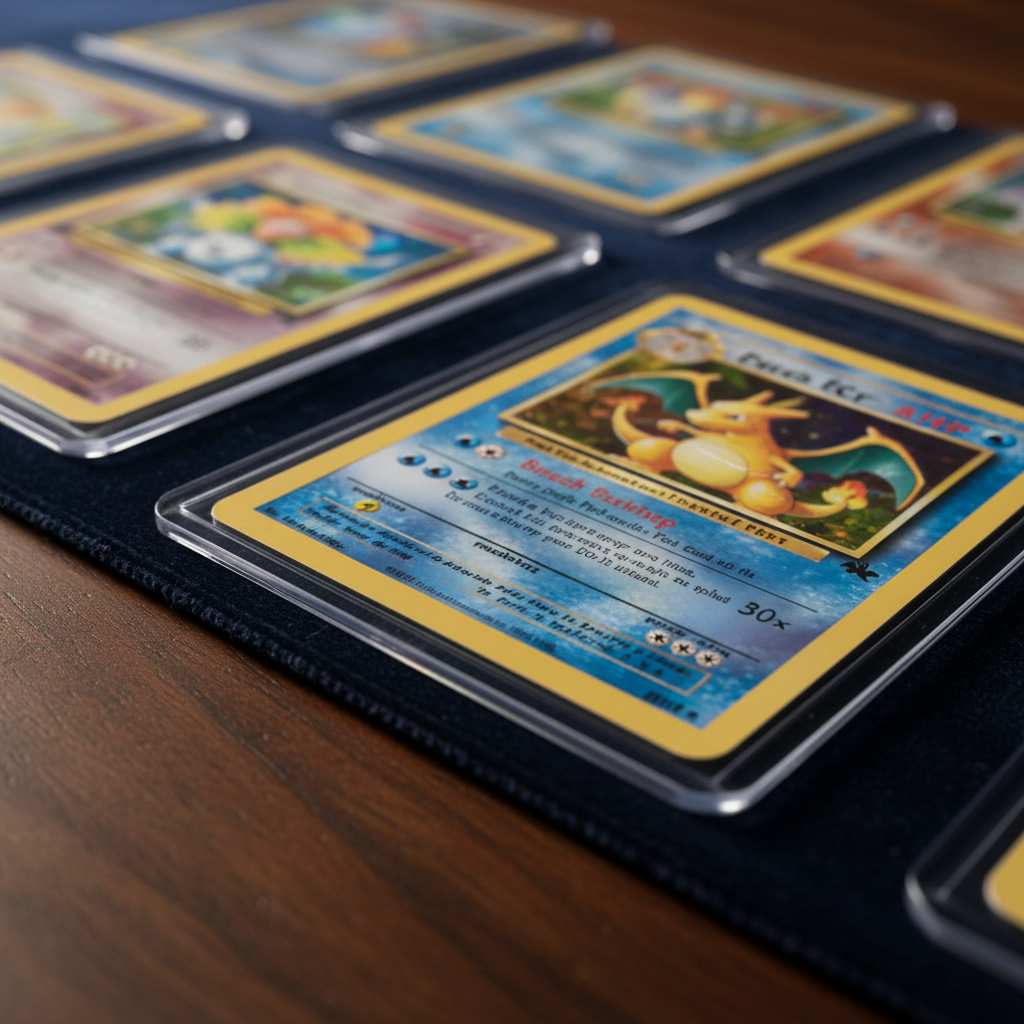
Released in October 1999, the Pokémon Fossil set arrived as the third expansion to the Base Set — and while it never commanded the same cultural gravity as its predecessor, it quietly produced some of the hobby's most resilient blue-chip assets. Three decades of grading data and auction results have made one thing clear: the Fossil set's top cards aren't just nostalgia plays. They're legitimate investment-grade collectibles with real market depth.
The Cards That Actually Move Markets
At the top of the food chain sits the Holo Rare Gengar (#5/62). A PSA 10 example hammered for $7,200 at Goldin in late 2023, and the population is tight enough to keep prices elevated — PSA has graded roughly 3,400 total copies, with fewer than 200 earning a perfect 10. That sub-6% gem rate is the story. Fossil holos are notoriously difficult to grade due to print lines and holo scratching, and Gengar's dark card face makes every flaw visible under light.
Dragonite (#4/62) is the set's other headline act. As one of the original 150's most beloved designs, Dragonite commands a premium that pure gameplay value can't fully explain — this is collector sentiment at work. PSA 10 copies have traded between $1,800 and $4,500 depending on timing and eye appeal, with BGS 9.5 Black Labels occasionally punching above that range at Heritage auctions. Population for PSA 10 sits under 150, making it one of the rarest gem-grade pulls in the entire 1999-era Pokémon catalog.
Then there's Lapras (#10/62), which doesn't get the headline treatment it deserves. A PSA 10 sold for $2,100 on PWCC in early 2024 — strong for a card that rarely dominates top-10 lists. Lapras benefits from crossover demand: it's a fan-favorite design, a competitive card historically, and one of the harder Fossil holos to pull in gem condition. The centering on Lapras is notoriously inconsistent straight from pack, and that's reflected in its gem population.
Mid-Tier Cards With Long-Term Upside
Below the top three, the Fossil set offers a range of cards that serious collectors shouldn't overlook.
- Haunter (#6/62, Holo) — PSA 10 copies trading in the $800–$1,400 range; ghost-type demand keeps a floor under prices
- Articuno (#2/62) — Legendary bird status and iconic artwork push PSA 10s to $1,200–$2,000; one of the cleaner holo pulls in the set
- Moltres (#12/62) — Undervalued relative to Articuno, with PSA 10s hovering around $900–$1,500; the population gap between the two is narrower than the price gap suggests
- Zapdos (#15/62) — Historically the weakest of the three legendary birds in Fossil, but PSA 10s still clear $700–$1,100 consistently
- Aerodactyl (#1/62) — The set's most mechanically disruptive card in competitive play; PSA 10 examples have reached $1,800 at auction, driven by dual collector and vintage player demand
Aerodactyl deserves a closer look. Its gameplay ability — preventing Pokémon Power use — made it a staple in 1999-era competitive decks, and that historical significance adds a layer of demand that pure aesthetics can't replicate. It's one of the few Fossil cards where competitive history and collector demand genuinely converge.
What the Grading Data Tells You
The Fossil set has a grading problem — or rather, a grading opportunity, depending on your position. The cardstock and print quality from this era means raw copies frequently show print lines, off-center cuts, and holo surface wear that kills grades. PSA 9s are common. PSA 10s are not. That gap between supply and gem-grade supply is where the real value lives.
For context: PSA has graded over 8,000 copies of Gengar (#5/62) across all grades. Fewer than 200 are 10s. That's a conversion rate that would embarrass most modern set releases, where gem rates routinely hit 30–50%. The scarcity isn't manufactured — it's structural, baked into the production quality of 1999 Wizards of the Coast print runs.
BGS graders have added another dimension here. BGS 9.5 Black Labels on Fossil holos are extraordinarily rare — the subgrade requirements expose every flaw the PSA scale might overlook — and when they surface at Heritage or Stack's Bowers, they consistently set new benchmarks. A BGS 9.5 Gengar sold privately for a reported $9,500 in 2022, a figure that underscores just how thin the top of this market really is.
The Fossil set will never dethrone Base Set in the hierarchy of Pokémon collecting. But for buyers who understand what gem-grade scarcity actually means — and who can read population reports rather than just hype cycles — it remains one of the most compelling value propositions in the vintage Pokémon market. The cards are out there. The 10s aren't.