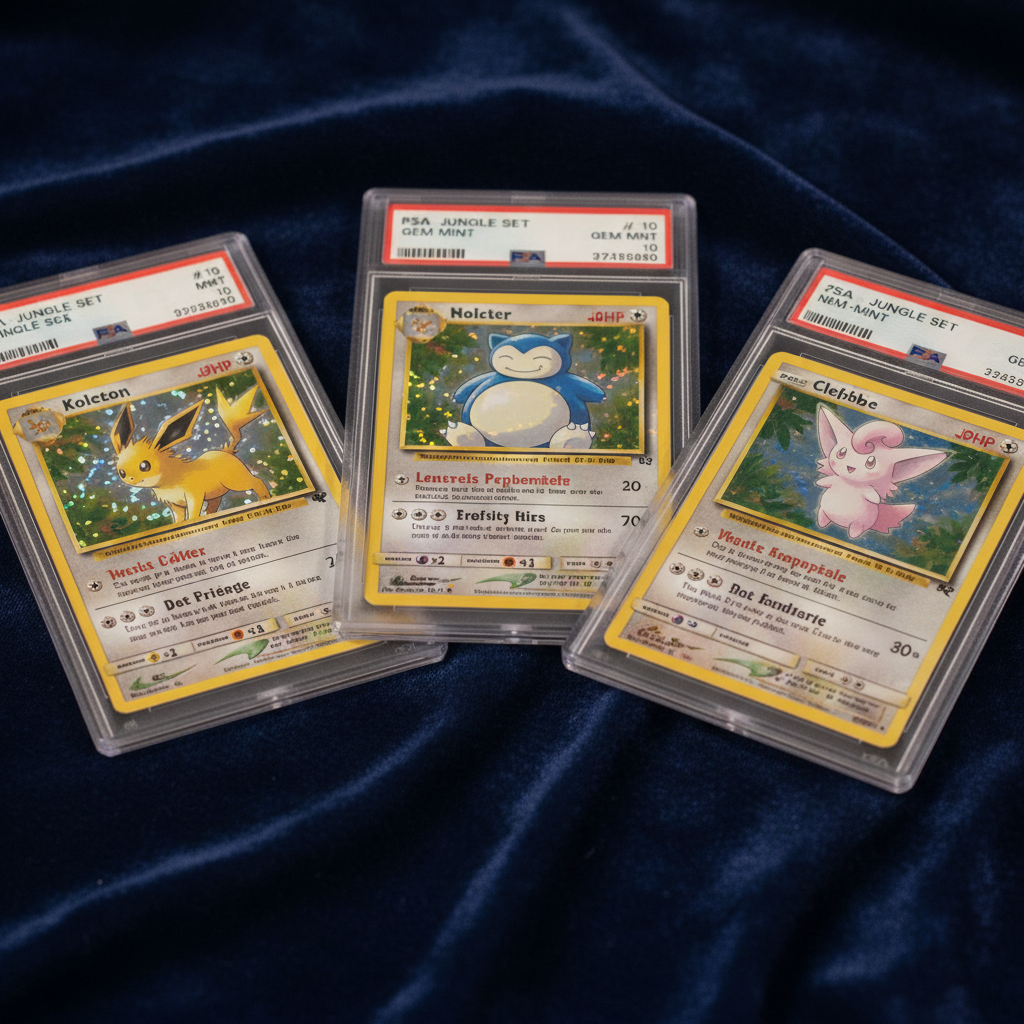
Twenty-five years after hitting hobby shop shelves, the 1999 Pokémon Jungle expansion is no longer just nostalgia fuel — it's a condition-driven asset class where the difference between a PSA 8 and a PSA 10 can mean thousands of dollars. Released on June 16, 1999, Jungle was the first set to push beyond the original Base Set, and the market has never forgotten it.
The set introduced structural precedents that still define the hobby: the expansion symbol, the holo/non-holo rare split, and a print quality inconsistent enough to make gem-mint copies genuinely scarce. That last point is where the real money lives.
Snorlax #11 and the Condition Rarity Premium
Snorlax #11 is the headline act. A raw, ungraded copy trades around $40 — accessible, unremarkable. But climb the grading ladder and the economics shift dramatically. The card's holographic surface is notoriously prone to print lines, surface scratches, and centering issues that plagued the Wizards of the Coast print runs of this era. PSA 10 population on Jungle holos is thin across the board, and Snorlax is no exception.
This is the defining dynamic of the vintage Pokémon market: cards that are common in low grades but functionally rare in high ones. It's not about scarcity of the card itself — it's about scarcity of the card in a condition that meets modern collector standards. Snorlax #11 exemplifies that tension better than almost anything else in the set.
For context, PSA 10 examples of top Jungle holos have cleared four-figure sums at auction houses including Goldin and PWCC, with the spread between a PSA 9 and PSA 10 often exceeding 300% on the strongest pulls. That's not a rounding error — that's a market telling you exactly how much condition matters.
Manufacturing Errors and the Collector Premium They Command
Beyond condition, Jungle carries another layer of complexity: manufacturing anomalies. Wizards-era production introduced error variants — most notably the no-symbol error cards, where the Jungle expansion symbol was omitted from the card's lower right corner. These cards were printed without the jungle tree icon, making them visually identical to Base Set cards at a glance.
Error variants from Jungle command significant premiums over their standard counterparts. The no-symbol versions of cards like Scyther and Clefable are legitimately scarce, and authenticated examples in high grade have attracted serious bidding from vintage specialists. Heritage Auctions has moved certified error variants in this space, and the category continues to draw crossover interest from error collectors who wouldn't otherwise touch Pokémon.
The broader Jungle checklist — 64 cards total, split across 16 holos and 48 non-holos — doesn't look intimidating on paper. But completing a PSA 10 master set is a multi-year, multi-thousand-dollar project. Population reports bear this out. Several Jungle holos have fewer than 50 PSA 10 examples in existence, and a handful sit well below that threshold.
Where Jungle Sits in the Vintage Pokémon Hierarchy
Base Set gets the headlines. Shadowless Base, 1st Edition Base, the Charizard #4 — these are the cards that broke auction records and put Pokémon on Bloomberg terminals. Jungle operates one tier below in cultural cachet but arguably offers sharper value propositions for informed buyers.
The set benefits from the same Wizards-era print quality issues that make Base Set 1st Editions so condition-sensitive, without carrying the same speculative premium that has inflated Base Set pricing since the 2020-2021 boom. A collector who missed the Base Set window hasn't necessarily missed the vintage Pokémon opportunity — Jungle and its immediate successor Fossil represent the next frontier of serious graded collecting.
Institutional buyers have started paying attention. PWCC's marketplace data shows consistent demand for PSA 9 and PSA 10 Jungle holos from repeat bidders, a signal that the set is moving from pure nostalgia play toward portfolio-grade asset. That shift, once it takes hold, tends to be durable.
The Jungle set turned 25 this year. The collectors who understand condition rarity — not just card rarity — are the ones positioned to benefit from what comes next.