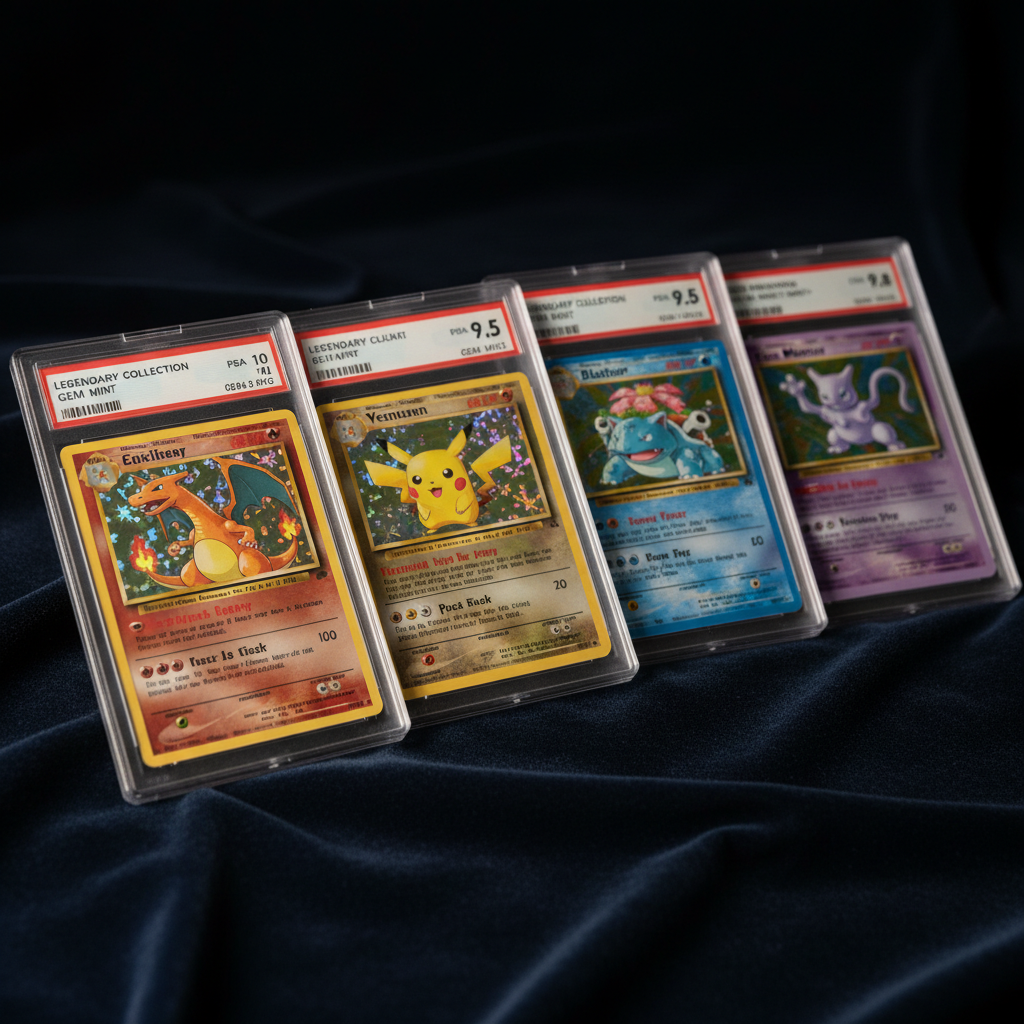
Twenty-three years after its May 2002 release, Pokémon's Legendary Collection remains one of the most quietly significant sets in the hobby — and its top cards are commanding prices that would have seemed absurd at the time of printing. This was a reprint set, remember. A second-chance product built entirely from cards already seen in Base Set, Jungle, Fossil, and Team Rocket. And yet, the market has spoken: condition-sensitive, low-population gems from this set are genuinely difficult to acquire, and dealers know it.
The reason comes down to one innovation that no Pokémon set before or since has replicated: the reverse holographic treatment. Legendary Collection introduced a fireworks-style foil pattern applied to the card background — not the artwork, but the surrounding field — creating a visual effect that's immediately identifiable to anyone who has held one. Every single card in the set received this treatment in reverse holo form, which means even a Rattata or a Gastly carries real secondary market value if it grades well. That's not hyperbole. That's the market in 2024.
Why Condition Scarcity Drives This Set
Legendary Collection was a mass-market product aimed at players, not collectors. Packs were opened, cards were sleeved and shuffled, binders were stuffed. The reverse holo cards in particular were novelty items to kids in 2002 — not investment-grade assets to be kept flat and dry. The result, two decades later, is a population report problem for high-grade copies.
PSA 10 populations on the set's most desirable cards are thin. Not scarce in the way a 1998 Pikachu Illustrator is scarce, but scarce enough that a single high-grade auction can reset the comp entirely. The fireworks foil pattern also has a tendency to show surface wear and print lines more aggressively than standard holos, which pushes even well-preserved copies into PSA 8 or 9 territory. A true gem mint example stands out.
The five most valuable cards in the set reflect both the original card's legacy and the population dynamics at play today.
The Cards That Move the Market
At the top sits the Charizard reverse holo, the card that anchors nearly every Legendary Collection conversation. As a reprint of the Base Set Charizard — still the most recognizable Pokémon card ever printed — the LC version carries enormous crossover demand. PSA 10 copies have sold north of $5,000, with the most pristine examples pushing considerably higher depending on centering and surface quality. The reverse holo treatment makes centering graders' primary concern, and off-center LC Charizards are plentiful.
The Venusaur reverse holo and Blastoise reverse holo round out the Base Set starter trio, both commanding four-figure prices in PSA 10. Neither approaches Charizard's ceiling, but both benefit from the same collector psychology: these are the original three, in a format that exists nowhere else in the hobby. Blastoise PSA 10s have cleared $1,500 at auction. Venusaur trails slightly but remains a consistent performer.
The Raichu reverse holo is the sleeper of the set. Raichu's Base Set holo was always undervalued relative to its cultural footprint — Pikachu's evolved form, perpetually overshadowed — and the LC reverse holo version follows that same pattern. Population at PSA 10 is extremely thin, and when a high-grade copy surfaces, it tends to attract disproportionate attention from set collectors trying to complete the top tier. Sales in the $800–$1,200 range for PSA 10s are well-documented.
Rounding out the five is the Mewtwo reverse holo. Mewtwo's position as the franchise's most powerful original Pokémon gives it enduring demand, and the LC reverse holo version benefits from the same population dynamics as the rest of the set's holos. PSA 10 copies have traded in the $1,000–$1,500 range, with variance tied almost entirely to surface quality and the consistency of the fireworks foil.
The Broader Set Play
What makes Legendary Collection interesting as a collector proposition isn't just the top five — it's the structure of value across the entire checklist. Because the reverse holo treatment was applied universally, a complete reverse holo set in high grade is a legitimate long-term project with real scarcity behind it. Set collectors who have attempted PSA 9 or PSA 10 complete runs report that the bottleneck cards are often not the Charizards and Mewtwos, but mid-tier holos and even some commons where print quality was inconsistent at the factory level.
The set also benefits from a generational tailwind. Collectors who were children in 2002 are now in their late twenties and thirties, with disposable income and nostalgia that's specifically tied to this era of the game. Legendary Collection was the product on shelves when many of them were buying packs. That emotional connection has a market value, and it compounds over time.
For a reprint set, Legendary Collection has aged remarkably well. The fireworks foil alone guarantees it a permanent footnote in the hobby's history. The prices at the top of the checklist suggest it deserves more than a footnote.