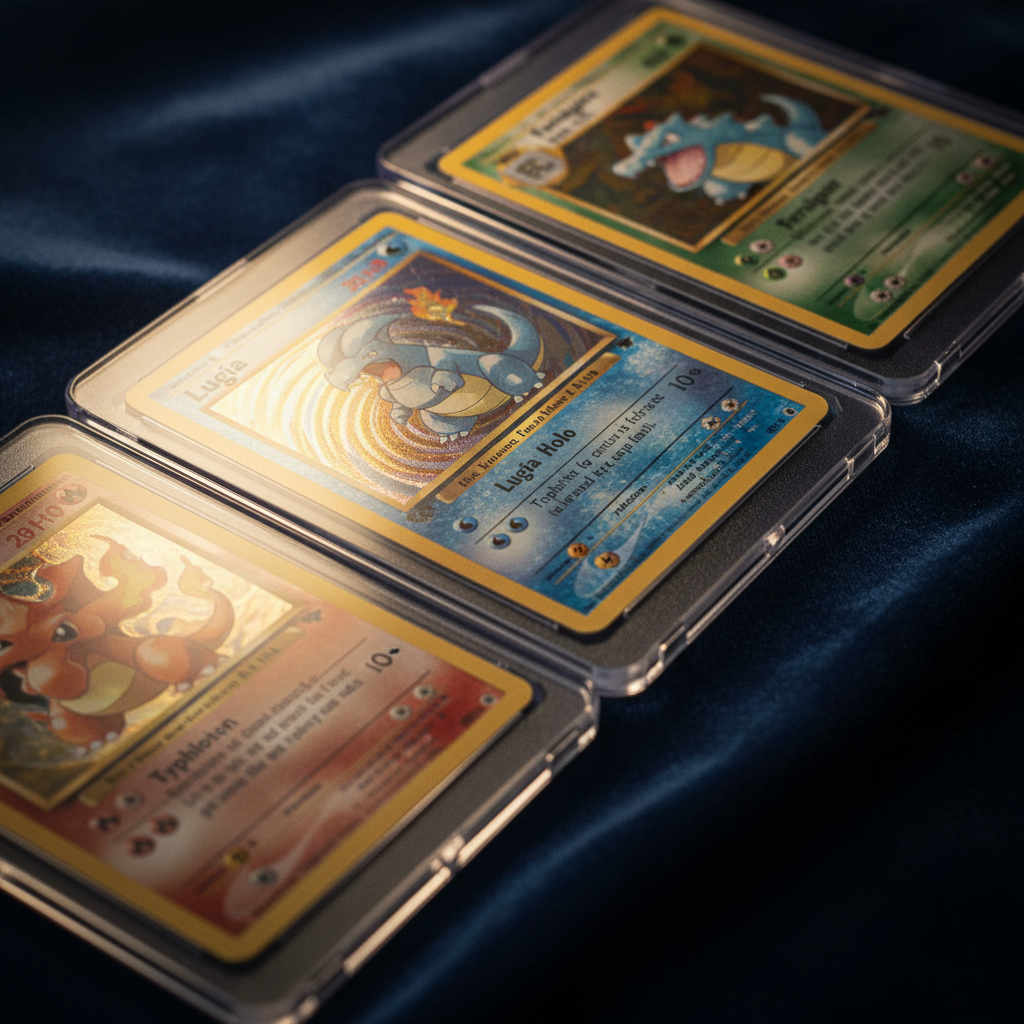
Twenty-four years after Wizards of the Coast shipped Neo Genesis to hobby shops worldwide, the set's elite cards are still punching well above their weight at auction. Released in December 2000, Neo Genesis wasn't just a new expansion — it was a structural overhaul of the Pokémon TCG, and the market has never forgotten it.
The set introduced Johto-region Pokémon to a global audience, but its mechanical legacy runs deeper than new creatures. Neo Genesis gave the game Darkness and Metal energy types, Special Energy cards, Pokémon Tools, and the Baby Rule — a stall mechanic that fundamentally slowed down the breakneck pace of the Wizards of the Coast base set era. For collectors, that mechanical significance translates directly into sustained demand. Sets that changed the game tend to hold their value. Neo Genesis changed it substantially.
The Cards That Define the Set's Ceiling
At the top of the Neo Genesis hierarchy sits Lugia (Holo, #9/111). It is, without meaningful debate, the set's centerpiece. A PSA 10 Lugia has cleared $3,000–$5,000 in recent Heritage and Goldin sales, with exceptional examples pushing higher depending on centering and surface quality. PSA's population for PSA 10 Lugia holos remains thin relative to demand — a function of the card's notoriously difficult print quality, which makes gem-mint copies genuinely scarce rather than artificially so.
The 1st Edition stamp changes the calculus entirely. A PSA 10 1st Edition Lugia is a five-figure card. That's not speculation — it's a price point the market has confirmed repeatedly. Collectors chasing the 1st Edition Unlimited distinction understand that Neo Genesis print runs were considerably smaller than Base Set, and the 1st Edition window was narrow. Scarcity here is structural, not manufactured.
Typhlosion (Holo, #17/111) and Feraligatr (Holo, #4/111) round out the holo rare tier with genuine collector heat. Both Johto starters carry nostalgia premiums from a generation of players who grew up with Gold and Silver versions, and PSA 10 copies of each have traded in the $400–$900 range depending on edition and timing. Neither card approaches Lugia's ceiling, but both represent legitimate value plays in high grade.
The Meganium (Holo, #10/111) completes the starter trio and trades at a modest discount to Typhlosion and Feraligatr — the Chikorita line has always carried a soft popularity penalty — but a PSA 10 1st Edition copy still commands respect in the $300–$600 range.
Grading Realities and the 1st Edition Premium
Neo Genesis cards present specific grading challenges that collectors underestimate. The holofoil pattern on this set is prone to scratching, and the card stock — while sturdier than some later WOTC-era sets — shows print lines and centering issues at a rate that suppresses PSA 10 populations across the board. For context, PSA's overall gem-mint rate on Neo Genesis holos hovers well below 10% on most submissions, making high-grade examples genuinely difficult to source rather than merely expensive.
BGS graders have noted similar surface sensitivity, and BGS 10 Black Labels on Neo Genesis holos are exceptionally rare. A Black Label Lugia would be a landmark result — the kind of card that generates its own auction event.
The 1st Edition versus Unlimited split matters more here than in many sets. Because Neo Genesis arrived after the initial Pokémon frenzy had somewhat cooled in North America, 1st Edition print runs were not as massive as collectors sometimes assume. That means the supply ceiling on 1st Edition PSA 10s is real and relatively low, which is exactly the condition that sustains long-term price appreciation.
Where Neo Genesis Sits in the Broader WOTC Market
The WOTC-era Pokémon market has matured considerably since the 2020–2021 speculative peak. Prices across Base Set, Jungle, and Fossil corrected sharply from their highs. Neo Genesis, however, has shown relative resilience — partly because it was never as aggressively hyped during the bubble, and partly because its collector base skews toward players who actually experienced Gold and Silver as formative games. That's a different buyer profile than the pure-investment crowd, and it tends to produce stickier demand.
Compared to a PSA 10 Base Set Charizard — which remains the genre's benchmark at $6,000–$10,000 for Unlimited and multiples of that for 1st Edition — Neo Genesis Lugia trades at a meaningful discount. Whether that gap is justified is a fair debate. Lugia's cultural footprint is arguably comparable to Charizard's among the Gold and Silver generation, and the population data suggests comparable scarcity at the gem-mint tier.
The market hasn't fully closed that gap yet. Whether it ever does depends on how the hobby values mechanical significance versus raw nostalgia — and right now, nostalgia for the original 151 still wins on price. But Neo Genesis isn't standing still, and collectors who've been sleeping on the set's top cards are waking up to thinner supply than they expected.