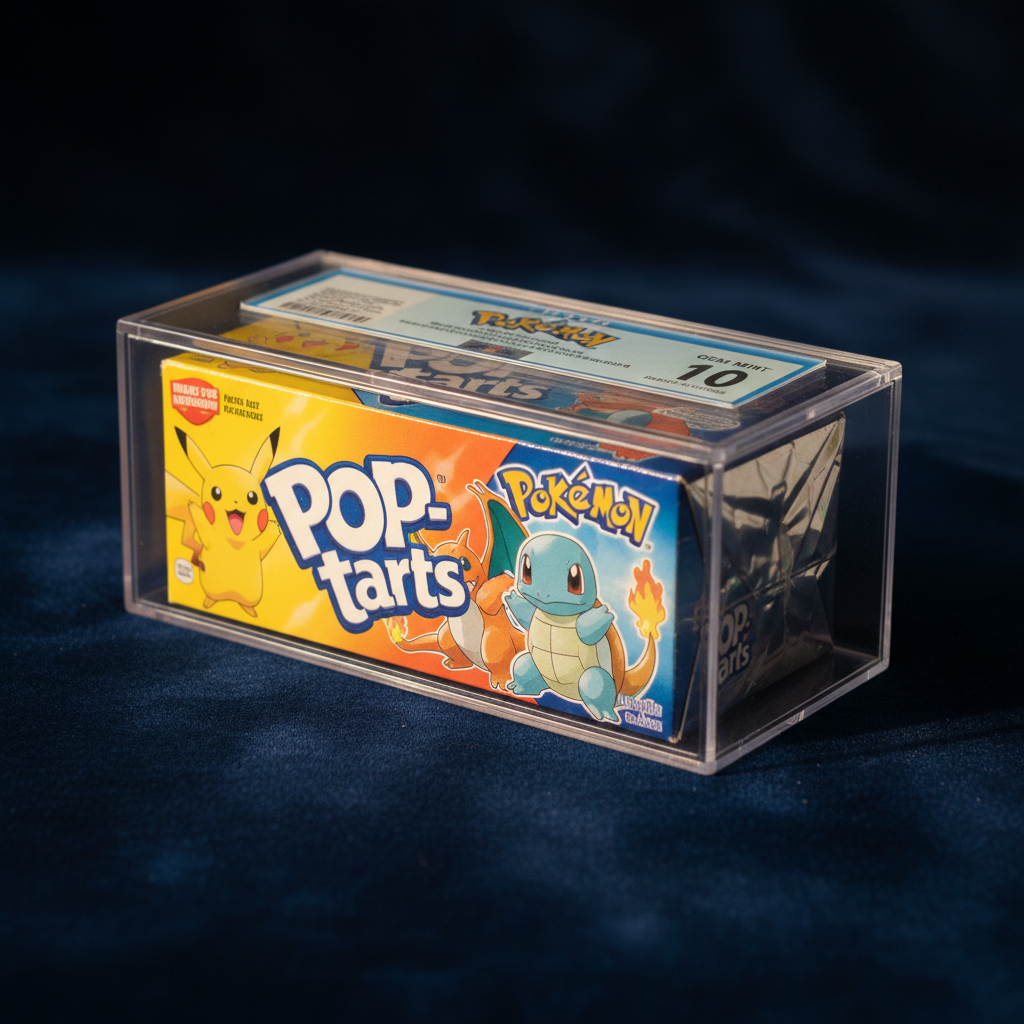
Breakfast pastries are not supposed to have a secondary market. And yet, here we are: Pokémon-branded Pop-Tarts are moving on eBay and resale platforms at multiples above retail, driven by the same collector psychology that turned a cardboard Charizard into a five-figure asset.
The crossover makes more sense than it sounds. Kellogg's has periodically released Pokémon-themed Pop-Tarts featuring character artwork on the packaging and, in some editions, printed designs on the pastries themselves. For a segment of the Pokémon collector base — one that has always extended well beyond cards into plush, video games, merchandise, and promotional items — branded food packaging is legitimate collectible territory. Sealed, unopened product is the key qualifier. An opened box is a snack. A sealed box with crisp, undamaged packaging is, to the right buyer, a piece of the broader Pokémon artifact universe.
The Resale Numbers
Completed eBay listings tell the story plainly. Individual boxes of Pokémon Pop-Tarts that retail for roughly $4 to $6 at grocery chains have sold in the $15 to $40 range depending on the specific edition, condition of the outer box, and whether the listing includes multiple boxes or a full case. Rarer promotional runs — particularly those tied to specific game launches or limited regional distribution — command the upper end of that range and occasionally exceed it.
Multipack lots and factory-sealed cases attract a different buyer profile: the long-term hoarder banking on scarcity appreciation. It's a strategy borrowed directly from the sports card world, where factory-sealed wax boxes from the late 1980s and early 1990s now sell for thousands precisely because almost nobody thought to preserve them at the time. Nobody grades a Pop-Tart box — yet — but the underlying logic is identical.
Search volume on platforms like Mercari and eBay spikes noticeably around new Pokémon game releases and the annual Pokémon World Championships, when collector enthusiasm is running hottest and casual fans are more likely to impulse-buy anything branded. That seasonal dynamic is something experienced resellers have learned to exploit, buying up shelf inventory in the weeks before peak demand and listing into the wave.
Where This Fits in the Broader Pokémon Collectibles Ecosystem
The Pokémon brand is, by any measure, the highest-grossing media franchise in history — surpassing $150 billion in total revenue as of recent estimates. That scale means the collectible footprint is enormous and deliberately maintained by The Pokémon Company through aggressive licensing across categories. Food and beverage licensing is one tentacle of that strategy, and it has produced collectible-grade crossover products before.
Pokémon-branded cereal boxes from the late 1990s — particularly those that included promotional cards — are now legitimate vintage collectibles. A sealed box of Pokémon Cereal from 1999 with intact promotional cards can fetch $100 to $300+ depending on condition, and a few exceptional examples have crossed the $500 threshold at auction. The Pop-Tarts category is earlier in that maturation curve, which is exactly why some buyers are positioning now.
The comparison to promotional cards embedded in food products is instructive. Burger King's 1999 Pokémon gold card promotion produced some of the most widely collected non-TCG Pokémon items in existence. A graded PSA 10 Burger King Pikachu gold card has sold for over $500. The packaging from those meals — the gold card boxes, the Poké Ball containers — also carries collector value in sealed condition. Food-adjacent Pokémon items have a documented track record. Pop-Tarts are simply the current chapter.
The Grading Question Nobody Is Asking Yet
No major grading service currently offers a product line for food packaging collectibles at scale, though CGC has expanded aggressively into non-card categories including coins, comics, and video games. The question of whether sealed food products could enter a grading pipeline — evaluated on packaging integrity, print quality, seal condition — is not as absurd as it sounds in 2025. CGC Games grades sealed video game boxes. The infrastructure logic is already there.
For now, the market operates on collector consensus around condition standards: no dents, no moisture damage, no fading, original seal intact. Boxes stored in protective sleeves or hard cases photograph better and sell faster. It's informal grading by another name.
The Pokémon Pop-Tarts resale phenomenon is a small story with a large implication: in the Pokémon ecosystem, almost nothing is too mundane to become collectible given enough time, scarcity, and community attention. The franchise has spent 25-plus years proving that point repeatedly. Collectors who laugh at the Pop-Tart market today are the same ones who passed on sealed 1999 cereal boxes at garage sales two decades ago.