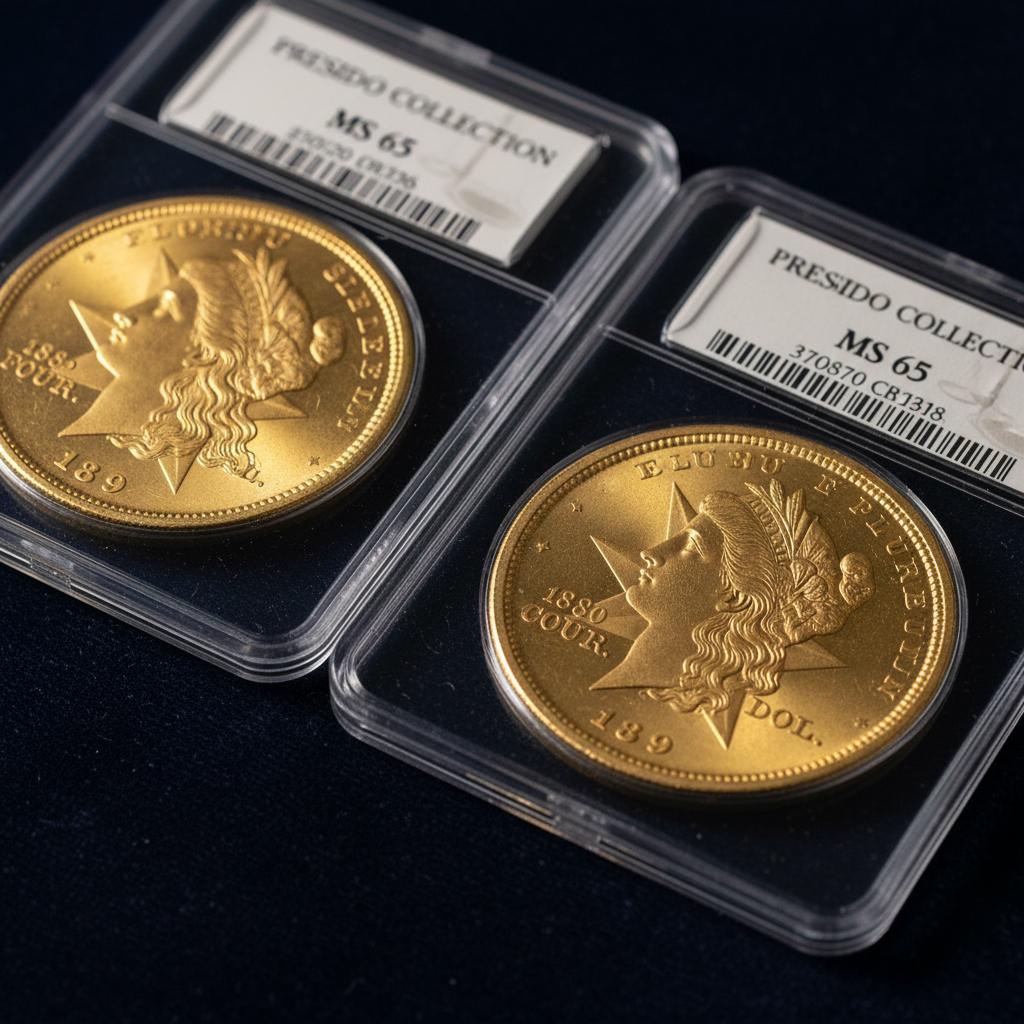
Pattern coin by classification. Trophy issue by demand. The Four Dollar Stella has never fit neatly into any single box, and that ambiguity — far from hurting it — has made it one of the most fiercely contested coins in American numismatics. The recent sale of a four-piece Four Dollar Stella set from The Presidio Collection made that case more forcefully than any catalog essay could.
The Stella was struck in 1879 and 1880 as a proposed international trade coin, intended to circulate alongside European denominations of similar weight and fineness. Congress never approved it for regular production. The Mint struck only small quantities — a few hundred examples across four distinct varieties — and most went to congressmen and government officials. They were never meant for commerce. They became legends anyway.
Four Varieties, One Defining Set
The complete Stella set breaks down across two design types and two years. The 1879 Flowing Hair is the most available of the group, with surviving populations measured in the hundreds. The 1879 Coiled Hair is dramatically rarer — PCGS and NGC combined census figures suggest fewer than 30 examples are known in all grades. The 1880 Flowing Hair and 1880 Coiled Hair round out the set, with the 1880 Coiled Hair considered by many specialists to be the single hardest date-and-variety to acquire in any grade above Fine.
Assembling all four in a single collection is a generational achievement. Most advanced collectors settle for one or two pieces over a lifetime of searching. The Presidio Collection bringing a complete set to market at once is the kind of event that pulls bidders out of retirement.
The four-piece grouping attracted exactly that level of attention. Bidding was aggressive across all four lots, a signal that demand for Stellas is not concentrated in just the headline variety. Even the comparatively accessible 1879 Flowing Hair drew serious competition — a reminder that in this market, accessible is relative. A coin that might trade for $30,000 to $50,000 in circulated grades can push well past $100,000 in gem mint state, and the finest known examples have cleared seven figures at major auction.
What the Presidio Results Tell Us About the Market
The Stella market has historically tracked closely with the broader U.S. gold type coin market, but with amplified volatility in both directions. When collector confidence is high and liquidity is flowing, Stellas outperform. When the market softens, they can sit. The Presidio results suggest the current environment leans firmly toward the former.
For context: a PCGS MS-64 example of the 1879 Flowing Hair Stella brought $264,000 at Heritage in a recent major auction. The 1879 Coiled Hair in comparable grade has fetched north of $500,000 when offered. The rarest varieties — particularly the 1880 Coiled Hair — have sold at prices that place them alongside the most valuable pattern coins in American numismatic history, including the 1913 Liberty Nickel and the 1804 Silver Dollar in terms of collector prestige, if not raw dollar value.
The Presidio sale reinforces a trend that has been building quietly for several years: collectors are willing to pay significant premiums for provenance and set integrity. A coin with a strong collection pedigree — especially one that is part of a documented, complete set — commands more than an equivalent raw example sourced from an anonymous estate. The Presidio name carried weight at the podium, and the results reflected it.
The Deeper Appeal of the Stella
Part of what makes the Stella market so durable is the coin's story. It failed as a monetary instrument and succeeded as an artifact. There is something genuinely compelling about a coin struck in a metal alloy — 6 parts gold, 3 parts silver, 1 part copper, designed to match European monetary standards — that never circulated a single day in commerce and yet commands prices that dwarf most regular-issue U.S. gold coinage.
Collectors who focus on pattern coins often argue that Stellas deserve to be catalogued separately from the broader pattern series, given their price levels, collector base, and auction frequency. That argument has merit. In practice, the coin already lives in its own market tier — one that overlaps with advanced U.S. gold collectors, with pattern specialists, and with generalist trophy hunters who simply want the most storied pieces American coinage produced.
The Presidio Collection set did not rewrite the record books. What it did was something arguably more meaningful: it confirmed that even without a headline-shattering single-coin result, a complete Stella set in strong grades draws the kind of bidding that serious markets are built on. Sustained demand, not just one-off fireworks, is what defines a healthy collectible category.
The $4 Stella market isn't just shining. It's holding temperature in conditions that have tested plenty of other corners of the rare coin world — and that kind of consistency is its own form of rarity.