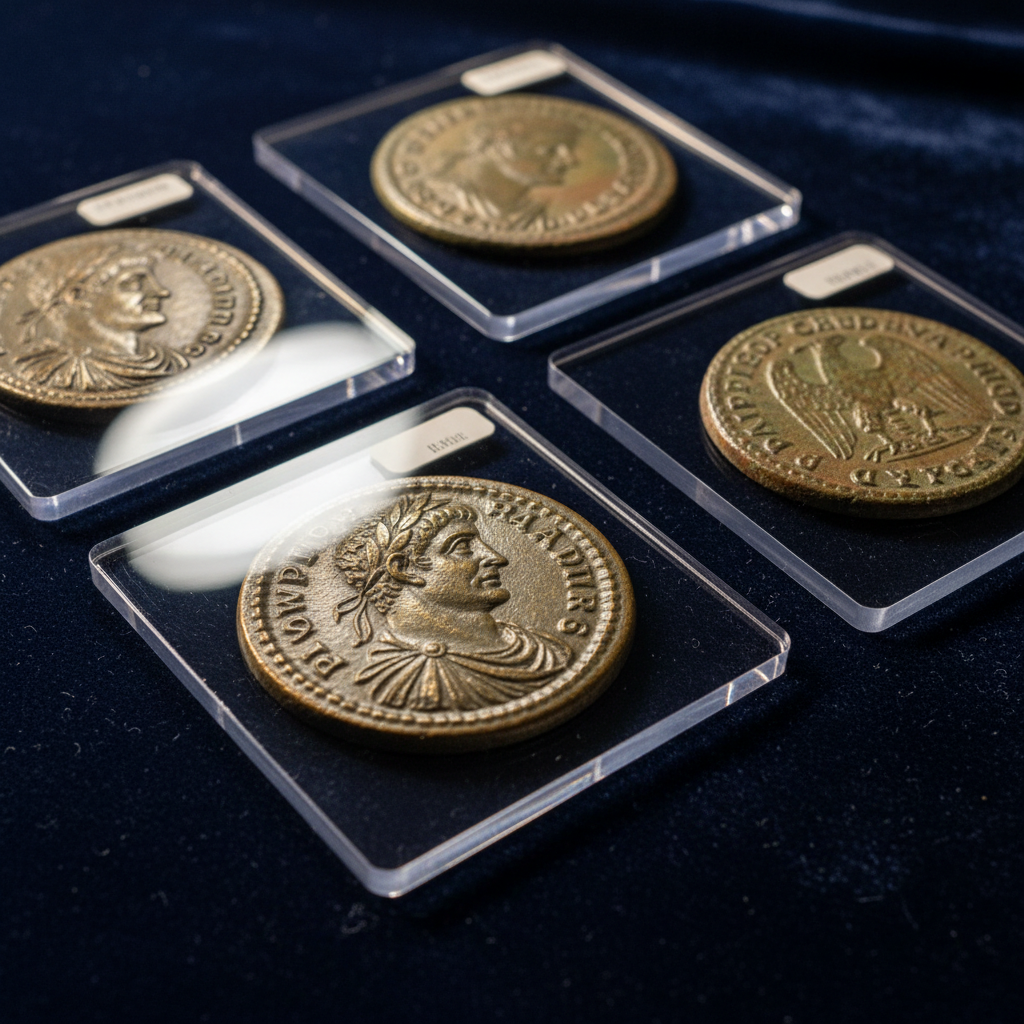
Seventeen emperors ruled Rome between 235 and 284 CE. Most lasted less than three years. Most died violently. Against that backdrop, Marcus Aurelius Probus — emperor from 276 to 282 CE — stands out not just for surviving six years on the throne, but for leaving behind one of the most visually diverse and collector-accessible coinages in all of Roman numismatics.
His soldiers murdered him anyway. But his coins endure.
A Mint Network That Spanned the Empire
Probus inherited a monetary system under stress. The silver content of the standard coin — the antoninianus, a double denarius introduced under Caracalla in 212 CE — had collapsed to roughly 2–5% by the 270s, the rest being bronze with a thin silver wash. What Probus lacked in metallurgical reform he compensated for in sheer administrative ambition: his coinage was struck across at least nine active mints, from Lugdunum (Lyon) in the west to Antioch and Cyzicus in the east.
That geographic spread is exactly why Probus coins fascinate advanced collectors. Each mint developed its own workshop marks, officina letters, and stylistic signatures. Antioch issues tend toward finer portraiture. The eastern mints — Tripolis, Siscia, Serdica — show distinct engraving traditions. A focused Probus collection can function almost as a survey of late Roman provincial die-cutting, all within a single six-year reign.
The consecration and radiate portrait types alone give collectors dozens of legitimate varieties to chase. Add the reverse types — Sol Invictus, Adventus, Clementia Temp, Virtus Probi — and a serious specialist can build a collection of several hundred coins without duplicating a single type-mint combination.
What the Market Actually Looks Like
Here is where Probus diverges sharply from, say, a Nero sestertius or an Augustus aureus: the price floor is genuinely low. Common Probus antoninianii in Very Fine condition routinely sell for $15–$40 on platforms like VCoins, MA-Shops, and through Heritage Auctions' world coin sessions. Even choice examples with sharp portraits and full silvering — the ancient equivalent of a high-grade slab — rarely breach $200–$300 at retail unless they carry exceptional provenance or a particularly rare mint-officina combination.
The outliers exist. A Probus aureus — gold was struck in limited quantities — can command $8,000 to $25,000+ depending on condition and type, with top examples appearing at Stack's Bowers and NAC (Numismatica Ars Classica) Geneva sales. A rare medallion or a billon issue with documented museum-quality provenance will move the needle further. But the core market — the antoninianus — remains one of the last genuinely affordable entry points into high-quality Roman imperial coinage from a historically significant reign.
NGC Ancients has graded Probus bronzes and silvered issues in meaningful volume, and a certified NGC Choice VF or MS example with a strike rating of 4/5 or better adds a layer of market confidence that appeals to collectors crossing over from U.S. coins or world coins. PCGS Ancients handles a smaller volume of late Roman material but has certified select high-grade examples. Neither population data nor census figures for ancient coins carry the same precision as modern U.S. coin registries — the open market is simply too fragmented — but certification has meaningfully increased liquidity for mid-to-upper-tier Probus pieces over the past decade.
The Collector Case for the Third Century
The Crisis of the Third Century remains one of the most underrepresented eras in serious ancient coin collections, which is almost perverse given how rich the material record is. Collectors who fixate on the Julio-Claudians or the Five Good Emperors are paying 3–5x premiums for comparable quality. Probus, Aurelian, Tacitus, Florian — these reigns produced coins of genuine historical weight, minted during an existential struggle for Roman survival, and they trade at a fraction of the cost.
Probus specifically reformed the western frontier, campaigned successfully against Germanic tribes, and reportedly encouraged viticulture in Gaul and the Danube provinces — a policy detail that shows up, indirectly, in the celebratory reverse types his mints produced. The coins are primary sources, not just collectibles.
For a collector with $500 to spend, a curated set of six to eight Probus antoninianii — one per major mint, each in solid VF or better — is entirely achievable and would represent a more intellectually coherent collection than a single mid-grade example of a common Vespasian denarius at the same price point.
The market hasn't caught up to that logic yet. That gap won't last forever.