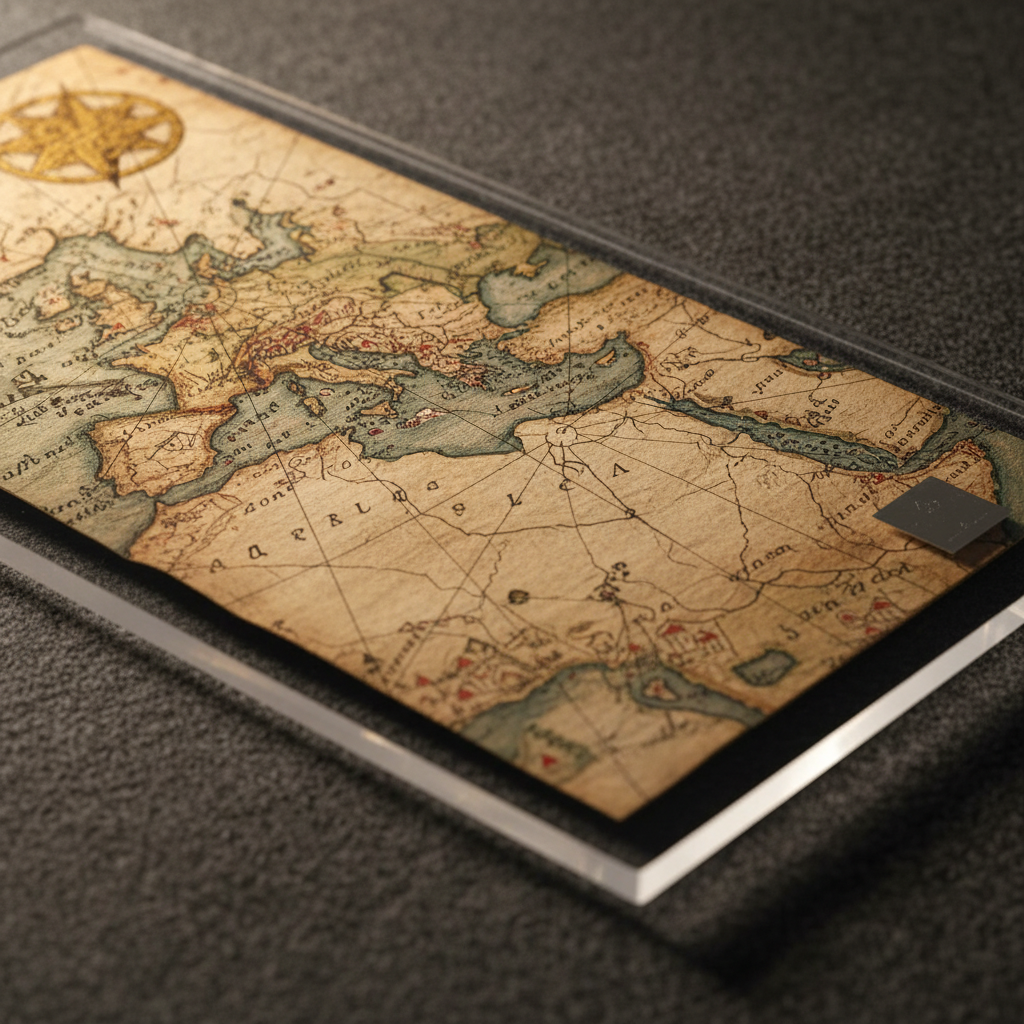
A medieval portolan chart that hasn't surfaced on the antiquarian market in over a hundred years is now available — and for serious collectors of antique cartography, that sentence alone should stop the scroll.
The piece in question is the Rex Tholomeus Portolan Chart, identified by specialists as the earliest obtainable complete map of Europe in existence. Not the earliest known. The earliest you can actually buy. That distinction matters enormously in a market where provenance and accessibility are often separated by generations, museum acquisitions, or outright inaccessibility.
What Makes This Chart Different
Portolan charts — navigational sea charts produced primarily between the 13th and 17th centuries — are among the most consequential cartographic documents in Western history. They were working tools: used by Mediterranean sailors to navigate coastlines with a precision that still impresses modern historians. The best surviving examples now live in institutions like the Biblioteca Medicea Laurenziana in Florence or the Bibliothèque nationale de France. The Rex Tholomeus is the rare exception: a museum-caliber artifact that has somehow remained in private hands long enough to re-enter the open market.
The chart's name references Ptolemy — the Greek-Roman mathematician and geographer whose Geographia formed the intellectual backbone of European cartography for centuries. A portolan bearing that association isn't merely decorative. It's a document sitting at the intersection of practical navigation and classical scholarship, which is precisely why examples this early and this complete are so seldom seen outside institutional collections.
Completeness is the operative word here. Fragmentary portolans appear occasionally at auction — Heritage Auctions and Christie's have both handled partial examples in recent decades — but a complete map of Europe at this age and quality is categorically different. Condition and completeness are the twin pillars of antique map valuation, and the Rex Tholomeus reportedly clears both bars at a level the market hasn't seen in living memory for this category.
The Market for Antique Cartography
To understand why this matters financially, consider the trajectory of the antique map market over the last two decades. Early printed maps by Ortelius, Mercator, and Blaeu have seen sustained institutional and private demand, with premium examples regularly clearing six figures at auction. Manuscript portolans — hand-drawn, pre-print — occupy an even rarer tier. A 14th-century portolan atlas sold through Sotheby's in 2017 for well over $1 million, and that was a bound atlas rather than a single navigational chart.
The Rex Tholomeus is being offered through the antiquarian trade rather than a major auction house, which means price transparency is limited — but that structure also suggests the seller is targeting a specific class of buyer: an institution, a serious private collection, or a well-capitalized dealer looking to place it strategically. That's not unusual for objects at this level. The most significant pieces often trade quietly.
For context, the last time a comparable portolan chart — complete, early, European — appeared on the open market, the internet didn't exist. The collector base for antique cartography has expanded considerably since then, driven partly by digitization projects that have raised public awareness of these objects and partly by a broader shift toward tangible, historically significant assets among high-net-worth collectors who have grown skeptical of purely financial instruments.
A Century Between Appearances
The hundred-year gap in market availability is the detail that deserves the most weight. In the trading card world, a PSA 10 rookie surfaces every few years. In the coin market, even the rarest dates — the 1804 Draped Bust Dollar, the 1913 Liberty Head Nickel — have changed hands multiple times in the last century. Antique cartography at the highest level operates on a completely different clock.
When a piece of this nature reappears, it doesn't just represent a single transaction. It becomes a market-setting event. Whatever the Rex Tholomeus ultimately sells for will function as a benchmark for the category for years, possibly decades. Dealers, appraisers, and institutions will cite it. That's the weight of a true rarity — not just scarcity in the grading population, but scarcity in the historical record itself.
The last time something like this was available, the buyers of that era couldn't have imagined the global collector infrastructure that exists today. The Rex Tholomeus is entering a market far more equipped to recognize what it is. Whether that translates into a sale commensurate with its significance is the only real question left.