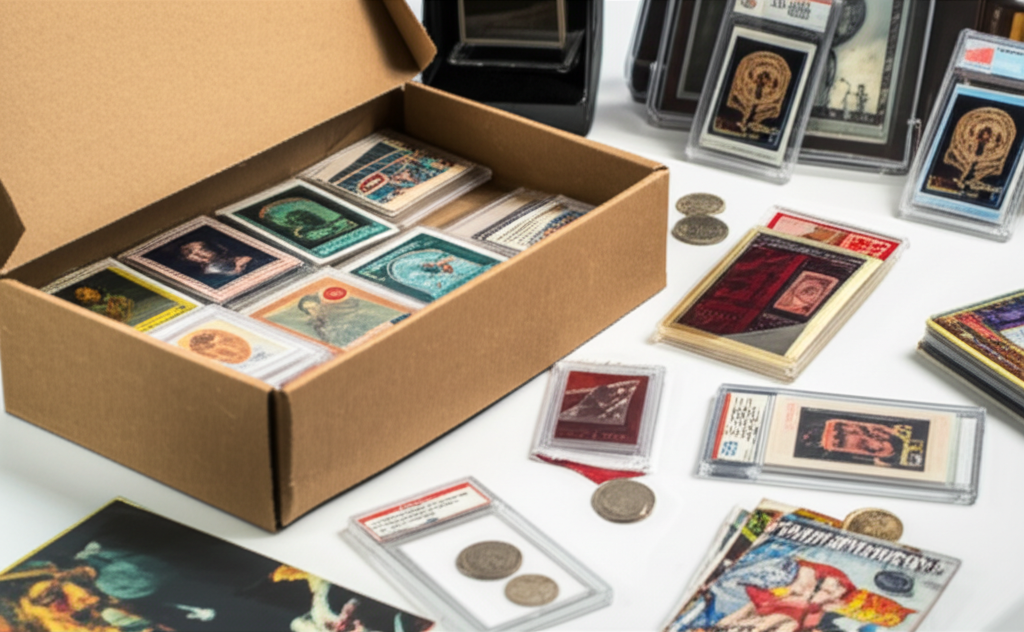
Sometimes the most significant finds arrive with zero fanfare — no velvet display case, no top-loader, no sleeve. A recently surfaced collection of ungraded vintage baseball cards, stored loose in a plain brown box, is heading to market and early assessments suggest it contains legitimate Hall of Fame-caliber material. For the vintage card community, few discovery narratives generate more electricity than a raw, untouched find like this one — and the implications for grading, valuation, and collector demand are substantial.
The Find: Raw, Unprotected, and Apparently Remarkable
The collection arrived exactly as described: loose cards in a nondescript brown box, handled with the casual indifference of a previous owner who almost certainly had no idea what they were sitting on. Details on the precise origin remain limited, but the cards are described as a small but fabulous find of vintage material — the kind of understated language dealers use when they want to manage expectations while quietly knowing the ceiling is very high. The cards are entirely raw, meaning none have been submitted to a third-party grading service such as PSA, BGS, or SGC, and they carry no certified grade, population data, or authentication documentation.
What makes this find particularly compelling is the reported Hall of Fame content. Vintage cards featuring enshrined players — think pre-1970 Topps, Bowman, or regional issues — represent the backbone of the high-end sports card market. Without confirmed player names, set identification, or specific card numbers released publicly yet, the collection sits in that tantalizing pre-market window where speculation runs high and early access is everything. The cards are expected to enter the market soon, likely through a grading submission pipeline before hitting a major auction platform.
Finds like this one are increasingly rare. The hobby has been combed over aggressively since the 2020 boom, and true untouched collections — ones that bypassed the eBay era entirely — are becoming generational events rather than annual occurrences. The brown-box provenance, while humble, is actually a positive signal: cards stored loosely in cardboard boxes were often kept in cool, dry environments like attics or closets, and can occasionally emerge with surprisingly well-preserved surfaces despite the lack of protective storage.
Why This Discovery Carries Real Market Weight
The vintage card market has shown remarkable resilience heading into 2025, even as the broader sports card market has corrected from its 2021 peak. Pre-war and early post-war material — sets from the 1948–1969 era — has held value more consistently than modern wax products, largely because supply is genuinely finite. There are no additional cases of 1955 Topps or 1952 Bowman waiting in a warehouse. Every new raw find that enters the grading pipeline represents a potential shift in PSA population reports, which in turn can affect registry set competition and per-card valuations.
The raw-to-graded pipeline is itself a market event. When a legitimate vintage find hits PSA or BGS for the first time, the grading results create new data points. A high-grade survivor — say, a PSA 7 or above on a card with a population of fewer than 50 copies at that grade — can command multiples of its lower-grade counterparts. A single PSA 8 on a key Hall of Famer from a scarce regional set could realistically fetch $10,000 to $100,000+ depending on the player and issue, while the same card in PSA 4 might bring a fraction of that. The grading outcome of this collection, whenever it's disclosed, will be closely watched.
There's also the provenance narrative to consider. The hobby increasingly values documented discovery stories — the estate sale, the barn find, the brown box. These origin stories add a layer of authenticity and romance that resonates with both serious collectors and casual buyers. Auction houses like Heritage Auctions, Goldin, and PWCC have demonstrated repeatedly that compelling provenance can push realized prices 10–25% above comparable lots without the backstory. This collection has that narrative built in from day one.
Collector Takeaway: Watch the Grading Results Closely
If you collect vintage Hall of Famers or pre-1970 Topps and Bowman material, this is a find worth tracking with serious attention. The moment grading results become public — whether through a PSA submission reveal, a dealer announcement, or an auction house preview — move quickly to assess the population impact. If any cards from this collection come back as condition rarities (high-grade examples in sets with thin PSA populations), expect immediate upward pressure on comparable raw and graded copies already in the market. Now is a smart time to audit your own holdings in those categories and know your exit or acquisition thresholds before the results drop.
More broadly, this find is a reminder that the vintage market rewards patience and expertise in equal measure. Raw cards still represent some of the best value opportunities in the hobby — but only for collectors who understand grading standards well enough to assess condition risk before submitting. If you're newer to vintage, this is the moment to build relationships with experienced dealers or graders who can walk you through surface wear, print defects, and centering tolerances before you commit capital. The brown box that just surfaced is someone's windfall. Make sure the next one you encounter becomes yours.