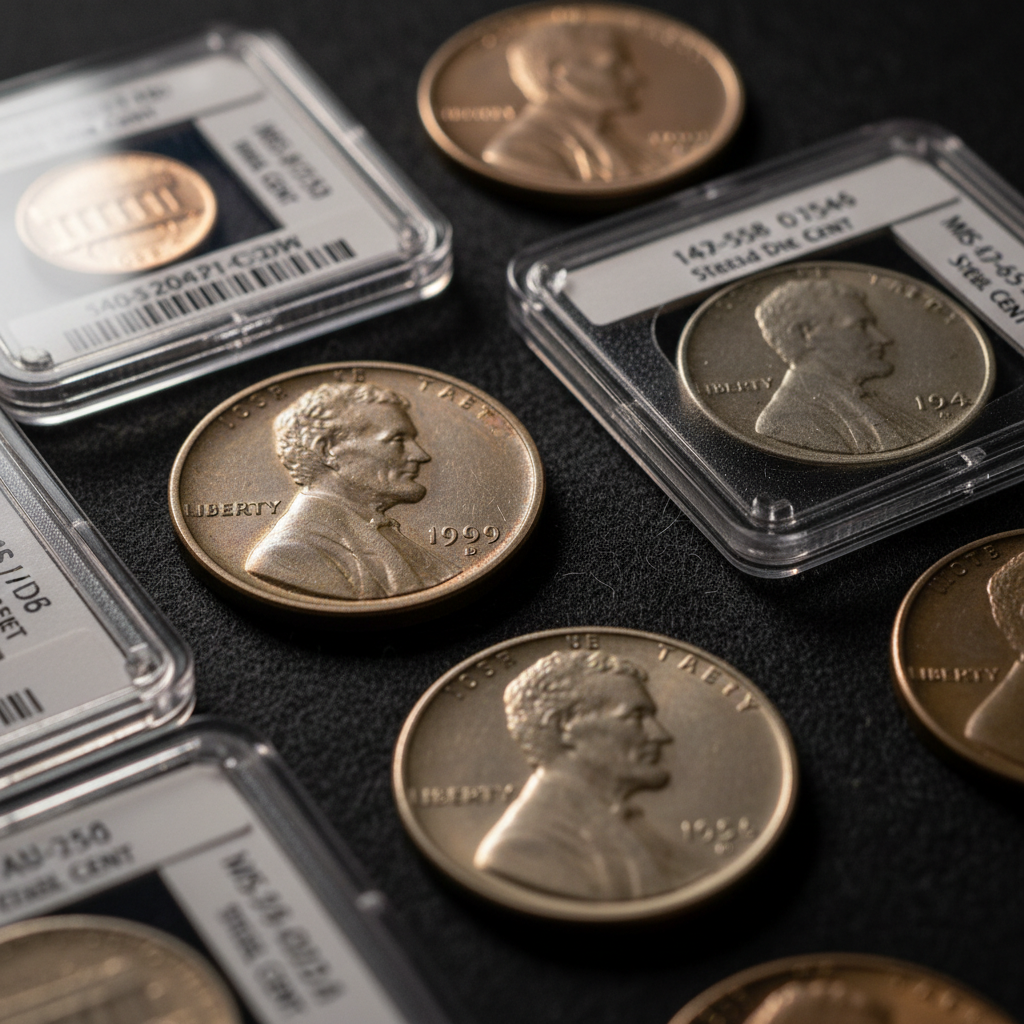
Twenty-five dollars. That's the buy-in for one of the most accessible treasure hunts in numismatics — a standard bank box of pennies, 50 rolls deep, 2,500 one-cent coins stacked and waiting. Joshua McMorrow-Hernandez, writing for CoinWeek, recently documented what a single box can realistically produce, and the results are a useful reality check for anyone curious about coin roll hunting as a hobby or a low-stakes entry point into serious collecting.
The short version: you probably won't retire on what you find. But the longer version is more interesting than that.
The Odds, the Targets, and the Thrill
A box of circulated cents pulled from a bank in 2024 is mostly modern copper-plated zinc — post-1982 coins worth exactly one cent each. But buried inside nearly every box is something older. Lincoln Wheat Cents, minted from 1909 through 1958, turn up with surprising regularity. They're not rare in the broad sense — billions were struck — but finding a 1941-S or a 1944 Wheat in a roll of modern change still delivers a genuine jolt.
Indian Head Cents, issued from 1859 to 1909, are a different story. Finding one in circulation is genuinely uncommon. When they do appear, they're typically heavily worn — think AG-3 to G-6 on the Sheldon scale — but even a problem-free example in Good condition carries retail value of $2 to $5 for common dates. Key dates like the 1877 or 1909-S would represent a windfall by any measure, though the odds of pulling either from a bank box approach lottery territory.
Die varieties are where roll searching gets genuinely technical. The Lincoln cent series is among the most variety-rich in American coinage. The 1955 Doubled Die Obverse — one of the most famous U.S. coin errors — has sold in MS-64 Red at Heritage Auctions for north of $20,000, though circulated examples in the VF-20 to EF-45 range trade between $1,500 and $4,500 depending on eye appeal. Finding one in a bank roll is extraordinarily unlikely, but not impossible. Documented examples have surfaced from circulation within the last decade.
More realistic targets include the 1969-S Doubled Die, the 1972 Doubled Die, and various RPM (repunched mintmark) varieties that reward collectors who know what to look for under a loupe. The 1972 Doubled Die in EF-40, for context, has cleared $500 to $800 at major auction houses in recent years.
The Economics of the Hunt
Roll searching occupies a peculiar economic space. Your downside is capped — you deposit the coins back at the bank when you're done, recovering your $25 minus whatever you keep. Your upside is theoretically uncapped, though practically bounded by probability. It's one of the few collecting activities where the floor is essentially zero loss.
That calculus has made coin roll hunting a persistent subculture within numismatics, particularly among younger collectors who don't have the capital to compete at auction for certified key dates. A PSA or PCGS holder on a 1909-S VDB in MS-63 Red will run you $8,000 to $12,000 at current market. A bank box costs twenty-five bucks. The gap between those two realities explains why roll hunting endures.
There's also a grading angle worth considering. Raw coins pulled from circulation and identified as genuine varieties or key dates can, in some cases, be worth submitting to PCGS or NGC for authentication and grading. Even a heavily worn 1914-D Lincoln Cent — one of the series' premier keys — grades out at AG-3 with a retail value around $175 to $225. A certified example, even in that condition, carries a premium over raw simply because the authentication eliminates counterfeiting risk. The 1914-D has been extensively faked via altered mintmarks from 1914-P coins, making third-party certification essentially mandatory for any serious transaction.
What a Realistic Box Actually Produces
Across documented roll searches — McMorrow-Hernandez's included — a typical $25 box yields somewhere between 5 and 15 Wheat Cents, the occasional Canadian or foreign one-cent piece, and sometimes a pre-1982 copper cent worth holding for its 2.2 cents in melt value (still technically illegal to melt in bulk, per U.S. Mint regulations, but collected by many as a hedge). Varieties and errors are possible but far from guaranteed in any single box.
The honest assessment is that coin roll hunting is not an investment strategy. It's a hobby with a built-in cost floor and an occasional, genuinely exciting payoff. For new collectors, it's also an education — handling thousands of coins accelerates the kind of pattern recognition that takes years to develop through books alone.
For $25, that's a reasonable trade.